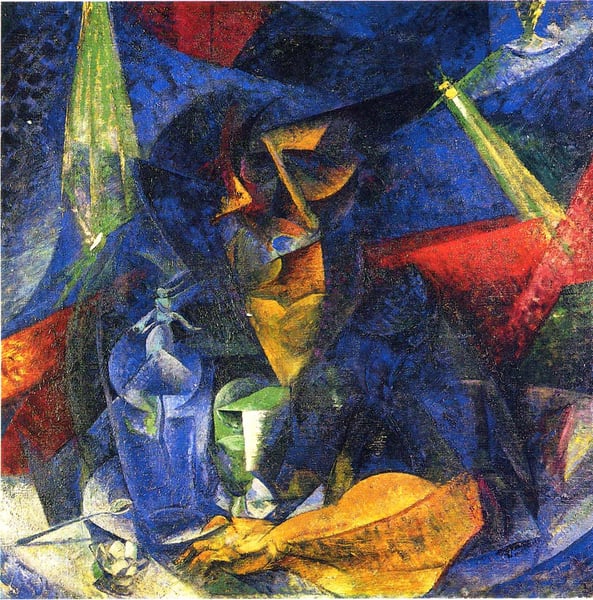
Woman in a Café: Compenetrations of Lights and Planes
Details
Expert analysis of Umberto Boccioni’s Woman in a Café: Compenetrations of Lights and Planes
Style: Futurism · Genre: genre painting
Expert Analysis of Woman in a Café: Compenetrations of Lights and Planes by Umberto Boccioni
Umberto Boccioni’s Woman in a Café: Compenetrations of Lights and Planes stands as a landmark of Futurist painting, embodying the movement’s radical break with static representation. Although the work is categorized as a genre painting (a scene of everyday life), Boccioni transforms the familiar café interior into a laboratory of dynamic perception, where the subject is not a passive figure but a nexus of intersecting forces.
Context and Style
As a leading theorist and practitioner of Futurism, Boccioni rejected naturalistic perspective and instead sought to capture modern life’s speed, movement, and simultaneity. This painting exemplifies two core Futurist principles: “compenetration” (the merging of figure and environment) and the “synthesis of lines, lights, and planes.” Where a traditional genre painter might depict a woman sitting in a café as a stable, isolated figure, Boccioni dissolves her contours into a field of fractured planes and vibrating light—an homage to the city’s electric energy and the restless gaze of the modern observer.
Significance Within Futurism
The painting’s significance lies in how it visually realizes the Futurist manifesto’s call to “paint the sensation, not the object.” Boccioni achieves this by:
- Fragmenting the figure into a constellation of shards—shoulders, face, hat, and dress are broken into angular, overlapping planes that seem to shift and re-form as we look.
- Integrating light and space: The “compenetrations of lights” suggests that artificial café lighting is not a passive illuminator but an active, plastic force that carves and unites the woman with the surrounding architecture, chairs, and tables. Shadows and highlights collide, creating a vibrant, pulsing surface.
- Conveying motion: Even in a seated pose, the woman appears to be in a state of becoming—her silhouette stretches and compresses, as if caught between multiple moments in time. This aligns with Boccioni’s later sculptural masterpiece Unique Forms of Continuity in Space, where form is expressed as a trajectory of energy.
Art-Historical Importance
Within the Futurist movement, this work bridges Boccioni’s early Divisionist color experiments and his mature, more abstracted style. It also challenges the traditional hierarchy of genres: a mundane café scene is elevated to a philosophical meditation on perception, modernity, and the fusion of subject and environment. The painting anticipates ideas later explored by Cubism and Abstract Expressionism, yet retains a distinctly Italian Futurist zest: the celebration of urban life, technology, and the dynamic forces that shape modern consciousness.
In short, Woman in a Café is not merely a portrait or a snapshot of leisure—it is a manifesto in paint, asserting that in the Futurist world, even a seated woman in a café is a field of intersecting lights, planes, and velocities, forever in motion.
Museum / Gallery
Genre
Style
Visually similar
20 works with related composition and palette
Žena S Vějířem
Emil Filla
Nude (complementary model of form-color)
Umberto Boccioni
Harlequin's family
Pablo Picasso
Quirinal Stables
Carlo Carra
Harlequin leaning
Pablo Picasso
Locomotive
Oleksandr Bogomazov
Vanity Box
Kazimir Malevich
Woman with Animals
Albert Gleizes
Figure with fruit dish
Pablo Picasso
Untitled
Mario Sironi
Tetragramista II
Oswaldo Vigas
Dynamism of a Human Body
Umberto Boccioni
Galleria In Milan
Carlo Carra
Femmes cousant
Albert Gleizes
Portrait Of Marinetti
Carlo Carra
Man on a Balcony (Portrait of Dr. Théo Morinaud)
Albert Gleizes
Танец
Александр Николаевич Волков
L'Atelier de mécanique
Jacques Villon
Man with guitar
Pablo Picasso
Smokers
Fernand Leger