
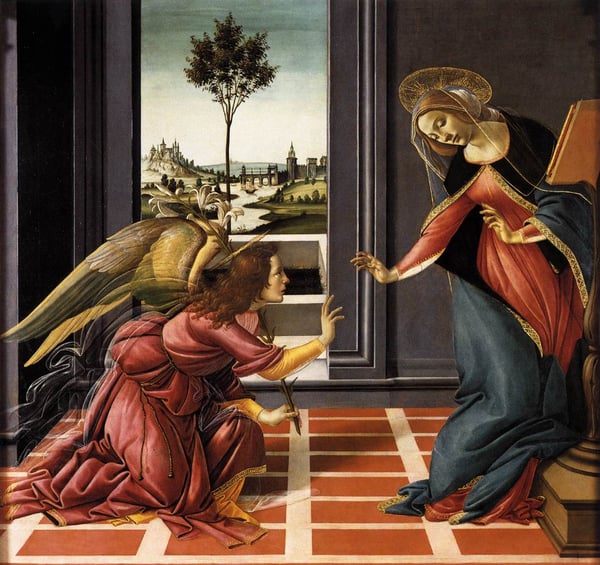
Expert analysis of Sandro Botticelli’s The Cestello Annunciation
Style: Early Renaissance · Genre: religious painting
Expert Analysis of "The Cestello Annunciation" (c. 1489–1490) by Sandro Botticelli
As a defining work of the Early Renaissance, Botticelli’s The Cestello Annunciation exemplifies the period’s shift toward naturalism, emotional depth, and symbolic clarity—while still retaining the ethereal grace that distinguishes the artist’s personal style.
Composition and Spatial Innovation
The painting is structured around a clear, perspectival architectural setting: a loggia with receding columns and a carefully rendered floor tiles, which anchors the sacred event in a believable, measured space. This use of linear perspective—a hallmark of Early Renaissance innovation—creates a sense of depth that draws the viewer into the intimate encounter. The open garden behind Mary, enclosed by a low wall, alludes to the hortus conclusus (enclosed garden), a traditional symbol of her virginity.
Gesture and Emotional Resonance
Botticelli departs from earlier, more static Annunciation scenes by imbuing the figures with psychological nuance. The angel Gabriel, still in motion, kneels with a reverent, slightly urgent poise, his hands crossed over his chest in a gesture of submission. Mary, interrupted at her reading, turns with a subtle recoil—her body language conveys both surprise and acceptance. This interplay of movement and stillness heightens the drama of the divine announcement.
Line and Color
The work is celebrated for its fluid, sinuous contours—Botticelli’s signature linea serpentinata—which give the figures a weightless, almost musical elegance. The color palette is luminous: the angel’s rose-pink robe contrasts with Mary’s deep blue mantle, while the pale architecture and sky create a serene, otherworldly atmosphere. The use of gold highlights on the angel’s wings and the dove (representing the Holy Spirit) ties the scene to the devotional traditions of earlier Gothic art, yet the overall effect is profoundly human and tender.
Significance Within the Early Renaissance
The Cestello Annunciation bridges the intellectual rigor of Early Renaissance perspective with the lyrical idealism that would later define Botticelli’s mythological works. It demonstrates how religious painting of this era could simultaneously serve as a tool for meditation and a demonstration of artistic skill—harmonizing sacred narrative with the new humanist interest in believable space, emotion, and natural beauty. The painting remains a touchstone for understanding how Florentine artists of the 1480s transformed traditional iconography into a deeply personal, visually compelling experience.
Museum / Gallery
Visually similar
20 works with related composition and palette
Annunciation
Leonardo da Vinci
The Annunciation with two Kneeling Donors
Filippo Lippi
Annunciation
Filippo Lippi
Annunciation
Filippo Lippi
Annunciation
Filippo Lippi
Annunciation
Filippino Lippi

The Annunciation
Mariotto Albertinelli
Madonna of Loreta (Annunciation)
Pietro Perugino
The Annunciation of Mary
Pietro Perugino
Annunciation
Fra Angelico
Virgin and Child with Four Angels
Gerard David
Annunciation
Fra Angelico
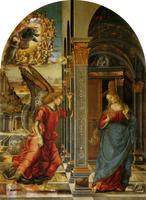
Annunciation
Luca Signorelli
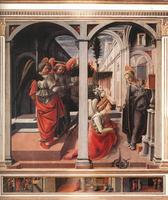
Annunciation
Filippo Lippi
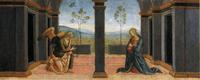
Pala di Corciano (Annunciation)
Pietro Perugino
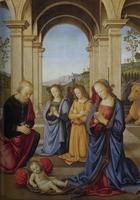
Polyptych Albani Torlonia (particular detail)
Pietro Perugino
Mystical Marriage of St. Catherine of Alexandria
Piero di Cosimo
Virgin and Child with Musician Angels
Hans Memling
The Virgin and Child with an Angel, St. George and a Donor
Hans Memling

Adoration of the Child
Filippino Lippi