Panel 7. Departure of Quetzalcoatl - The Epic of American Civilization
Detalles
Análisis experto de Panel 7. Departure of Quetzalcoatl - The Epic of American Civilization de Jose Clemente Orozco
Estilo: Muralism · Género: symbolic painting
Expert Art Historical Analysis: "Panel 7. Departure of Quetzalcoatl – The Epic of American Civilization" by José Clemente Orozco
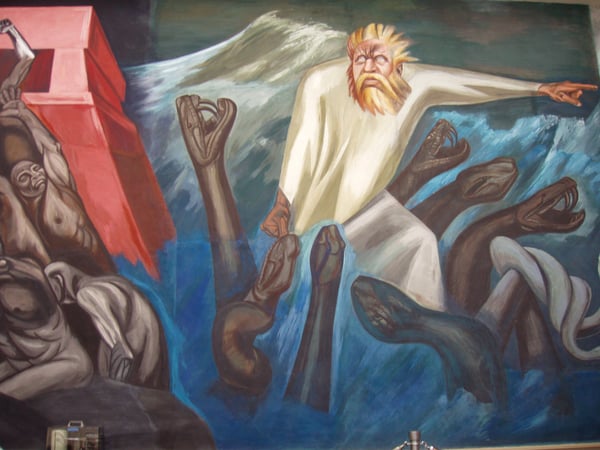
As a key work within the Mexican Muralism movement and a critical chapter in Orozco’s Dartmouth College fresco cycle, Panel 7 exemplifies the artist’s profound departure from celebratory nationalist narratives. Executed between 1932 and 1934, this symbolic painting reinvents the Pre-Columbian legend of Quetzalcoatl not as a triumphant feathered serpent or Promethean culture-bearer, but as a tragic, vulnerable human figure.
Significance within Muralism and Symbolic Painting:
-
Subversion of the “Indigenist” Ideal: Unlike contemporaries such as Diego Rivera, who often romanticized indigenous civilizations as heroic and unified, Orozco paints Quetzalcoatl as a weary, Christ-like outcast. The deity’s posture—hunched, back turned, striding into darkness—visually encodes failure and exile. This destabilizes the idealized vision of pre-Columbian glory, instead suggesting that even civilizations’ greatest gifts (knowledge, art, law) can be rejected or corrupted.
-
Mastery of Dramatic Allegory: As a symbolic painting, every element serves a moral argument. The angular, thrusting geometry of the raft and the churning, monochromatic sea convey a sense of violent rupture. Quetzalcoatl’s white cloak (often read as a symbol of purity and enlightenment) is starkly contrasted with the deep shadows around him—a chiaroscuro technique Orozco inherited from Expressionism and Baroque altarpieces. The absence of any accompanying figures isolates the hero, emphasizing his sacrifice.
-
Fresco as Philosophical Statement: In this panel, Orozco moves muralism beyond mere political propaganda into existential allegory. The Departure does not celebrate a golden age; it laments a lost opportunity for cross-cultural syncretism. The work foreshadows Orozco’s later, more pessimistic view of modern technology and war. By placing this scene at the midpoint of The Epic of American Civilization, Orozco argues that the continent’s history is one of cyclical violence and unresolved conflict, not linear progress.
-
Formal Innovation: Orozco’s brushwork here is deliberately raw and gestural—almost sketch-like in the rope, clouds, and water. This unsettled surface mirrors the spiritual turmoil of the subject. The composition’s asymmetry (the figure pushed to the left, the vast empty space ahead) creates an unsettling directional pull, forcing the viewer to confront the departure’s finality.
Conclusion: Panel 7 is significant because it transforms a foundational myth into a universal meditation on exile, hubris, and the tragic flaws inherent in civilization itself. It redefines Mexican Muralism as a vehicle for critical introspection rather than nationalistic celebration, securing Orozco’s reputation as the movement’s most psychologically penetrating and globally relevant voice.
Museum / Gallery
Visualmente similares
20 obras con composición y paleta relacionadas
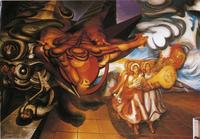
Panel 7. The Departure of Quetzalcoatl - The Epic of American Civilization
Jose Clemente Orozco
Mural
David Alfaro Siqueiros
La Acechanza
Jose Clemente Orozco
Catharsis
Jose Clemente Orozco
Panel 5. The Coming of Quetzalcoatl - The Epic of American Civilization
Jose Clemente Orozco
The great mexican revolutionary law and the freedom of slaves
Jose Clemente Orozco
The Rich People (detail)
Jose Clemente Orozco
Omniciencia
Jose Clemente Orozco
Farewell
Jose Clemente Orozco
Panel 6. Pre Columbian Golden Age - The Epic of American Civilization
Jose Clemente Orozco
Man Seeking Peace
Vela Zanetti
The Rich People (detail)
Jose Clemente Orozco
Father Hidalgo
Jose Clemente Orozco
Death to the Invader
David Alfaro Siqueiros
Ceiling of Colegio de San Ildefonso
Jose Clemente Orozco
Panel 21. Modern Industrial Man 1 - The Epic of American Civilization
Jose Clemente Orozco
Panel 4. Aztec Warriors - The Epic of American Civilization
Jose Clemente Orozco
Mankind's Struggle for Lasting Peace (detail)
Vela Zanetti
For Complete Social Security of All Mexicans
David Alfaro Siqueiros
The Mechanization ofThe Country
Diego Rivera