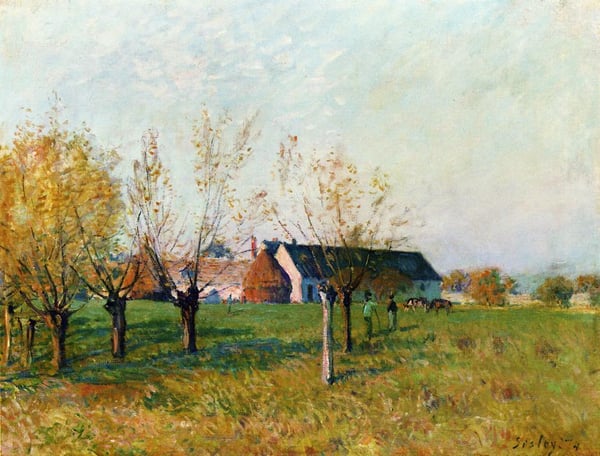
Expert analysis of Alfred Sisley’s The Farm at Trou d Enfer, Autumn Morning
Style: Impressionism · Genre: landscape
Expert Analysis: "The Farm at Trou d'Enfer, Autumn Morning" by Alfred Sisley
This work stands as a quintessential example of High Impressionist landscape painting, encapsulating the movement’s core ambition to capture fleeting moments of natural light and atmosphere. Alfred Sisley, often called the most "pure" Impressionist for his unwavering dedication to landscape, here transforms a humble rural scene into a study of transient, sensory experience.
Significance within Impressionism:
-
Atmospheric Sensitivity: The title specifies "Autumn Morning," and Sisley’s achievement lies in rendering the precise quality of early autumnal light—its soft, diffused glow that blurs edges and mutes contrasts. The cool, damp air of a rural morning is palpable through the muted, earthy palette, punctuated by subtle ochres and russets that signal seasonality without resorting to melodrama.
-
Compositional Serenity: Unlike many Impressionist works that emphasize urban bustle or water-reflected light, Sisley favors a quiet, structured rural landscape. The farm buildings and trees anchor the composition, while diagonal fields lead the eye into a hazy middle distance. This balance between structure and evanescence—solid forms dissolving in atmosphere—is distinctly Sisley’s contribution.
-
Brushwork and Color Harmony: Delicate, broken brushstrokes build surfaces of grass, foliage, and sky, vibrating gently without veering into the aggressive fragmentation of Monet or Pissarro. Sisley’s silvery tonalities—subtle grays, soft blues, and muted greens—create a unified coolness, interrupted only by warm accents that suggest dawn’s first rays. This restraint avoids sentimentality, offering instead a quiet, contemplative portrait of a passing moment.
-
Genre Fidelity: In an era when many Impressionists turned to figures or urban scenes, Sisley’s lifelong focus on landscape allowed him to refine his technique of capturing light’s modulations. The Farm at Trou d’Enfer epitomizes his ability to infuse an ordinary locale with profound atmospheric truth, making it a key work for understanding the Impressionist enterprise as one of pure perception.
In sum, this painting is significant for its serene yet rigorous negotiation between the solidity of rural life and the evanescence of its enveloping light—a hallmark of Sisley’s mastery and of Impressionism’s enduring legacy.
Museum / Gallery
Visually similar
20 works with related composition and palette
Farm to Höllenkaff
Alfred Sisley
A Normandy Farm
Alfred Sisley
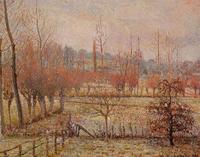
Snow Effect at Eragny
Camille Pissarro
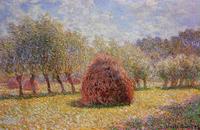
Haystacks at Giverny
Claude Monet
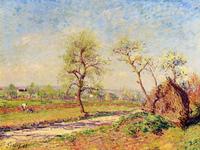
Road at Veneux
Alfred Sisley
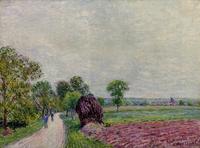
Countryside near Moret
Alfred Sisley
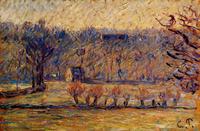
The Hill at Vaches, Bazincourt
Camille Pissarro
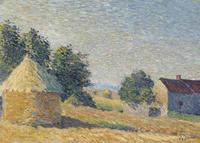
Paysage Aux Meules De Foins
Léo Gausson
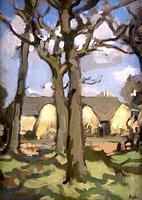
Farm Steading
Samuel Peploe
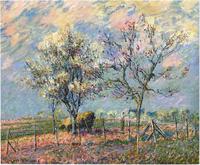
Spring
Gustave Loiseau
Haystack
Claude Monet
Fields around the Forest
Alfred Sisley
Along the Woods in Spring
Alfred Sisley
The Garden, Epping
Lucien Pissarro
Willows at Sunset
Claude Monet
Haystack at Giverny
Claude Monet
Saint Cyr du Vaudreuil
Gustave Loiseau
The Edge of the Forrest
Theodore Robinson
View of Bazincourt, Sunset
Camille Pissarro
Away in the spring Veneux Nadon
Alfred Sisley