
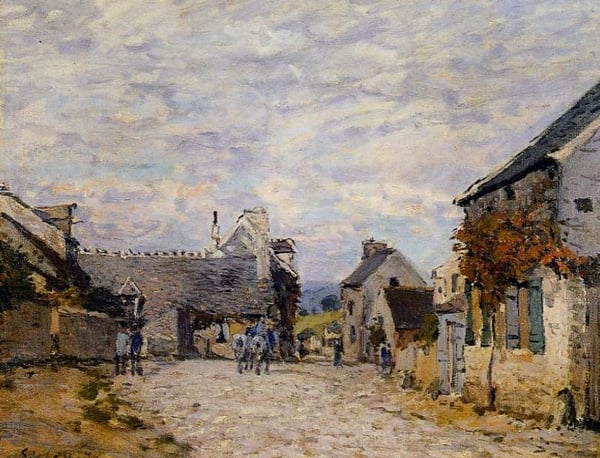
Expert analysis of Alfred Sisley’s Village Street Louveciennes
Style: Impressionism · Genre: cityscape
Expert Analysis of "Village Street Louveciennes" by Alfred Sisley
Alfred Sisley’s Village Street Louveciennes stands as a quintessential example of Impressionist cityscape painting, demonstrating the movement’s core ambition to capture fleeting atmospheric effects and the quiet poetry of everyday suburban life. As a cityscape rather than a pure landscape, the work focuses on the human-altered environment—a village street lined with modest houses—yet treats it with the same ephemeral, light-saturated approach that defines Impressionism.
Significance within Impressionism
Sisley was one of the most steadfast Impressionists, rarely straying from the plein-air technique and the exploration of changing light. In this painting, he transforms an ordinary street into a shimmering study of color and atmosphere. The composition typically employs a high horizon line, allowing the road to recede into the distance, drawing the viewer’s eye through patches of sunlight and shadow. Sisley’s characteristic soft, broken brushwork conveys the dappled effect of light filtering through trees or clouds, while muted blues, greens, and earthy tones evoke the humid, moderate climate of the Île-de-France region.
What Makes It Significant
- Genre within Impressionism: While many Impressionists focused on bustling Parisian boulevards (e.g., Pissarro, Monet), Sisley often chose quiet provincial streets like this one. Village Street Louveciennes exemplifies the movement’s interest in the unassuming, transient beauty of the outskirts—a theme that connects the urban and rural experiences of 19th-century France.
- Atmospheric Unity: Sisley’s mastery lies in unifying the entire scene through a consistent light condition. The street, houses, and sky are all bathed in the same delicate, glowing haze, achieving a sense of natural harmony rather than dramatic contrast. This subtle optical blending is a hallmark of his mature style.
- Role of Sisley: Unlike Monet or Renoir, Sisley remained dedicated to landscape and cityscape throughout his career, rarely painting figures or still lifes. Thus, Village Street Louveciennes represents the purest form of Impressionist observation—a direct, unembellished record of a specific moment in a specific place, devoid of narrative or sentiment.
In summary, this work is significant for its faithful embodiment of Impressionist principles: the prioritization of light and atmosphere over detail, the choice of a humble subject, and the artist’s unwavering commitment to painting from nature. It captures the serenity and transient beauty that Sisley found in the ordinary streets of Louveciennes, making it a valuable testament to his contribution to the movement.
Museum / Gallery
Visually similar
20 works with related composition and palette
Village Street Grey Weather
Alfred Sisley
Rue a Ennery
Gustave Loiseau
Street in Veneux
Alfred Sisley
Courtyard at Les Sablons
Alfred Sisley
Near the Seine
Gustave Loiseau
The Tumbledown Cottage near Osny
Camille Pissarro
Village Road
Gustave Loiseau
The village of Sablons
Alfred Sisley
Landscape of Seine et Oise
Gustave Loiseau
The Hamlet of Chantemesie at the Foot of the Rock
Claude Monet
Landscape, near Auxerre
Gustave Loiseau
Village Street, Vaudreuil
Gustave Loiseau
First Snow in Louveciennes
Alfred Sisley
The street of Hermitage, Pontoise
Camille Pissarro
Mont St. Michel
Maurice Utrillo
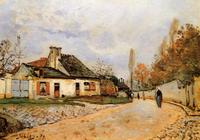
Neighborhood Street in Louveciennes (Rue de Village (Voisins to Louveciennes))
Alfred Sisley
Veslez
Gustave Loiseau
Essoyes Landscape
Pierre-Auguste Renoir
Pont-Aven, Noon Day
Childe Hassam
Near the Mill
Maxime Maufra