Alfred Sisley sanatçısının The village of Sablons eseri hakkında uzman analizi
Tarz: Impressionism · Tür: landscape
Expert Analysis of The Village of Sablons by Alfred Sisley
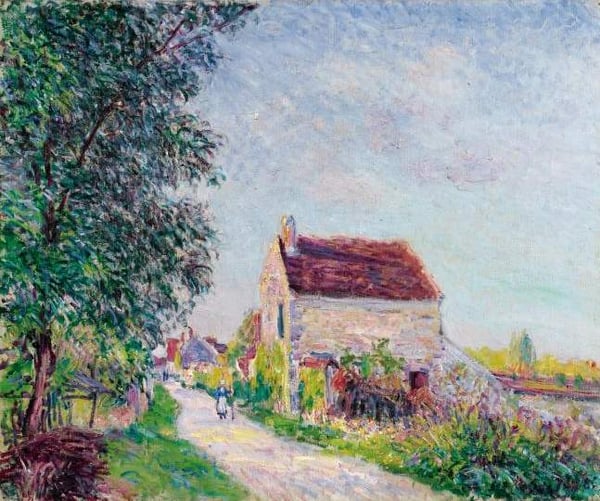
Alfred Sisley’s The Village of Sablons stands as a quintessential example of Impressionist landscape painting, reflecting the movement’s core preoccupations with light, atmosphere, and the fleeting beauty of rural life. Though Sisley is sometimes overshadowed by his peers Monet and Renoir, his unwavering dedication to plein air painting and his subtle mastery of color and tone make this work significant within the Impressionist canon.
Composition and Technique
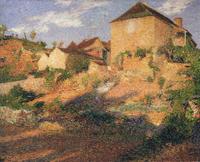
Sisley’s composition is characteristically serene and balanced. The village of Sablons—a small hamlet near the forest of Fontainebleau—is depicted with a gentle recession into depth, leading the eye from a winding path or foreground foliage to the clustered houses beneath a broad, luminous sky. The artist employs broken brushwork, dabbing paints in short, visible strokes to capture the shimmering effect of sunlight on leaves, rooftops, and earth. The palette is restrained yet rich: soft greens, muted ochres, pale blues, and touches of white and lilac in the clouds, all harmonized to evoke a specific moment of day—perhaps late morning or early afternoon—when the air is at its most transparent.
Significance within Impressionism
- Pure Landscape Focus: Unlike Monet, who often infused his landscapes with industrial or urban motifs, Sisley remained devoted to the unspoiled countryside. The Village of Sablons epitomizes his quiet, meditative approach, where human presence is implied through architecture rather than figures, allowing nature to take precedence.
- Atmospheric Precision: Sisley was particularly gifted at rendering the subtle gradations of sky and water. Here, the sky occupies a large portion of the canvas, its shifting clouds and soft blue acting as the primary source of light and mood. This emphasis on atmospheric effect aligns perfectly with the Impressionist goal of capturing a “sensation” of a particular moment.
- Color Theory in Practice: The work demonstrates Sisley’s nuanced understanding of color relationships. He avoids pure black even in shadows, using complementary blues and violets to suggest depth, while warm highlights in yellow and peach enliven the whitewashed walls of the cottages. This technique was revolutionary in the 1870s, rejecting academic conventions for a more empirical, optical realism.
Historical and Artistic Context
Painted in the mid-1870s, during the height of the Impressionist exhibitions, The Village of Sablons reflects Sisley’s personal struggle for recognition—he sold few works in his lifetime—yet his commitment never wavered. The village of Sablons was one of several locations he revisited repeatedly (alongside Moret-sur-Loing and Saint-Mammès), each time finding new light conditions to explore. This serial approach, though less famous than Monet’s haystacks, underscores the Impressionist belief that a single subject contains infinite visual truths.
Conclusion
The Village of Sablons is significant not only for its technical brilliance but also as a testament to Sisley’s role as a pure, steadfast landscapist within Impressionism. It encapsulates the movement’s radical idea that everyday rural scenes—a village, a sky, a patch of greenery—could be elevated to high art through the artist’s sensitive observation of light and color. The work invites viewers to pause and experience the quiet poetry of a sun-drenched afternoon, forever preserved in Sisley’s deft, luminous brushstrokes.
Museum / Gallery
Görsel olarak benzer
İlişkili kompozisyon ve renk paletine sahip 20 eser
Village Road
Gustave Loiseau
Street in Veneux
Alfred Sisley
Near the Seine
Gustave Loiseau
Landscape of Seine et Oise
Gustave Loiseau
Village Street, Vaudreuil
Gustave Loiseau
Abandoned House
Alfred Sisley
Veslez
Gustave Loiseau
The Old Mill (vieux Moulin)
Theodore Robinson
Landscape, near Auxerre
Gustave Loiseau
House in the Country
Gustave Loiseau
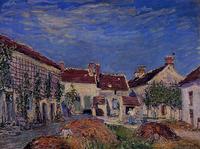
Courtyard at Les Sablons
Alfred Sisley
Louvier Road in Winter
Gustave Loiseau
The diligence
Camille Pissarro
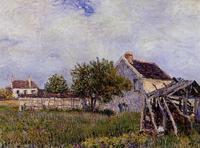
An Old Cottage at Sablons
Alfred Sisley
Epinay-sur-Orge
Armand Guillaumin
Village Street Louveciennes
Alfred Sisley
Houses of Lezaven
Roderic O'Conor
Port Joie
Gustave Loiseau
The old house
Henri Martin
A Peasant in the Lane at Hermitage, Pontoise
Camille Pissarro