Saint Mammes in Winter
Analyse experte de Saint Mammes in Winter de Alfred Sisley
Style : Impressionism · Genre : landscape
Expert Analysis of Saint Mammes in Winter by Alfred Sisley
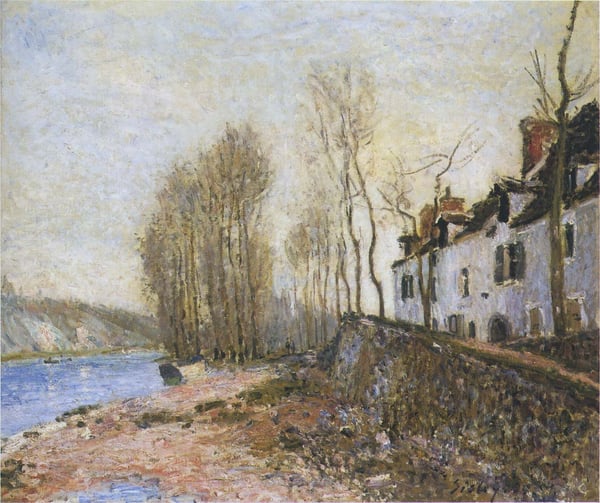
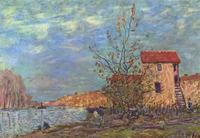
Alfred Sisley’s Saint Mammes in Winter is a quintessential Impressionist landscape that exemplifies the movement’s core pursuit: capturing the fleeting effects of light, atmosphere, and season on a familiar scene. Painted during the artist’s mature period, the work reflects Sisley’s unwavering commitment to plein air observation and his sensitivity to the subtleties of winter’s muted palette.
Significance within Impressionism:
-
Mastery of Winter Light and Atmosphere
Sisley was one of the few Impressionists who repeatedly returned to winter subjects. In this painting, the low, diffused sunlight of a cold day is rendered through delicate harmonies of gray, white, and pale blue. The snow-covered ground and frozen water of the Loing River at Saint-Mammès become a canvas for soft reflections and subtle tonal variations. Unlike the dazzling snow scenes of Monet, Sisley’s winter is quiet, almost melancholic—a study in restraint that underscores his unique ability to evoke mood through understated color. -
Emphasis on Transient Effects
The Impressionist obsession with the ephemeral is evident in the way Sisley captures the texture of snow and the shimmer of ice. His loose, broken brushwork—characteristic of the style—conveys the way light trembles on the surfaces. The sky, filled with low, grey clouds, suggests the imminent change of weather, reinforcing the painting’s sense of a specific, fleeting moment. -
Dedication to Pure Landscape
Sisley was, above all, a landscape painter. Unlike his peers Renoir or Degas, he never strayed into figures or urban scenes. Saint Mammes in Winter embodies his lifelong focus on the natural environment (the river, the bare trees, the village along the bank) and his belief that the landscape itself could carry profound emotional weight. This work stands as a testament to his purity of vision: no narrative, no human drama—only the quiet poetry of winter. -
Contribution to the Saint-Mammès Series
Saint-Mammès, a small town at the confluence of the Loing and Seine rivers, was a recurring subject for Sisley. He painted it in varying seasons and light conditions. Saint Mammes in Winter is a key piece within this series, showing how a single locale could yield infinite variations under the Impressionist method. It demonstrates Sisley’s rigorous attention to the way specific weather and light transform a place—a central tenet of the movement.
Why It Matters While Sisley is sometimes overshadowed by Monet, his winter landscapes are considered among the finest achievements of Impressionism. Saint Mammes in Winter is significant for its delicate balance between structure (the calm horizontal lines of the river and rooftops) and dissolution (the soft, blurred edges of treetops and reflections). It exemplifies Impressionism not as a celebration of vibrant color, but as a profound meditation on the quiet beauty of the natural world in its most subdued season.
Visuellement similaire
20 œuvres à la composition et à la palette proches
Saint Mammes
Alfred Sisley
Matratat s Boatyard, Moret sur Loing
Alfred Sisley
Grand Jatte
Alfred Sisley
The Bend of the Seine at Lavacourt, Winter
Claude Monet
By the Oise River
Gustave Loiseau
The banks of the Loing Moret
Alfred Sisley
Street in Rouen
Paul Gauguin
Quay of Pothius in Pontoise
Gustave Loiseau
The Banks of the Seine
Claude Monet
Flood in Pontoise
Camille Pissarro
Matrat Cottages
Alfred Sisley
Thaw, Pontoise
Camille Pissarro
The First Hoarfrost
Alfred Sisley
The Tugboat
Alfred Sisley
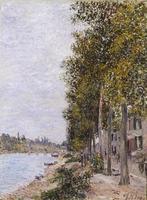
Road Along the Seine at Saint Mammes
Alfred Sisley
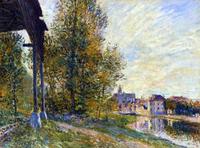
Near Moret sur Loing
Alfred Sisley
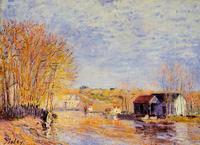
High Waters at Moret sur Loing
Alfred Sisley
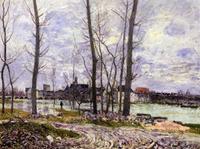
Flood at Moret sur Loing
Alfred Sisley
The Loing at Moret
Alfred Sisley
Moret Sur Loing
Alfred Sisley