Expertenanalyse zu Qi Baishis A fisherman with a fishing rod
Stil: Ink and wash painting · Genre: genre painting
Expert Analysis of "A Fisherman with a Fishing Rod" by Qi Baishi
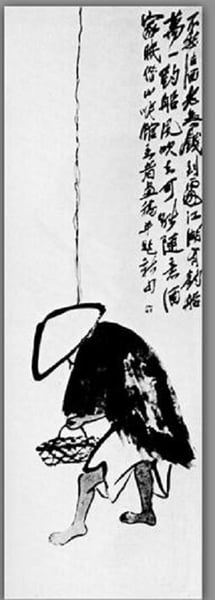
Qi Baishi’s A Fisherman with a Fishing Rod is a masterful example of early 20th-century Chinese ink and wash painting that elevates a simple genre scene into a profound statement on spontaneity, humility, and the artist’s bond with nature. Executed in the expressive xieyi (sketching-idea) style, the work demonstrates Qi’s revolutionary ability to distill complex subjects into minimal, yet deeply evocative, brushstrokes.
Significance within the Ink and Wash Tradition
Qi Baishi revitalized the centuries-old ink wash tradition by infusing it with a vibrant, folk-inspired immediacy. Here, the fisherman is not a detailed portrait but a collection of swift, confident strokes—the rod a single curved line, the figure a few dashes of ink—that convey motion, character, and a sense of serene purpose. This economy of means reflects Daoist ideals of simplicity and the artist’s famous dictum: “Paintings should be somewhere between likeness and unlikeness.” The work succeeds precisely because it captures the essence of fishing rather than a literal copy.
Genre Painting as Philosophical Statement
Qi Baishi often chose humble subjects—fish, shrimp, laborers—over lofty historical or landscape themes, challenging the hierarchy of Chinese painting. This fisherman, silhouetted against ample negative space, embodies the dignity of ordinary life. The empty background invites the viewer to project a riverbank, a breeze, or the waiting stillness of the angler. In doing so, Qi transforms a genre scene into a meditation on patience, solitude, and harmony with the natural world—themes central to both folk culture and literati ideals.
Innovative Brushwork and Ink Mastery
What makes this artwork significant is Qi’s daring use of “ink splashes” (bomo) and dry-brush texture. The angular, almost calligraphic strokes of the fishing rod contrast with the softer, wetter ink used for the figure’s clothing, creating rhythm and depth. His deliberate “awkwardness” (zhuo)—a mark of his mature style—avoids refinement in favor of raw vitality. This approach influenced generations of modern Chinese painters, bridging traditional ink painting and contemporary expression.
In sum, A Fisherman with a Fishing Rod stands as a quintessential Qi Baishi work: an unassuming moment elevated through technical brilliance and philosophical resonance, affirming the profound significance found in the simplest of acts.
Visuell ähnlich
20 Werke mit ähnlicher Komposition und Farbpalette
The man with the comb
Qi Baishi
Traveling Monk and kyoku
Sengai
Drenching
Sengai
All the World's a Stage
Ding Yanyong
Untitled
Sengai
Drinking Tea
Huang Yongyu
Hotei with his Treasure Bag
Hakuin Ekaku
Wang Xizhi Catching The Goose
Xu Wei
Kanzan and Jittoku
Sengai
Rake
Qi Baishi
Gale to Asajigahara
Katsushika Hokusai
Old water in the grass
Shitao
A peasant with a rake
Qi Baishi
Persimmon and Moth
Qi Baishi
Begging Monks
Deiryu
Fisherman and Fisherwoman
Huang Shen
Cicada
Ding Yanyong
Single Line Calligraphy
Nakahara Nantenbo
Cherry blossom viewing during the Genroku period
Toyota Hokkei
Opera Figures
Ding Yanyong