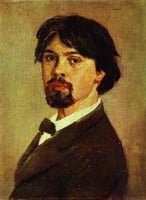
Analisi esperta di Executioner di Vasily Surikov
Stile: Realism · Genere: sketch and study
Expert Analysis of "Executioner" by Vasily Surikov (Sketch and Study, Realism)
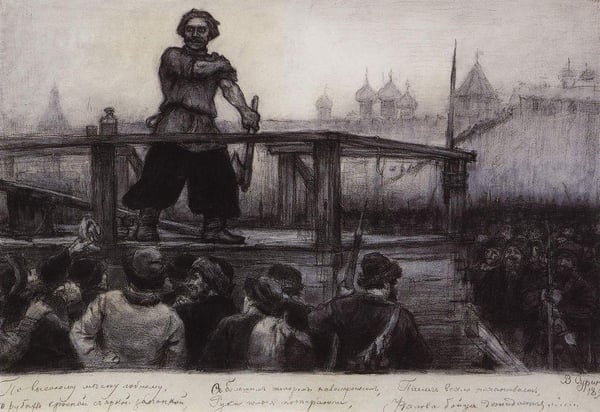
As a preparatory study within the Realist tradition, Surikov’s Executioner offers a rare, unpolished glimpse into the artist’s working method—a raw, psychological exploration that elevates the sketch from mere draft to a significant document of 19th-century Russian art.
Immediate Visual and Technical Significance
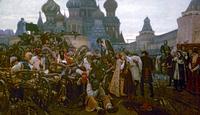
Even without the finished painting, the study likely captures the tense, somatic weight of a historical figure—perhaps linked to Surikov’s monumental masterpieces Morning of the Streltsy Execution (1881) or Boyarynya Morozova (1887). In Realism, the sketch is not a preliminary afterthought but a critical stage of empirical observation; here, Surikov’s loose, confident strokes convey the executioner’s stoic demeanor, hinting at the moral ambiguity of state power. The unfinished quality underscores the Realist commitment to unidealized truth: the executioner is neither a monster nor a hero, but a laborer of violence, rendered with deliberate ambiguity.
Significance Within Realism and Surikov’s Oeuvre
- Authenticity of Process: Surikov was notorious for exhaustive preparatory studies, often painting from live models to capture psychological verisimilitude. This sketch exemplifies that discipline—a snapshot of the artist’s search for the exact gesture or expression that would later anchor a vast historical canvas.
- Psychological Depth: Realism demanded not just visual accuracy but emotional candor. The executioner’s face likely reflects a resigned solemnity, avoiding theatrical villainy. Surikov’s ability to imbue a minor, often caricatured figure with dignity and pathos anticipates the humanist complexity of later Realist and Socialist Realist works.
- Historical Context: Painted during a period when Russia grappled with autocracy and reform, the executioner becomes a charged symbol. As a sketch, the work retains the immediacy of a private thought—more direct and unguarded than Surikov’s polished historical tableaux—allowing viewers into the moral unease beneath official narratives.
Conclusion
Executioner matters because it reveals Realism’s core paradox: the pursuit of objective truth through intensely subjective artistic labor. Surikov’s study preserves the fleeting moment of decision—the artist’s hand wrestling with history’s dark servant—making it not a footnote, but a vital key to understanding how 19th-century Realism transformed historical painting into a mirror of the human condition.
Visivamente simili
20 opere con composizione e palette affini
Krasnoyarsk rebellion
Vasily Surikov
Boyarynya Morozova (study)
Vasily Surikov
Appeal of Minin
Konstantin Makovsky
Exit of Tsar Ivan the Terrible
Boris Kustodiev
Dancing
Klavdy Lebedev
The burning of Archpriest Avvakum
Grigoriy Myasoyedov
Vasily Buslaev. Illustration for the book "Russian epic heroes"
Andrei Ryabushkin
Moscow Street of XVII Century
Andrei Ryabushkin
Fist fight on the Moscow River
Boris Kustodiev
Moscow in the XII century
Sergey Solomko
At cradling archers walk
Boris Kustodiev
In the monastery
Boris Kustodiev
Boyarynya Morozova (study)
Vasily Surikov
Revolt against the boyars in the old Russia
Boris Kustodiev
At the council. Sketch.
Mikhail Nesterov
Morning of the Strelets’ (Streltsi) Execution
Vasily Surikov
The development of new lands by Russian
Klavdy Lebedev
Martha the Mayoress. Destruction of Novgorod by Ivan III.
Klavdy Lebedev
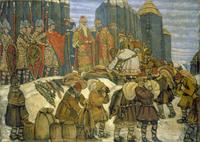
Russian prince collects tribute
Nicholas Roerich
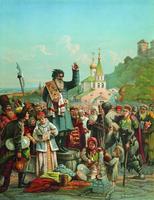
Proclamation of Kuzma Minin in Nizhny Novgorod in 1611
Konstantin Makovsky