Edouard Vuillard sanatçısının Boulevard of Battignolles eseri hakkında uzman analizi
Tarz: Post-Impressionism · Tür: cityscape
Expert Analysis: "Boulevard des Batignolles" by Édouard Vuillard
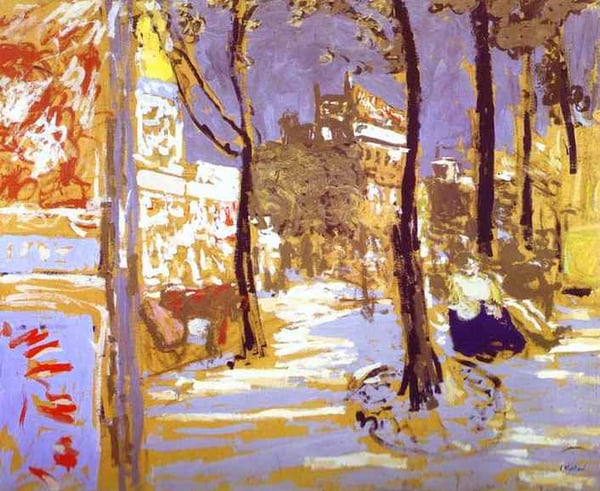
Édouard Vuillard’s Boulevard des Batignolles stands as a compelling example of Post-Impressionist cityscape painting, yet it defies the typical grandeur of urban views. Instead of celebrating the bustling boulevard with sweeping perspective or dramatic light, Vuillard brings the intimate, decorative sensibility of his Nabi training to a public Parisian scene.
Significance within Post-Impressionism and Vuillard’s Oeuvre:
-
Synthesis of Nabi Interiority and Urban Modernity
While Vuillard is best known for his small-scale, psychologically charged domestic interiors (intimisme), this cityscape transposes that same cloistered, pattern-heavy aesthetic onto the street. The boulevard is not rendered as a grand, receding space in the manner of Impressionists like Pissarro or Monet. Instead, Vuillard flattens depth, clusters figures and trees into dense, almost tapestry-like blocks, and uses muted, earth-toned harmonies accented by patches of brighter color. This approach makes the modern boulevard feel as enclosed and contemplative as a drawing room—a quiet observation of urban life rather than a spectacle. -
Decorative Abstraction over Illusionism
A hallmark of Vuillard’s Post-Impressionism—and of Nabi philosophy—is the subordination of realistic depiction to rhythmic patterns and surface design. In Boulevard des Batignolles, the pavement, foliage, and building façades are broken into painterly, interlocking shapes. The brushwork is visible and deliberate, emphasizing the canvas as a two-dimensional decorative field. This aligns Vuillard with other Post-Impressionists who pushed beyond optical realism toward expressive, structured color and form. -
Atmospheric Restraint and Psychological Tone
Unlike the vivid, saturated hues of Gauguin or van Gogh, Vuillard’s palette here is restrained—soft grays, olive greens, muted blues, and warm ochres. The light is diffused, almost hazy, evoking a specific Parisian moment rather than a timeless spectacle. This atmospheric discretion reinforces the work’s introspective quality, setting it apart from noisier urban depictions of the era. -
Contribution to the Evolution of the Cityscape
By merging the private, patterned world of Nabi decoration with the public subject of a bustling boulevard, Vuillard expands the vocabulary of the cityscape genre. The painting suggests that the modern city can be experienced not only as a space of movement and spectacle but also as a site for formal, decorative meditation—an idea that would resonate with later modernists.
In summary, Boulevard des Batignolles is significant because it demonstrates how Post-Impressionism’s devotion to color, pattern, and subjective vision could transform even the most recognizable urban view into a quiet, pattern-rich, and deeply personal composition—a bridge between the intimate and the public, the decorative and the modern.
Görsel olarak benzer
İlişkili kompozisyon ve renk paletine sahip 20 eser
On the Boulevard
Kazimir Malevich
Street Scene in Paris
Louis Hayet
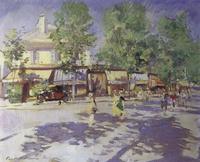
Paris in the morning
Konstantin Korovin
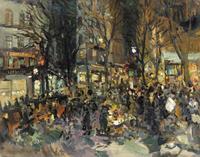
Parisian Street
Konstantin Korovin
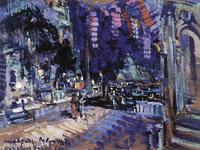
Masquerade
Konstantin Korovin
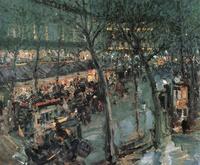
Paris.Cafe de la Paix
Konstantin Korovin
On the Outskirts of Paris
Vincent van Gogh
Quay at Dieppe
Gustave Loiseau
Boulevard de Clichy
Louis Abel-Truchet
The Forest at Boulogne
Alfred Sisley
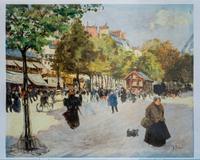
The Boulevard of Clichy
Louis Abel-Truchet
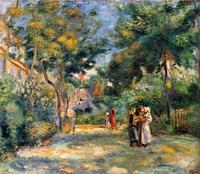
Figures in a Garden
Pierre-Auguste Renoir
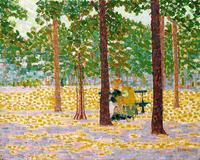
Park in Paris
Auguste Herbin
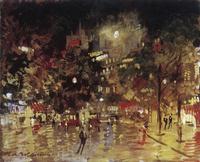
Paris by Night
Konstantin Korovin
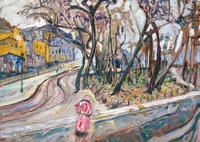
Scheiber Hugó, Városi Park Alakkal, 1920
Scheiber Hugó
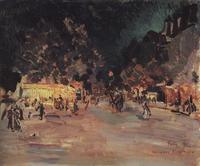
Paris at Night
Konstantin Korovin
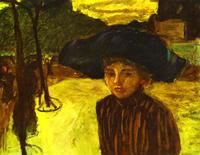
Woman in a Blue Hat
Pierre Bonnard
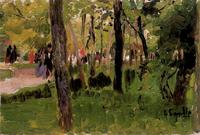
El Retiro, Madrid
Joaquín Sorolla
Nice.Street at night
Konstantin Korovin
Street Entering the Village
Alfred Sisley