
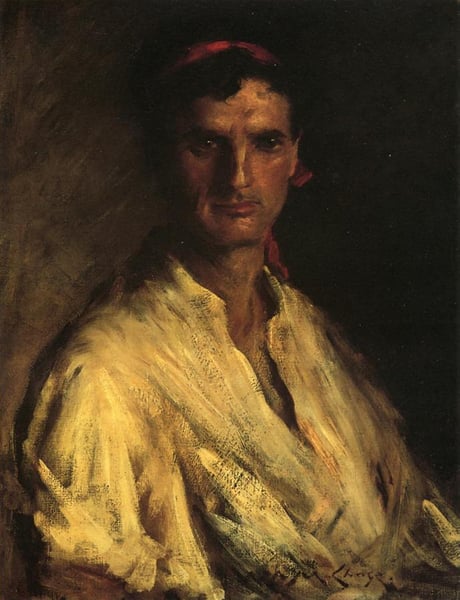
A Young Roman
Expertenanalyse zu William Merritt Chases A Young Roman
Stil: Realism · Genre: portrait
Expert Analysis: A Young Roman by William Merritt Chase
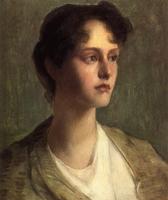
William Merritt Chase’s A Young Roman stands as a compelling example of American Realism at the turn of the 20th century, demonstrating the artist’s mastery of portraiture and his deep engagement with European artistic traditions. Painted during one of Chase’s many European sojourns, the work captures a Roman youth with a directness and psychological depth that elevate it beyond mere likeness.
Stylistic Context and Significance
Chase, though often associated with Impressionism, rooted his practice in the rigorous Realism he absorbed during his training at the Munich Academy. A Young Roman showcases his ability to blend this academic foundation with a more spontaneous, modern touch. The portrait’s significance lies in how it synthesizes two traditions: the Old Master influence of Velázquez and Hals (seen in the bold, confident brushwork and the dramatic play of light and shadow) and a distinctly American interest in capturing the individuality of the sitter without idealization.
Composition and Technique
Chase employs a restrained palette—likely dark, rich tones—to focus attention on the face and expression. The subject is presented with a direct gaze, suggesting a quiet dignity and self-possession. The loose, almost sketch-like handling of the costume and background contrasts with the more finished rendering of the face, a hallmark of Chase’s portrait style that imbues the work with a sense of immediacy and life. This technique reflects the Realist commitment to capturing the world as it is, yet it also anticipates the fluidity of early modernist portraiture.
Art-Historical Importance
Within Chase’s oeuvre, A Young Roman exemplifies his role as a bridge between European realism and American art at the turn of the century. It demonstrates how he brought the lessons of the Old Masters into a contemporary idiom, making the genre of portraiture feel vital and fresh. The painting also underscores Chase’s influence as a teacher—he founded the Chase School of Art (later Parsons School of Design)—and his advocacy for direct observation of nature and human character.
Thematic Resonance
More than a simple portrait, A Young Roman is a meditation on the universal human presence. By presenting a young man from a historically resonant city, Chase invites comparisons between the enduring spirit of ancient Rome and the vitality of youth. The painting captures a fleeting moment of quiet contemplation, yet it feels timeless—a key achievement of Realism.
In sum, A Young Roman is significant for its technical mastery, its fusion of American and European traditions, and its ability to convey both the particularity of its sitter and a broader human truth. It stands as a testament to Chase’s skill in reinvigorating portraiture with a modern, realist sensibility.
Visuell ähnlich
20 Werke mit ähnlicher Komposition und Farbpalette
Albert de Belleroche
John Singer Sargent
Bust of a man, allegory of Bacchus
Marià Fortuny
Bust Of Man, allegory of Bacchus
Marià Fortuny
Portrait of Georgi Gerasimov
Georgi Mashev
Head of a Capri Girl
John Singer Sargent
The Catalan Sculptor Manolo (Manuel Hugué)
Pablo Picasso
Gladys (detail)
Abbott Handerson Thayer
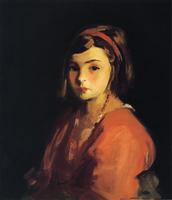
Agnes in Red (Agnes Schleicher)
Robert Henri
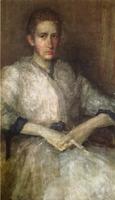
Portrait of Ellen Sturgis Hooper
James McNeill Whistler
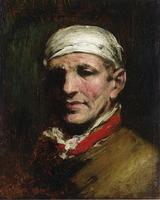
Man with Bandana
William Merritt Chase
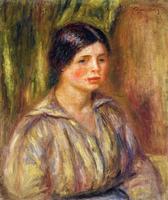
Bust of a Young Woman
Pierre-Auguste Renoir
Female Portrait
Francesco Paolo Michetti
Adelaida del Moral
Marià Fortuny
Self-Portrait
David Bomberg
Weda Cook
Thomas Eakins
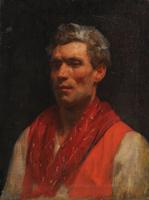
Male portrait with red handkerchief
Michele Cammarano
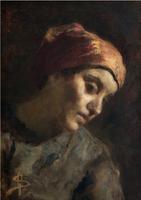
Portrait of a peasant woman
Giovanni Segantini
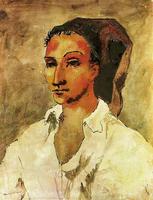
Spaniard
Pablo Picasso
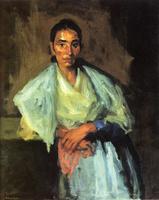
Gypsy
Robert Henri
Ideal Head
Julian Alden Weir