
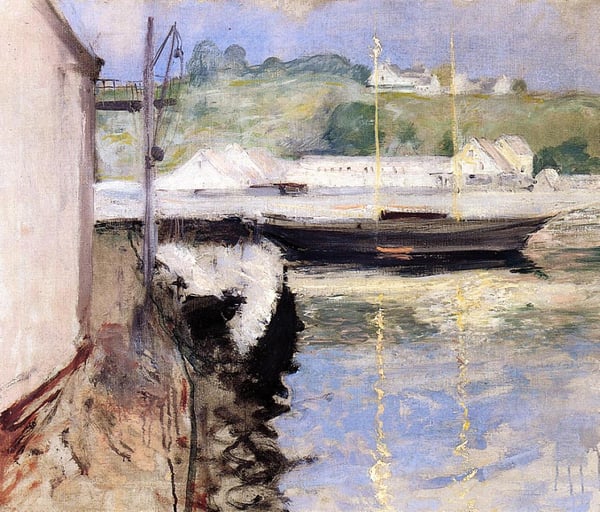
Expert analysis of William Merritt Chase’s Fish Sheds and Schooner, Gloucester
Style: Impressionism · Genre: marina
Expert Analysis of "Fish Sheds and Schooner, Gloucester" by William Merritt Chase
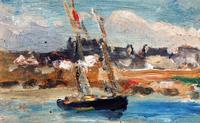
William Merritt Chase’s Fish Sheds and Schooner, Gloucester stands as a notable example of American Impressionism, specifically within the marina genre—a category that captures seascapes, harbors, and coastal life. Painted during Chase’s productive summers in Gloucester, Massachusetts, the work reflects the artist’s commitment to translating the tenets of French Impressionism into an American coastal vernacular.
Significance within Impressionism:
Chase adopted the Impressionist emphasis on light, atmosphere, and spontaneity, but he infused it with a distinctly American sense of place and structure. Unlike the more radical broken-color techniques of Monet or Renoir, Chase often retained a strong compositional framing—here, the fish sheds and schooner provide geometric anchors. The painting’s significance lies in how it balances impulsive brushwork with a clear depiction of working waterfront life, bridging the gap between European Impressionist theory and the American preference for recognizable subject matter.
Contribution to the Marina Genre:
As a marina, the work does not merely document a harbor scene; it transforms the everyday—fish sheds, a moored schooner, the shimmer of water—into a study of transient effects of light. Chase’s use of rapid, dappled strokes captures the glint of sun on wet docks and the reflective quality of the harbor, evoking a specific moment in time. This focus on atmosphere over narrative detail echoes the Impressionist goal of “painting the air,” making the scene feel immediate and vibrant.
Historical Context:
Chase was a leading figure in American art education and a champion of Impressionism in the United States. Fish Sheds and Schooner, Gloucester exemplifies his mature style, where he synthesized European influences with an intimate, local perspective. The painting’s significance is further heightened because it represents the Gloucester colony—a key site where American Impressionists reimagined marine painting, moving away from Romantic seascapes toward a more sensory, modern vision.
In summary, this work is significant as a masterful fusion of Impressionist technique with an American coastal motif, showcasing Chase’s ability to elevate a humble harbor scene into a luminous, atmospheric composition that remains defining of the movement’s adaptation in the United States.
Museum / Gallery
Visually similar
20 works with related composition and palette
Fish Sheds and Schooner, Gloucester
John Henry Twachtman
Boats at Anchor
John Henry Twachtman
Harbor Scene
John Henry Twachtman
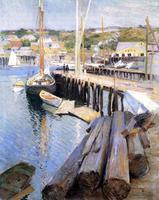
Fish Wharves - Gloucester
Willard Metcalf
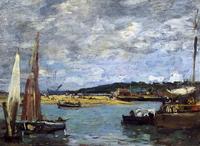
The Ferry to Deauville
Eugene Boudin
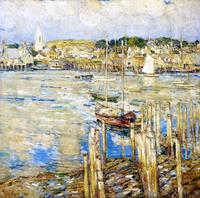
Gloucester
Childe Hassam
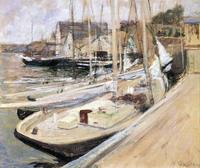
Fishing Boats at Gloucester
John Henry Twachtman
Landscape at La Ciotat
Georges Braque
Port of Fecamp
Gustave Loiseau
Gloucester Harbor
John Henry Twachtman
Reentering Port at Douarnenez (Finistere)
Maxime Maufra
The River Rance at La Hisse
Clarence Gagnon
The Port of Martigues
Raoul Dufy
Harbor in the Port of Fecamp
Berthe Morisot
View of Duquesne and Berrigny Basins in Dieppe
Camille Pissarro
The Port of Nice
Berthe Morisot
Cherbourg
Eugene Boudin
The Port Of Rouen
Paul Gauguin
The Port of Morgat
Odilon Redon
Two Masted Schooner, Concarneau
Robert Henri