Expert analysis of Willard Metcalf’s Coast of Brittany
Style: Impressionism · Genre: landscape
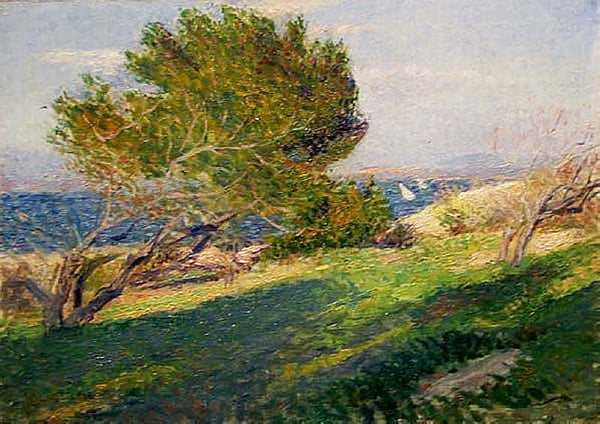
Willard Metcalf’s Coast of Brittany (1886) stands as a luminous testament to the pivotal moment when American artists began fully embracing the tenets of French Impressionism. Visually, the painting is a masterclass in capturing the ephemeral quality of light and atmosphere. Metcalf utilizes short, broken brushstrokes—a technique known as the "tache"—to render the vibration of sunlight hitting the windswept grass and the shimmering blue of the sea. The composition is anchored by the dynamic, leaning tree on the left, its form bent by the prevailing coastal winds, creating a sense of movement that contrasts with the serene, sun-dappled meadow. The color palette is particularly significant; rather than using black for shadows, Metcalf employs rich purples, deep greens, and blues, demonstrating a sophisticated understanding of color theory that defines the Impressionist movement.
Historically, this work is of great significance as it dates from Metcalf’s transformative period in France. Painted just before he helped found the art colony at Giverny—where he would eventually meet Claude Monet—this piece illustrates the artist's transition from academic training to the avant-garde practice of en plein air painting. It captures the rugged beauty of the Brittany coast, a region favored by artists for its distinct, harsh light and ancient landscape. In this context, the painting serves as a bridge, documenting the specific point in art history where American sensibilities met French innovation, a synthesis that Metcalf would later transplant to the landscapes of New England.
Symbolically, the painting evokes the harmonious yet powerful relationship between land and sea. The solitary tree, sculpted by the elements, suggests resilience and the passage of time, while the distant sailboat hints at humanity’s quiet presence within the vastness of nature. The heavy shadow stretching across the foreground invites the viewer into the scene, offering a tangible sense of the late afternoon sun. Coast of Brittany is not merely a topographical record; it is a sensory experience that prioritizes the feeling of the location—the salt air, the warmth of the sun, and the rustle of leaves—marking Metcalf as a master of atmospheric perception.
Visually similar
20 works with related composition and palette
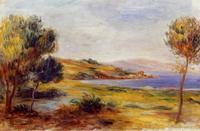
The Bay
Pierre-Auguste Renoir
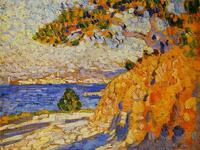
Midi Landscape
Theo van Rysselberghe
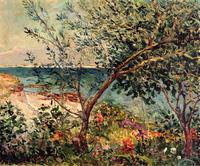
Monsieur Maufra's Garden by the Sea
Maxime Maufra
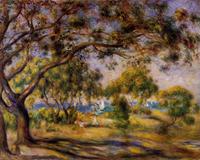
Noirmoutiers
Pierre-Auguste Renoir
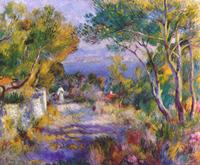
The estaque
Pierre-Auguste Renoir
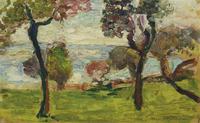
Paysage
Henri Matisse
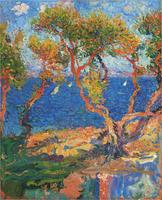
Olive Trees by the Sea
Henri Martin
Egry József, Kilátás a Domról, 1906
Egry József
The Bay of Cavaliere (study)
Henri-Edmond Cross
Landscape with Pines
Leon Dabo
Landscape, Sounion
Nikolaos Lytras
Cliffs of Varengeville, Gust of Wind
Claude Monet
The Alps Seen from Cap d'Antibes
Claude Monet
Untitled
Nicolae Tonitza
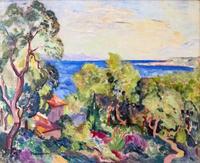
Le Golfe
Henri Manguin
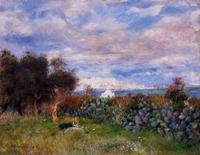
The Bay of Algiers
Pierre-Auguste Renoir
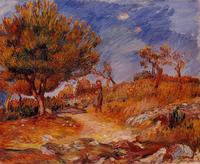
Woman under a Tree
Pierre-Auguste Renoir
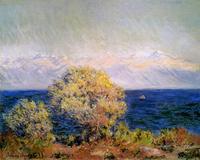
At Cap d'Antibes, Mistral Wind
Claude Monet
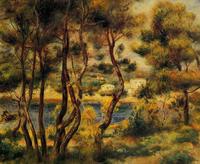
Cape Saint Jean
Pierre-Auguste Renoir
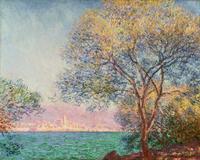
Antibes in the Morning
Claude Monet