
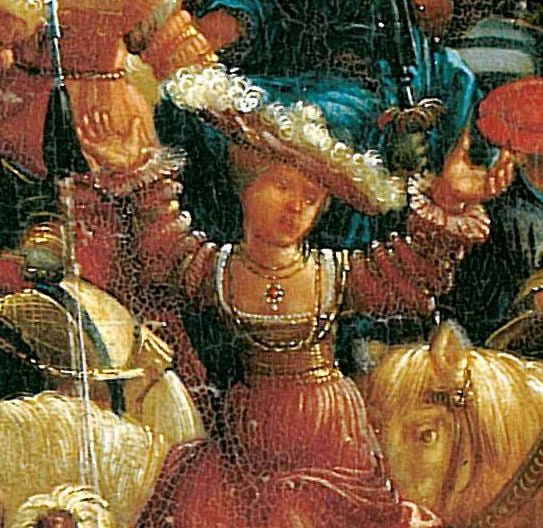
Analisi esperta di The battle of Issus(fragment) di Albrecht Altdorfer
Stile: Northern Renaissance · Genere: battle painting
Expert Analysis: The Battle of Issus (fragment) by Albrecht Altdorfer
Albrecht Altdorfer’s The Battle of Issus (1529) is a landmark of Northern Renaissance painting, and even in fragmentary form, it demonstrates the artist’s revolutionary approach to battle imagery. Painted in the early 16th century, the work transcends the traditional war picture by merging precise historical detail with an almost cosmic vision of landscape and divine providence.
Significance within the Northern Renaissance:
Altdorfer, a leading figure of the Danube School, brought a distinctly Northern Renaissance sensibility to history painting: an intense observation of nature combined with a metaphysical, almost mystical atmosphere. In The Battle of Issus, he depicts Alexander the Great’s victory over the Persian King Darius III in 333 BCE. The full original painting is famous for its vast, panoramic bird’s-eye view—a radically innovative perspective for its time. The fragment likely preserves a portion of the teeming chaos of the battlefield, with miniature soldiers clashing beneath a swirling sky of storm clouds and celestial light.
What makes this work significant:
-
Cosmic Scale and Landscape as Narrative: Altdorder does not merely show a battle; he frames it as a world-historical event under the watchful eye of heaven. The landscape itself—mountains, a sea, and a setting sun—becomes a protagonist. The Greek title “Issus” is inscribed on a tablet floating in the sky, emphasizing the event’s place in recorded history. This fusion of landscape painting with history was groundbreaking, elevating a battle scene to a meditation on fate, time, and empire.
-
Microscopic Detail and Macro Vision: The fragment showcases Altdorfer’s Northern Renaissance precision. Each soldier, standard, and weapon is rendered with obsessive detail, yet they are subsumed into the greater visual symphony of the whole. The viewer is invited to move between the epic and the intimate—a hallmark of Altdorfer’s genius.
-
Symbolic Use of Color and Light: The fragment likely contains the dramatic interplay of gold, crimson, and deep blues that characterize the original. Altdorfer uses light not just for naturalistic effect but to convey spiritual and political meaning. The radiant glow over the battlefield suggests divine favor for Alexander, while the gathering storm clouds hint at the transience of human glory.
-
Influence on Later History Painting: The Battle of Issus anticipates the grand battle scenes of Baroque and Romantic art (e.g., by Rubens, Delacroix) while retaining the eerie, crystalline clarity unique to the Northern Renaissance. Its ambitious synthesis of land, sky, and human action makes it a touchstone for the genre.
Even as a fragment, this work exemplifies Altdorfer’s ability to transform a historical clash into a cosmic drama, where every spear thrust and cloud formation resonates with symbolic weight. It stands as a testament to the Northern Renaissance’s power to merge naturalism with visionary imagination.
Visivamente simili
20 opere con composizione e palette affini
The battle of Issus(fragment)
Albrecht Altdorfer
Adoration of the Magi (detail)
Filippo Lippi
Roman soldiers and Jewish judges (left wing from the Triptych of the Crucifixion)
Gerard David

The Ghent Altar (detail)
Jan van Eyck
Saint George and the Princess of Trebizond
Pisanello
The Lady of the festival du Rosaire(fragment)
Albrecht Durer
Julius Caesar on a triumphal car
Andrea Mantegna
Trumpet players
Andrea Mantegna
The Soldiers of Christ
Jan van Eyck
Exaltação da Santa Cruz
Cristovao de Figueiredo
Procession of the Magus Balthazar (detail)
Benozzo Gozzoli
Procession of the Magus Balthazar (detail)
Benozzo Gozzoli
Group of Victims
Hieronymus Bosch
The Adoration of the Magi
Paolo Uccello
The Martyrdom of St. Catherine
Lucas Cranach the Elder
Victory of Louis III and Carloman on the Normans
Jean Fouquet
King Brennus of Gaul Captures the City of Rome; Marcus Furius Camillus Expels King Brennus From rome
Lo Scheggia
Allegory of March – Triumph of Minerva and Sign of Aries. Frescos in Palazzo Schifanoia (detail)
Francesco del Cossa
Victory over Bernardino della Ciarda
Paolo Uccello
The Martyrdom of St. Catherine
Jan Provoost