
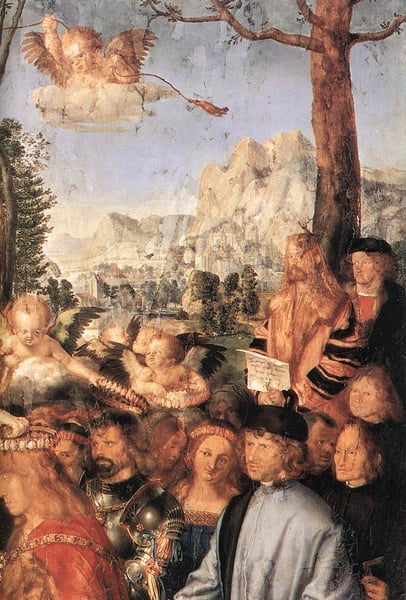
Expert analysis of Albrecht Durer’s The Lady of the festival du Rosaire(fragment)
Style: Northern Renaissance · Genre: religious painting
Expert Art Historical Analysis: “The Lady of the Festival du Rosaire (fragment)” by Albrecht Dürer
As a work of the Northern Renaissance, this fragment from Albrecht Dürer’s larger altarpiece The Festival of the Rosary (1506) exemplifies the period’s fusion of meticulous naturalism with profound religious symbolism. Even in its fragmented state, the painting is significant for several reasons:
-
Synthesis of Northern and Italian Traditions: Painted during Dürer’s second visit to Venice, this work demonstrates his masterful integration of Northern European attention to texture, surface detail, and symbolic objects (e.g., the rosary itself) with Italianate compositional balance, volumetric form, and warm, atmospheric color. The fragment likely retains Dürer’s characteristic precision in rendering hair, fabric, and light, while the overall composition—centered on the Virgin and Child—adopts the pyramidal stability favored by Italian Renaissance artists.
-
Innovation in Religious Imagery: As a religious painting intended for a confraternity dedicated to the rosary, Dürer’s interpretation transforms a traditional devotional subject into a dynamic, multi-figure gathering that includes saints, donors, and even the artist himself. The fragment’s focus on the “Lady” (the Virgin Mary) emphasizes her role as intercessor, while the rosary beads serve as a bridge between the earthly and divine—a hallmark of Northern Renaissance piety.
-
Technical and Material Significance: Fragments of this scale are rare and valuable for understanding Dürer’s workshop techniques. The careful preservation of color, glazing, and underdrawing in the fragment offers scholars insight into his layered painting method, which combined opaque and translucent layers to achieve lifelike skin tones and rich drapery.
-
Cultural and Historical Context: Completed during a period of intense artistic exchange, this altarpiece was one of Dürer’s most prestigious commissions in Venice. The fragment’s survival allows viewers to appreciate the artist’s response to Italian humanism while retaining the detailed realism that defines the Northern Renaissance. It stands as a testament to Dürer’s role in bridging two great artistic traditions.
Museum / Gallery
Visually similar
20 works with related composition and palette
The Three Kings Altarpiece
Hans Baldung
The Martyrdom of St. Catherine
Jan Provoost
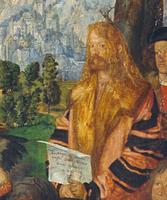
Feast of the Rosary (detail, Supposed Self Portrait)
Albrecht Durer
Calvary Triptych (detail)
Justus van Gent
The Adoration of the Magi
Raphael
Calvary Triptych (detail)
Justus van Gent
Holy Family with Two Donors
Vittore Carpaccio
Triptych of the Mystical Marriage of St. Catherine of Alexandria, left wing: The Beheading of John the Baptist
Hans Memling
The Portinari Altarpiece, St. Mary Magdalen and St. Margaret with Maria Baroncelli and Daughter Margherita Portinari, Right Wing
Hugo van der Goes
The Adoration of the Magi
Pietro Perugino
The Tree of Jesse
Geertgen tot Sint Jans
The Adoration of the Magi (particular detail)
Pietro Perugino
Adoration Of The Magi
Hans Baldung
The Meeting of Abraham and Melchizedek
Dirk Bouts
St. Augustine Departing for Milan (detail)
Benozzo Gozzoli
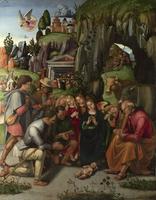
Adoration of the Shepherds
Luca Signorelli
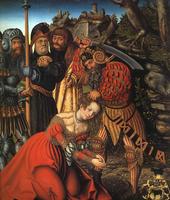
The Martyrdom of St. Barbara
Lucas Cranach the Elder
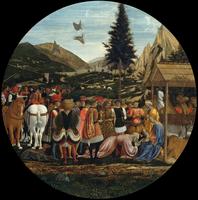
The Adoration of the Magi
Domenico Veneziano
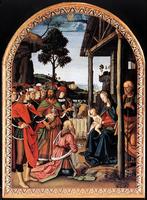
Adoration of the Kings (Epiphany)
Pietro Perugino
Moses's Journey into Egypt and the Circumcision of His Son Eliezer (detail)
Pietro Perugino