
Analisi esperta di Cairo di Konstantin Makovsky
Stile: Realism · Genere: cityscape
Expert Analysis of "Cairo" by Konstantin Makovsky
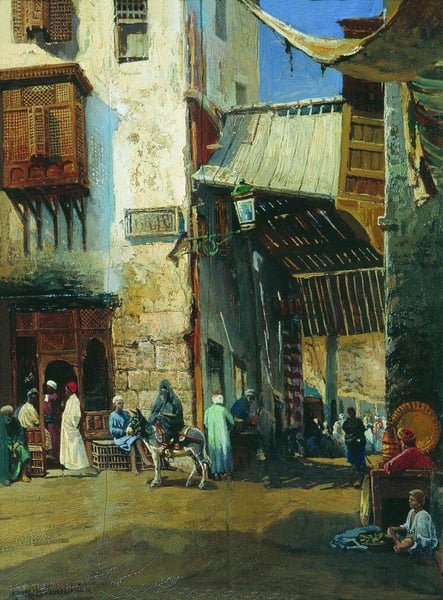
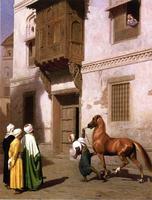
Konstantin Makovsky’s Cairo is a compelling example of how 19th-century Russian Realism engaged with Orientalist themes. Executed in the style of Realism and classified as a cityscape, the work transcends mere topographic documentation to become a vivid ethnographic and atmospheric study.
Significance within Realism and Orientalism:
Makovsky, a member of the influential "Wanderers" (Peredvizhniki), was celebrated for his meticulous attention to detail and his ability to capture the texture of everyday life. In Cairo, he applies these Realist principles not to a Russian scene, but to an Eastern subject—a common practice among European artists of the period, yet remarkable for its Russian perspective. The painting is significant for its fusion of Realism’s commitment to observable truth with the Romantic allure of the Orient. Makovsky does not idealize Cairo; instead, he renders its architecture, light, and street life with the same rigorous observation he would apply to a Moscow marketplace.
Artistic Choices and Effect:
The composition likely emphasizes the interplay of harsh sunlight and deep shadow, a hallmark of Realist cityscapes that reveals the city’s character. Makovsky’s brushwork balances precision with atmospheric depth, capturing the textures of sunbaked stone, dust, and bustling activity. By focusing on a Cairo street or landmark, he transforms a foreign locale into a believable, lived-in environment—a testament to his skill in using Realist techniques to convey the unique energy of an Islamic city. This work stands out because it avoids the overt exoticism or fantasy common in Orientalist painting; instead, it grounds the scene in authentic, observed details, making the unfamiliar familiar.
Cultural and Historical Impact:
Cairo represents the intersection of Russian art with broader 19th-century Orientalism, offering a window into how Russian painters—emerging from a distinct cultural and political context—viewed the Islamic world. The painting’s significance lies in its documentation of Cairo at a moment of transformation, preserved through a Realist lens that values accuracy over stereotype. As such, it is both a masterpiece of atmospheric cityscape painting and a valuable historical record of cross-cultural artistic exchange.
Visivamente simili
20 opere con composizione e palette affini
Binnenplein te Kairo On an oriental square
Willem de Famars Testas
Middle Eastern street scene
Rubens Santoro
The Mosque of Emir Mindar in Cairo
John Varley II
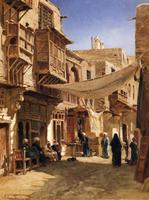
Street in Boulaq near Cairo
John Varley II
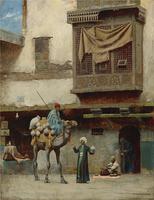
the Pottery Seller in Old City Cairo
Charles Sprague Pearce
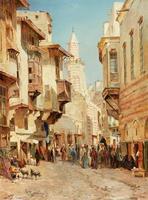
The Mosque of Emir Mindar, Cairo
John Varley II
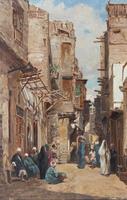
Street Scene, Cairo
John Varley II
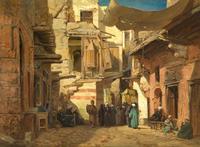
A Street in the Hassonayn Quarter, Cairo
John Varley II
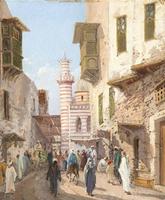
Cairo scene
Gustavo Simoni
A Cairo Street Scene
Augustus Osborne Lamplough
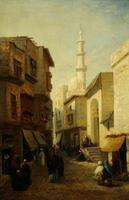
Mosque near the Bab al-Nasr, Cairo
John Varley II
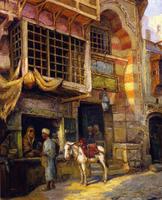
Untitled
Louis Comfort Tiffany
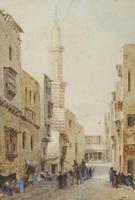
Street Scene, Cairo (also known as A North African Street)
John Varley II
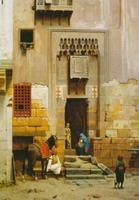
An Arab street scene
Willem de Famars Testas
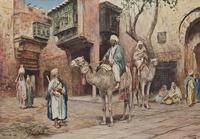
An Arab Courtyard
Haddon Sundblom
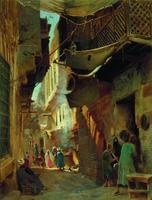
Street in Cairo
Konstantin Makovsky
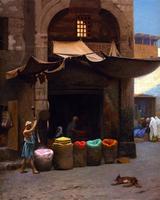
The Color Grinder
Jean-Leon Gerome
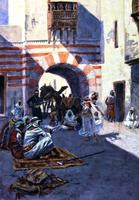
Street Scene in Arabia
Charles M. Russell
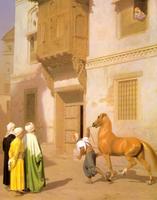
Cairene Horse Dealer
Jean-Leon Gerome
Horse Merchant in Cairo
Jean-Leon Gerome