
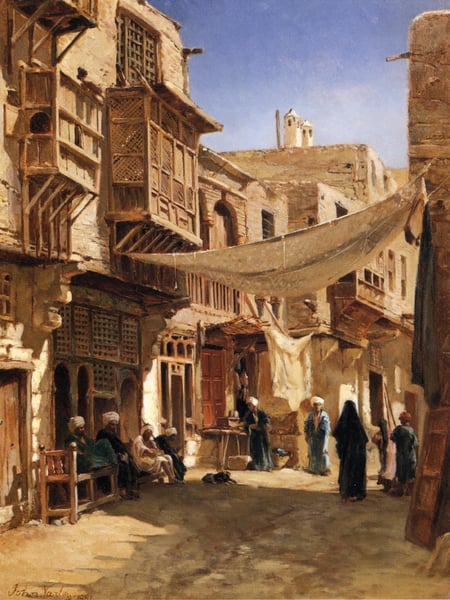
Analisi esperta di Street in Boulaq near Cairo di John Varley II
Stile: Realism · Genere: cityscape
Expert Analysis: "Street in Boulaq near Cairo" by John Varley II
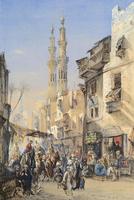
John Varley II’s Street in Boulaq near Cairo is a compelling example of Orientalist Realism—a branch of 19th-century Realism that sought to document the daily life and architecture of North Africa and the Middle East with ethnographic precision. Painted in the latter half of the 19th century, the work is a cityscape that transcends mere topography, serving instead as a visual record of a rapidly modernizing world.
Significance within Realism:
Varley II adheres to the core tenets of Realism by rejecting idealized or romanticized views of the East. Instead, he presents a matter-of-fact street scene in Boulaq—then a bustling port district on the Nile, home to merchants, laborers, and artisans. The artist’s careful attention to light and shadow, the texture of sunbaked mud-brick walls, and the subtle gradations of dust and heat evoke a palpable sense of place. This aligns with Realism’s commitment to truthful, unembellished observation.
Significance within the Orientalist Tradition:
Unlike earlier Romantic Orientalists who often staged exotic fantasies, Varley II’s approach is documentary. He captures the everyday rhythm of Cairene life: a narrow street flanked by overhanging wooden mashrabiya windows, the glimpse of a domed mosque in the distance, and figures in local dress engaged in mundane activities. This focus on vernacular architecture and ordinary people marks a shift toward a more anthropologically informed art, prefiguring later photographic reportage.
Artistic execution:
The composition is balanced yet dynamic—the receding street draws the viewer into the scene, while the interplay of warm terracotta, ochre, and blue-grey sky anchors the work in a specific Mediterranean light. Varley II’s brushwork is controlled but not rigid, allowing the surface to retain a painterly vitality that avoids the coldness of a mere topographical study.
Cultural and historical context:
Boulaq was a center of trade and cross-cultural exchange, and Varley II’s choice to depict it—rather than the more frequently painted pyramids or bazaars—reflects a Realist concern with the contemporary, the lived environment. At a time when colonial powers were reshaping Egyptian cities, this painting quietly preserves a vanishing urban fabric, making it both an artistic achievement and a historical document.
In sum, Street in Boulaq near Cairo is significant for its sober, unromanticized vision of Cairene street life, executed with the technical rigor of Realism while contributing a valuable, empathetic account of 19th-century urban Egypt.
Visivamente simili
20 opere con composizione e palette affini
Street Scene, Cairo
John Varley II
Middle Eastern street scene
Rubens Santoro
A Street in the Hassonayn Quarter, Cairo
John Varley II
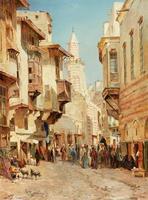
The Mosque of Emir Mindar, Cairo
John Varley II
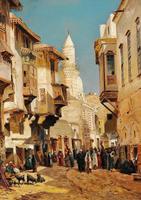
The Mosque of Emir Mindar in Cairo
John Varley II
A Cairo Street Scene
Augustus Osborne Lamplough
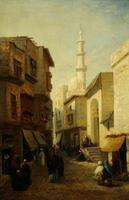
Mosque near the Bab al-Nasr, Cairo
John Varley II
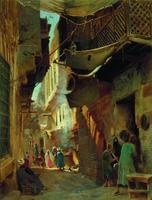
Street in Cairo
Konstantin Makovsky
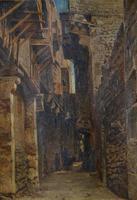
The Coptic Quarter, Cairo
John Varley II
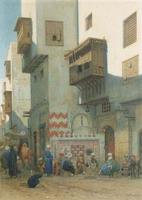
Binnenplein te Kairo On an oriental square
Willem de Famars Testas
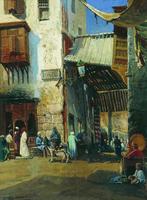
Cairo
Konstantin Makovsky
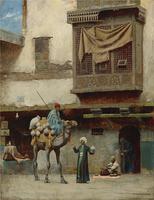
the Pottery Seller in Old City Cairo
Charles Sprague Pearce
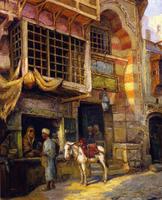
Untitled
Louis Comfort Tiffany
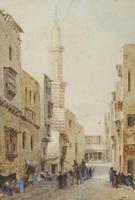
Street Scene, Cairo (also known as A North African Street)
John Varley II
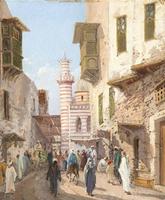
Cairo scene
Gustavo Simoni
DANS LA CASBAH D’ALGER ALGIERS, IN THE CASBAH
Henri Felix Emmanuel Philippoteaux
Game El Syer, Cairo
John Varley II
Street Scene in Bombay
Edwin Lord Weeks
An Arab Courtyard
Haddon Sundblom
UN CARREFOUR AU CAIRE
Louis-Amable Crapelet