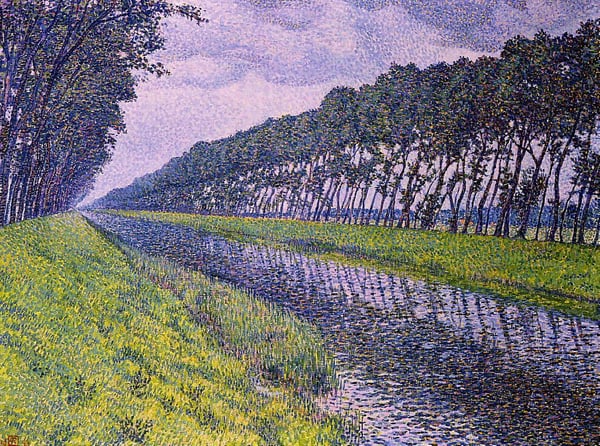
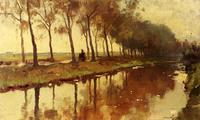
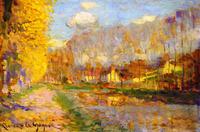
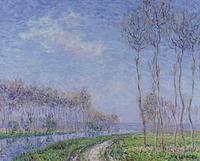
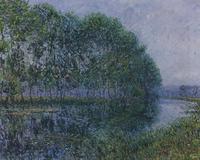
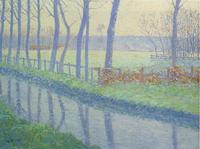
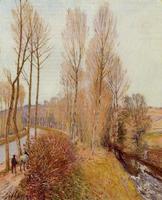
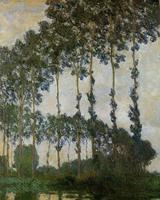
"Canal in Flanders" by Theo van Rysselberghe is a quintessential example of Neo-Impressionist landscape painting. Executed in the Pointillist technique—which employs small, distinct dots of pure color that optically blend at a distance—the work demonstrates van Rysselberghe’s mastery of the scientific color theories championed by Georges Seurat and Paul Signac.
What makes this piece significant within its style and period is its adaptation of Pointillism to the specific light and atmosphere of the Flemish lowlands. Unlike the sun-drenched coastal scenes often favored by French Neo-Impressionists, van Rysselberghe applies the method to a cool, northern landscape of canals, damp skies, and muted greenery. The structured dots meticulously capture the shimmer of water and the hazy diffusion of light across flat terrain, proving that Pointillism was not limited to Mediterranean motifs but could render the subtle tonalities of Flanders.
As a leading Belgian figure of the movement, van Rysselberghe helped legitimize Neo-Impressionism beyond France, and Canal in Flanders stands as a testament to the style’s flexibility—merging rigorous optical science with a distinctly local, pastoral sensibility.