Summer Landscape of the Moor
Theo van Rysselberghe sanatçısının Summer Landscape of the Moor eseri hakkında uzman analizi
Tarz: Pointillism, Neo-Impressionism · Tür: landscape
Expert Analysis of Summer Landscape of the Moor by Theo van Rysselberghe
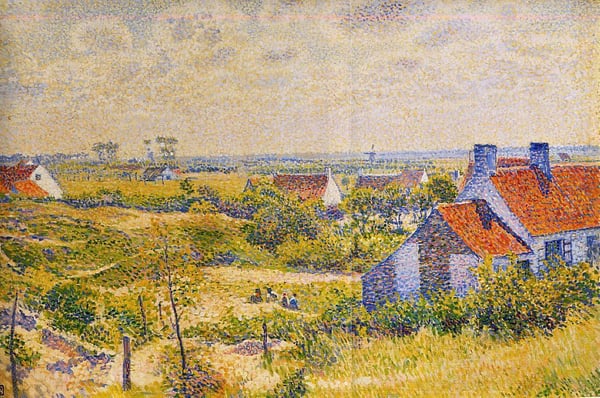
Theo van Rysselberghe’s Summer Landscape of the Moor stands as a luminous testament to the pioneering spirit of Neo-Impressionism beyond the borders of France. As a leading member of the Belgian avant-garde group Les XX, van Rysselberghe adopted Georges Seurat’s Pointillist technique but infused it with a distinctly northern European sensitivity to natural light and atmosphere.
Significance within Pointillism and Neo-Impressionism:
- Mastery of Optical Mixing: Van Rysselberghe applies pure, unmixed pigments in minute dots, relying on the viewer’s eye to blend them optically. In this moorland scene, he juxtaposes blues, yellows, greens, and subtle purples to create a vibrant, shimmering surface that captures the intense, hazy light of a summer day.
- Expansion of the Genre: Unlike Seurat’s urban or formal subjects, van Rysselberghe chose the wild, open moor—a landscape of heath, low shrubs, and undulating terrain. This demonstrates Neo-Impressionism’s capacity to render the transient effects of sun and breeze on a natural, unstructured environment.
- Atmospheric and Emotional Tone: The painting’s title emphasizes “summer”—a season of heat and stillness. Through his systematic dotting, van Rysselberghe evokes the sensation of warm air, the drone of insects, and the almost palpable stillness of a sun-drenched landscape. The composition leads the eye across a lightly rolling horizon, with a sky built from layered points of cerulean, pale yellow, and pink—capturing the subtle gradations of midday light.
Technical and Stylistic Innovation:
- Color Harmony: Van Rysselberghe adheres to Chevreul’s law of simultaneous contrast: warm oranges and yellows in the foreground heath are balanced by cool blue-violet shadows in the middle distance, creating a vibration that animates the entire canvas.
- Texture and Rhythm: The uniformity of his touch creates a unifying tapestry-like surface, yet the density of dots varies—denser in the foreground for solidity, looser in the sky for airiness. This rhythm guides the viewer’s gaze through the composition.
Art-Historical Context:
- Van Rysselberghe’s Summer Landscape of the Moor represents the height of Belgian Neo-Impressionism in the 1890s, when artists like him and Henry van de Velde adapted Pointillist theory to produce works that feel both systematic and deeply poetic. The painting is significant for showing that Pointillism could transcend the studio—capturing the raw, fleeting beauty of a moor in summer—and for proving that the technique’s scientific rigor need not sacrifice emotional resonance.
In sum, this artwork is a key example of how van Rysselberghe synthesized the structural discipline of Seurat with a personal, lyrical observation of nature, making him a vital bridge between French Neo-Impressionism and the later Fauvist explorations of color.
Museum / Gallery
Görsel olarak benzer
İlişkili kompozisyon ve renk paletine sahip 20 eser
Houses at Knocke, Belgium
Camille Pissarro
An Old Cottage at Sablons
Alfred Sisley
Springtime
Alfred Sisley
View of a Farm in Osny
Camille Pissarro
From the Upper Terrace
John Henry Twachtman
Landscape, near Auxerre
Gustave Loiseau
Abandoned House
Alfred Sisley
View of Auvers
Vincent van Gogh
Veslez
Gustave Loiseau
Vineyards with a View of Auvers
Vincent van Gogh
The Village of Knocke, Belgium
Camille Pissarro
Poppy Field at Giverny
Claude Monet
Après la pluie
Armand Guillaumin
An Orchard at Harvest Time
Camille Corot
House at Beynac
Gustave Loiseau
Houses of l'Hermitage, Pontoise
Camille Pissarro
View of Auvers
Paul Cezanne
View of Osny near Pontoise
Camille Pissarro
Giverny
Theodore Robinson
Coast at Chaponival
Gustave Loiseau