Expertenanalyse zu Eugene Boudins Quittebeuf
Stil: Impressionism · Genre: cityscape
Expert Art Historical Analysis of Quittebeuf by Eugène Boudin
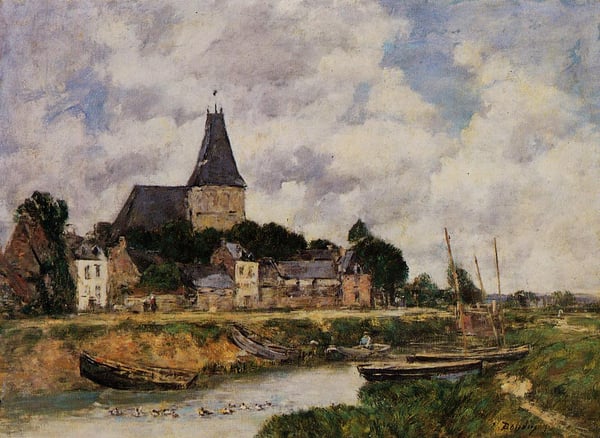
Eugène Boudin’s Quittebeuf (c. 1870s–1880s) stands as a quietly revolutionary work within the Impressionist movement, even though it depicts a modest Norman village rather than the fashionable resorts or bustling ports for which Boudin is best known. As a precursor and mentor to the Impressionists—most notably Claude Monet—Boudin’s dedication to plein air practice and his nuanced observation of atmospheric light are fully evident here, making Quittebeuf a significant example of how the artist translated his celebrated seascape methods into the cityscape genre.
Breaking from Convention: At a time when the official Salon still favored historical or mythological subjects rendered in studio darkness, Boudin chose the unassuming rural town of Quittebeuf. The painting’s importance lies in its democratic subject matter: a quiet street, modest buildings, and the interplay between architecture and nature. This focus on everyday life—without narrative or moral lesson—was a radical embrace of modernity that later defined Impressionism.
Light and Atmosphere as Protagonist: Boudin’s signature “sky studies” come indoors, so to speak. The sky in Quittebeuf is not a backdrop but an active compositional force. Soft gradations of cloud and pale blue light filter across the scene, casting dappled shadows on the road and rooftops. He captures the ephemeral quality of a specific moment—likely a cloudy morning or late afternoon—through rapid, broken brushstrokes that suggest rather than define forms. This technique, which he taught to a young Monet, directly anticipates the Impressionist fixation on transient light.
Structural Influence on Impressionist Cityscapes: While later Impressionists like Pissarro or Sisley would paint bustling Parisian boulevards, Boudin’s quiet village scenes like Quittebeuf established a template: anchoring the composition with a receding road or path, balancing natural and built elements, and using a high horizon to emphasize the sky’s role. The painting’s muted tonal palette—soft grays, ochres, and muted greens—demonstrates Boudin’s restraint, prioritizing tonal harmony over local color, a lesson that Monet would later transform into vibrant, broken color.
Significance within Boudin’s Oeuvre: Quittebeuf exemplifies Boudin’s ability to find sublimity in the ordinary. Unlike his better-known beach scenes (e.g., Trouville), this work is introspective, still, and intimate. It reveals his deep sympathy for rural French life and his belief that a simple street corner, rendered with fidelity to atmospheric conditions, could hold as much beauty as a dramatic coastline. For art historians, this painting bridges the Barbizon school’s love of nature and the Impressionists’ celebration of modern life—a crucial pivot that underscores Boudin’s role as a father figure to the movement.
Conclusion: Quittebeuf is significant not because it is flashy, but because it is foundational. It encapsulates the quiet shift from romantic landscape to modern perceptual painting. Boudin’s dedication to capturing the “instantaneity” of light on humble stone and dirt—before Monet made that his manifesto—makes this cityscape a quiet masterpiece of early Impressionism and a testament to the artist’s profound influence on the course of modern art.
Museum / Gallery
Visuell ähnlich
20 Werke mit ähnlicher Komposition und Farbpalette
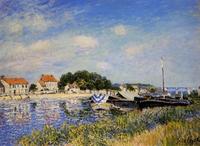
Banks of the Loing at Saint Mammes
Alfred Sisley
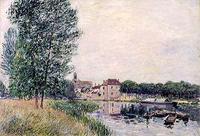
Moret Sur Loing
Alfred Sisley
Saint Mammes Dam
Alfred Sisley
The Port of Trouville
Eugene Boudin
Loing Dam at Saint Mammes
Alfred Sisley
The Dam at Saint Mammes
Alfred Sisley
Trouville
Eugene Boudin
The Port of Trouville
Eugene Boudin
Harbour Scene, Dieppe
Paul Gauguin
Barges on the canal at Saint-Valery-sur-Somme
Eugene Boudin
Breton Village by the Sea
Ferdinand du Puigaudeau
Banks of the Loing at Saint Mammes
Alfred Sisley
The Mouth of the Loing at Saint Mammes
Alfred Sisley
The Loing at Saint Mammes
Alfred Sisley
Saint Mammes, Ducks on Canal
Alfred Sisley
The Somme at Saint-Valery-sur-Somme
Eugene Boudin
Saint Mammes
Alfred Sisley
Sand on the Quayside, Port Marly
Alfred Sisley
Morning Sun, Saint Mammes
Alfred Sisley
View of Bonnieres
Paul Cezanne