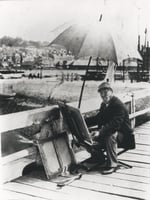
Expert analysis of Eugene Boudin’s Return of the Terre Neuvier
Style: Impressionism · Genre: genre painting
Expert Analysis of "Return of the Terre Neuvier" by Eugène Boudin
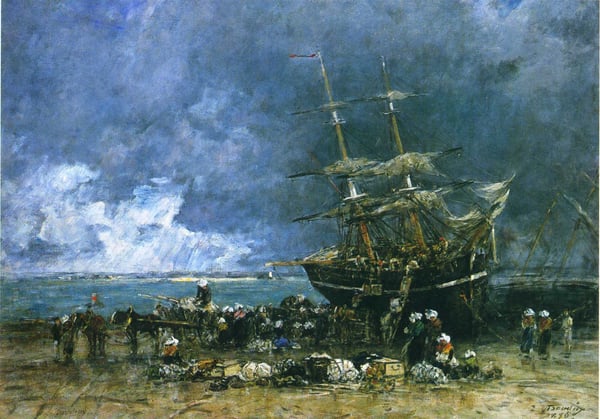
Eugène Boudin’s "Return of the Terre Neuvier" stands as a pivotal work within the early Impressionist movement, bridging the naturalism of the Barbizon school with the nascent Impressionist fascination with light, atmosphere, and everyday modernity. Painted in the 1860s–70s (the exact date varies by source), this genre scene depicts the return of a terre-neuvier—a fishing vessel from the Newfoundland cod fisheries—to a French port, likely Le Havre or Honfleur.
Significance in Impressionist Context
Boudin was a direct mentor to the young Claude Monet, and this painting exemplifies the principles he instilled: an unwavering commitment to painting en plein air (outdoors) to capture transient effects of weather and light. The composition is less about narrative drama than about the sensory experience of the scene—the grey, overcast sky, the choppy green water, the damp air, and the weary, anonymous figures of the fishermen. This focus on atmosphere over anecdote was radical for its time and directly anticipated the core concerns of Impressionism.
Visual and Thematic Elements
-
Sky and Light: Boudin was called the “king of skies,” and here the vast, cloud-filled expanse dominates the canvas. The cool, muted palette of greys, silvers, and pale blues creates a hazy coastal light, capturing the specific weather of the English Channel. This treatment of sky as both a source of luminosity and a mood-setter was groundbreaking.
-
Maritime Genre: As genre painting, the work elevates a routine, labor-intensive event—the return of fishermen—into a subject worthy of fine art. Boudin treats the figures with dignity but without sentimentality; they are absorbed in their tasks, dwarfed by the boat and the elemental forces of sea and sky. This reflects the Impressionist interest in contemporary life and the working classes, moving away from historical or mythological themes.
-
Brushwork and Composition: The brushstrokes are loose and rapid, particularly in the water and sky, yet the hulls and rigging retain enough definition to anchor the scene. The diagonal line of the boat and the horizontal band of the shore create a dynamic tension, while the low horizon line emphasizes the immensity of the heavens.
Why It Matters
"Return of the Terre Neuvier" is significant not only for its technical prowess but for its role in defining the Impressionist ethos: the celebration of the fleeting moment, the harmony of human activity with nature, and the belief that a simple docking scene could hold as much visual poetry as a classical allegory. Boudin’s work here directly influenced Monet’s later series like "Impression, Sunrise" (1872), making this painting a crucial—yet often underappreciated—stepping stone toward the dawn of modern art.
Visually similar
20 works with related composition and palette
Unloading the Newfoundland Fishing Boat
Eugene Boudin
Evening, Le Havre
Eugene Boudin
Sunset at the seashore
Konstantinos Volanakis
Marine landscape
Ivan Aivazovsky
The Port of Deauville
Eugene Boudin
The Trouville Coastline, Low tide
Eugene Boudin
Entrance to Port of Havre
Eugene Boudin
The Thames in Ice
James McNeill Whistler
Two Ships Anchored off a Beach
Ivan Aivazovsky
Sailing Boats at Anchor
Eugene Boudin
Le Havre. Avent Port.
Eugene Boudin
Camaret, the Port
Eugene Boudin
Deauville, the Harbor
Eugene Boudin
Fishermen on the Shore
Ivan Aivazovsky
The port Portrieux at low tide unloading fish
Eugene Boudin
Statue of Liberty Arrives in New York Harbor
Edward Moran
Trouville, piers, high tide
Eugene Boudin
Russian-Turkish Sea Battle of Sinop on 18th November 1853
Ivan Aivazovsky
Greek frigate at anchor
Konstantinos Volanakis
The Battle of Navarino
Ivan Aivazovsky