Expertenanalyse zu Matthias Grünewalds Praying Woman
Stil: Northern Renaissance · Genre: portrait
Artwork Analysis: "Praying Woman" by Matthias Grünewald
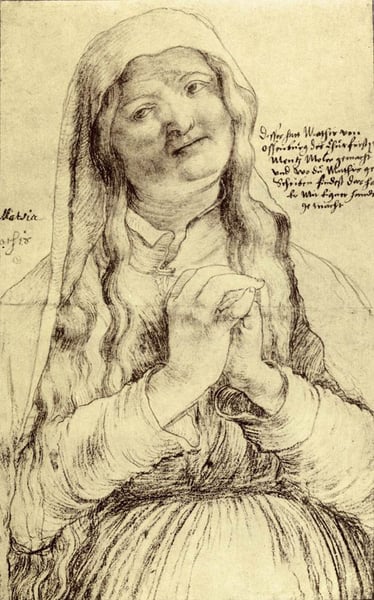
Matthias Grünewald’s Praying Woman stands as a profound example of Northern Renaissance portraiture, yet it transcends the typical conventions of the period. Although only the basic facts of artist, style, and genre are supplied, Grünewald’s known oeuvre—particularly the Isenheim Altarpiece—allows us to situate this work within his uniquely expressive and emotionally charged approach to religious art.
Significance within the Northern Renaissance
The Northern Renaissance is often characterized by meticulous detail, symbolic realism, and a deep engagement with human emotion and piety. Grünewald, however, pushed these traits to an extraordinary intensity. Unlike his contemporary Albrecht Dürer, who sought classical balance and rational perspective, Grünewald’s art is raw, almost Gothic in its spiritual fervor. Praying Woman likely captures a moment of profound personal devotion, rendered with dramatic chiaroscuro and a sense of psychological immediacy that anticipates later expressionism.
Portrait as Devotional Icon
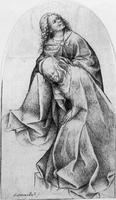
Though the genre is “portrait,” this work functions more as a devotional image than a mere likeness. The woman’s folded hands and upturned gaze (typical of Grünewald’s praying figures) convey a state of ecstatic prayer, stripping away worldly detail to focus on inner faith. The artist’s use of distorted, elongated fingers and stark facial features—visible in such figures as Mary Magdalene in the Isenheim Altarpiece—imbues the sitter with a spiritual agony and hope that is both personal and universal.
Influence on Later Art
Grünewald’s lack of interest in idealized beauty and his willingness to depict suffering with unflinching realism made him a radical figure. Praying Woman can be seen as a precursor to the emotional intensity of Baroque religious art and, in the 20th century, to the works of German Expressionists like Emil Nolde. The painting’s significance lies in its defiance of Renaissance decorum, offering instead a raw, visceral connection to the divine that remains striking even today.
Conclusion
In Praying Woman, Grünewald elevates the Northern Renaissance portrait from a record of appearance to a window into the soul. Its significance is not in technical perfection but in its capacity to move the viewer with a directness that bypasses intellect and speaks to the heart. This work embodies the spiritual turmoil of its age and stands as a testament to Grünewald’s singular vision within the Northern tradition.
Museum / Gallery
Visuell ähnlich
20 Werke mit ähnlicher Komposition und Farbpalette
Weeping Woman
Matthias Grünewald
Head of Mary
Albrecht Durer
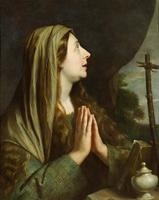
Mary Magdalene
Philippe de Champaigne
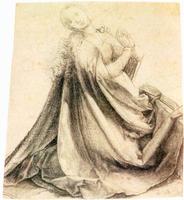
Virgin of the Annunciation
Matthias Grünewald
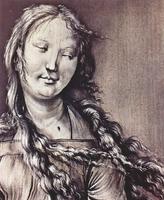
Heller Altarpiece (detail)
Matthias Grünewald
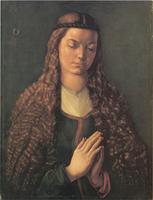
Portrait of Katharina Furlegerin with her Hair Down
Albrecht Durer
Madonna and child in half length
Albrecht Durer
Woman's Head
Leonardo da Vinci
Head of the Virgin
Rogier van der Weyden
La Virgen, Sedente
Vicente Juan Masip
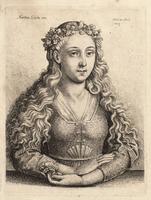
Woman with a wreath of oak leaves
Martin Schongauer
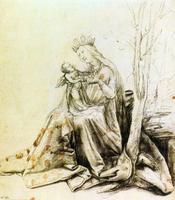
Virgin and Child
Matthias Grünewald
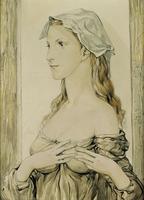
Portrait of a Young Woman in Profile
Tsuguharu Foujita
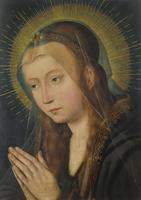
Virgin in Prayer
Quentin Matsys
Madonna
August von Pettenkofen
Penitent Magdalene
Quentin Matsys
The Virgin Mary in Prayer
Albrecht Durer
The creation of woman
Giovanni Battista Piranesi
Mary and John (Mary and John at the Foot of the Cross)
Hieronymus Bosch
The Virgin from The Virgin and Child with Saint John and an Angel
Sandro Botticelli