Disputation of Saints Erasmus and Mauritius (Maurice)
Dettagli
Analisi esperta di Disputation of Saints Erasmus and Mauritius (Maurice) di Matthias Grünewald
Stile: Northern Renaissance · Genere: religious painting
Expert Analysis: "Disputation of Saints Erasmus and Mauritius (Maurice)" by Matthias Grünewald
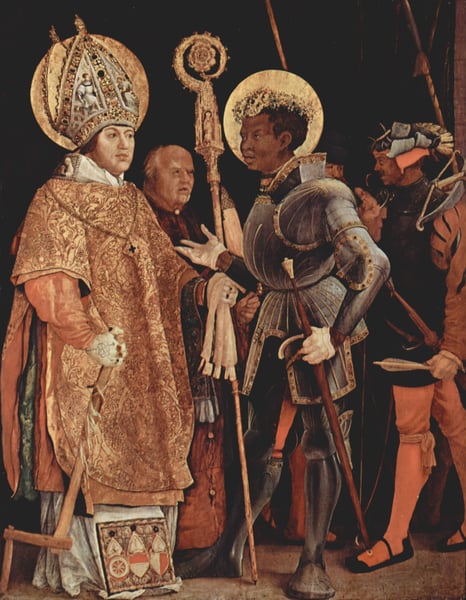
As a quintessential work of the Northern Renaissance, this religious painting by Matthias Grünewald stands apart for its visceral intensity and unorthodox composition, which fuse late medieval piety with the emerging naturalism of the era. The title itself signals a theological rarity: a disputation—a formal intellectual debate—between Saint Erasmus, a Western Church Father, and Saint Maurice, a legendary African saint of the Theban Legion. This iconographic choice is significant, as it reflects the period’s growing engagement with diverse hagiographic traditions and the humanist interest in dialogue between different Christian lineages.
Grünewald’s treatment is anything but serene. Unlike the harmonious, balanced compositions favored by Italian Renaissance contemporaries, his Northern Gothic roots erupt through exaggerated emotionalism, stark chiaroscuro, and a palette of acid greens, deep reds, and luminous golds. The two saints are locked in a tense, almost confrontational exchange: Erasmus, bishop with a book and martyr’s palm, gestures with scholarly authority, while Maurice, in full armor with a banner, embodies militant faith. Their physical proximity and forceful gestures create a charged psychological space—an intellectual and spiritual duel rather than a polite doctrinal discussion.
What makes this work especially significant within the Northern Renaissance is Grünewald’s deliberate repudiation of idealized beauty in favor of raw expressive power. The wrinkled skin, gnarled hands, and furrowed brows of the figures are rendered with unflinching realism, emphasizing human frailty even in sanctity. This aligns with the devotional focus of Northern art, which sought to provoke empathetic prayer rather than intellectual admiration. The painting thus stands as a masterful bridge: it retains the medieval taste for symbolic, visionary drama while embracing the Renaissance discovery of the individual, the psychological, and the tangible presence of the sacred in the material world.
Museum / Gallery
Visivamente simili
20 opere con composizione e palette affini
Panel of the Bishop
Nuno Gonçalves
St. Maurice (detail from The Meeting of St. Erasmus and St. Maurice)
Matthias Grünewald
Sts. Catherine, Hubert and Quirinus
Stefan Lochner
Panel of the Infant
Nuno Gonçalves
Sts Thomas Aquinas and Flavian, Sts Peter the Martyr and Vitus
Lorenzo Lotto
S. Vicente panels
Nuno Gonçalves
Lateral panels of the triptych The Burning Bush
Nicolas Froment
Bênção de Santa Auta em Lisboa
Cristovao de Figueiredo
Henry VIII and the Barber Surgeons
Hans Holbein the Younger
Apparition of the Virgin to Sts Anthony Abbot and George
Pisanello
Roman soldiers and Jewish judges (left wing from the Triptych of the Crucifixion)
Gerard David
Coronation of Louis VIII and Blanche of Castile at Reims
Jean Fouquet
Saint Peter Martyr and Saint Venetianus of Camerino
Carlo Crivelli
St Ambrose with Saints
Ambrogio Bergognone
Altar of Recanati polyptych, the right wing: martyr St. Peter and St. Vitus
Lorenzo Lotto
In front of the High Priest (Grey Passion-3)
Hans Holbein the Elder
April. Fresco in Palazzo Schifanoia (detail)
Francesco del Cossa
Peter II de Beaujeu of Bourbon with St. Peter - left wing of the Bourbon Altarpiece
Jean Hey
Jesus in front of Pontius Pilate
Jan Joest
The Martyrdom of Saint Thomas of Canterbury
Master Francke