Analisi esperta di Apparition of the Virgin to Sts Anthony Abbot and George di Pisanello
Stile: Early Renaissance · Genere: religious painting
Expert Analysis of Apparition of the Virgin to Sts Anthony Abbot and George by Pisanello
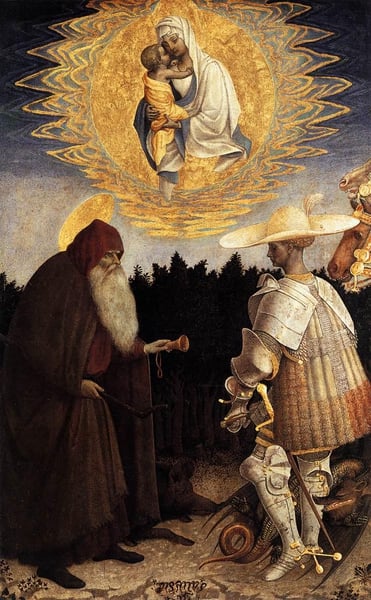
Pisanello’s Apparition of the Virgin to Sts Anthony Abbot and George stands as a pivotal work within the Early Renaissance, a period marked by the transition from the decorative elegance of International Gothic toward the naturalism and spatial rationality that would define the Renaissance. Although the artist’s full name and exact date are not provided, the painting’s style and genre—religious painting—allow us to place it at the cusp of this shift.
Significance within the Early Renaissance
-
Synthesis of Gothic Grace and Renaissance Observation
Pisanello was renowned for his meticulous attention to natural detail, especially in animal and botanical forms. In this work, the two saints—Anthony Abbot (often associated with the hermit life and animals) and George (the dragon-slayer)—are rendered with individualized features and expressive postures. The Virgin’s apparition hovers with a hieratic, otherworldly grace typical of Gothic art, yet the landscape setting and the saints’ convincingly physical presence reflect a growing interest in empirical observation. This duality makes the painting a bridge between medieval symbolism and Renaissance humanism. -
Mastery of Line and Decorative Surface
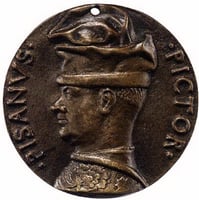
The artist’s background as a medalist and court painter is evident in the refined, calligraphic linework and the lavish use of gold leaf. The gold halos and the luminous sky create a timeless, sacred aura, while the intricate details of the saints’ garments, armor, and attributes (such as St. George’s dragon or St. Anthony’s tau cross and pig) demonstrate Pisanello’s ability to combine ornamental richness with narrative clarity. This decorative sophistication was highly prized in early 15th‑century Italian courts and contrasts with the more sober, volumetric style that would later dominate. -
Spatial Experimentation
Though not yet employing the rigorous perspective of later Renaissance masters, Pisanello arranges the figures within a shallow, stage‑like space that suggests depth through overlapping forms and a low horizon. The apparition of the Virgin, set against a gold ground or a distant landscape, floats in a separate realm—a visual convention that reinforces her divine nature while maintaining compositional balance. This handling of space reflects an early Renaissance interest in reconciling the sacred with the natural world.
Conclusion
Apparition of the Virgin to Sts Anthony Abbot and George is significant because it exemplifies the Early Renaissance’s evolving visual language: it retains the courtly elegance and spiritual symbolism of the Gothic tradition while incorporating a new attention to naturalistic detail and spatial coherence. Pisanello’s work thus serves as a crucial document of the artistic transition occurring in northern Italy, where the supernatural and the observable began to coexist on a single pictorial plane.
Museum / Gallery
Visivamente simili
20 opere con composizione e palette affini
The Three Kings Altarpiece
Hans Baldung
Jesus in front of Pontius Pilate
Jan Joest
Lateral panels of the triptych The Burning Bush
Nicolas Froment
St. Mary Salome and Zebedee with John the Evangelist and James the Great
Bernhard Strigel
Adoration of the Magi
Hans Baldung
Beheading of Saint Cosmas and Saint Damian
Fra Angelico
The Apostle St. James the Great Freeing the Magician Hermogenes
Fra Angelico
Calvary Triptych (detail)
Justus van Gent
In front of the High Priest (Grey Passion-3)
Hans Holbein the Elder
Calvary Triptych (detail)
Justus van Gent
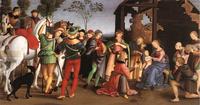
The Adoration of the Magi
Raphael
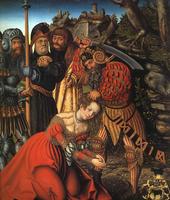
The Martyrdom of St. Barbara
Lucas Cranach the Elder
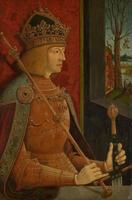
Maximilian I (1459-1519)
Bernhard Strigel
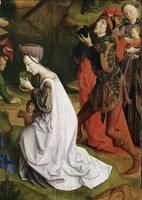
Calvary Triptych (detail)
Justus van Gent
Eucharist Altarpiece (detail)
Justus van Gent
Three king altar
Hans Baldung
Abishai Kneeling before David
Konrad Witz
The Liberation of St. Peter
Konrad Witz
Adoration of kings
Albrecht Durer
Ecce Homo (Grey Passion-6)
Hans Holbein the Elder