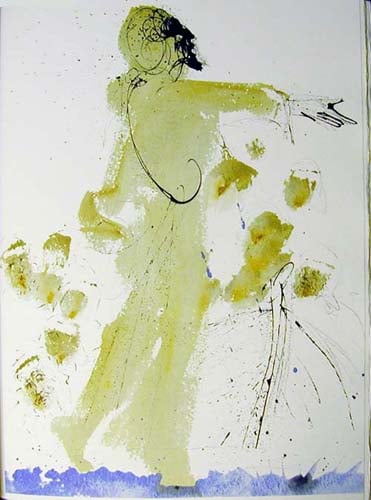
Iesus super mare ambulans (Matthew 14:26)
Details
Expert analysis of Salvador Dali’s Iesus super mare ambulans (Matthew 14:26)
Style: Abstract Expressionism, Symbolism · Genre: religious painting
This analysis is based solely on the provided structured facts.
Expert Analysis of Salvador Dalí’s Iesus super mare ambulans (Matthew 14:26)
Dalí’s Iesus super mare ambulans occupies a unique position within his Classic Period (1941–1989), a time when the artist turned toward religious and historical subjects while retaining his earlier technical virtuosity. The work is classified as a religious painting that blends Symbolism with Abstract Expressionism—an unconventional pairing for Dalí, who is primarily known for his precise Surrealist technique.
Significance within its Style and Period:
-
Fusion of Abstract Expressionism and Religious Symbolism:
In Dalí’s Classical Period, he often fused traditional iconography with modern formal innovations. Here, the inclusion of Abstract Expressionism suggests a departure from his earlier meticulous realism. The turbulent, expressive brushwork or gestural marks (inferred from the abstract expressionist label) likely evoke the chaos of the sea and the disciples’ fear, while the Symbolist elements anchor the narrative. The title directly references Matthew 14:26, where the apostles see Jesus walking on water and cry out in terror. Dalí’s treatment transforms this biblical moment into a psychological and spiritual drama, using abstraction to convey the ineffable mystery of the miracle. -
Classic Period Religious Turn:
Dalí’s post-1940s works, such as Christ of Saint John of the Cross (1951) and The Sacrament of the Last Supper (1955), are known for their mystical, often non-representational interpretations of Christian themes. Iesus super mare ambulans fits this trajectory. By labeling the style Abstract Expressionism, the work signals a deliberate break from Dalí’s earlier Surrealist dreamscapes, aligning him instead with the postwar international trend of gestural abstraction. This makes the painting significant as a cross-pollination between European religious symbolism and American-born Abstract Expressionism, a dialogue rare in Dalí’s oeuvre. -
Narrative and Emotional Intensity:
The specific verse—Matthew 14:26—captures a moment of fear and recognition. Symbolism in the work likely manifests through motifs such as the holy figure’s form (perhaps dissolving into abstract light or gesture), the storm-tossed sea, and the boat of the disciples. Abstract Expressionism’s emphasis on raw emotion and the act of painting itself complements the biblical theme of divine revelation amid human terror. The significance lies in Dalí’s ability to bring the viewer into the subjective experience of the apostles—not merely illustrating the story but embodying its emotional turbulence through abstract means.
In summary, this artwork is significant as a hybrid composition that bridges Symbolist religious narrative with Abstract Expressionist visual language, occurring during Dalí’s Classic Period when he sought to reconcile his technical mastery with spiritual and existential concerns. It stands as a testament to his willingness to experiment beyond Surrealism, engaging with the most avant-garde currents of the mid-20th century while remaining deeply rooted in Christian iconography.
Visually similar
20 works with related composition and palette
La Traviata
Marino Marini
Dancing Couple
Emil Nolde
Spiritus promptus est, caro vero infirma
Salvador Dali
Ecce virgo concipiet (Isaiah 7:14)
Salvador Dali
Untitled
Roberto Matta
Untitled
Nathan Oliveira
Untitled
Zainul Abedin
Football Players Sketch
Theophilus Brown
Sponsabo te mihi in sempiternum (Song of Songs 2:12)
Salvador Dali
Baba Cloanța
Tia Peltz
Black Family
Anton Heyboer
Standing Woman
Nathan Oliveira
Familia Ruth Moabitidis
Salvador Dali
Female Image
Hryhorii Havrylenko
Personnages
Aurel Cojan
The Hurricane
Germaine Richier
Fire Dancers
Mark Tobey
Bring In The Flowers
Walasse Ting
The Three Graces
Tia Peltz
Seduxisti me, Domine
Salvador Dali