
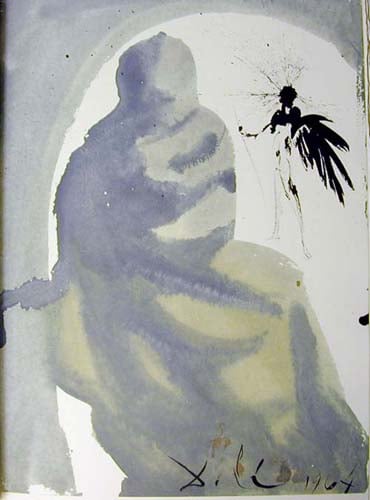
Seduxisti me, Domine
Details
Expert analysis of Salvador Dali’s Seduxisti me, Domine
Style: Abstract Expressionism, Symbolism · Genre: religious painting
Expert Art Historical Analysis
"Seduxisti me, Domine" by Salvador Dalí
Style: Abstract Expressionism, Symbolism
Genre: Religious painting
Period: Classic Period (1941–1989)
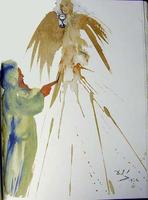
Dalí’s Seduxisti me, Domine stands as a remarkable fusion of two seemingly opposing movements—Abstract Expressionism and Symbolism—within the framework of a religious subject. This work dates from what scholars term Dalí’s Classic Period, a phase during which the artist turned toward spiritual and mystical themes, often drawing on Catholic iconography and the writings of theologians like Saint John of the Cross. The title, a Latin phrase meaning “You have seduced me, Lord,” is a direct quotation from the prophet Jeremiah (20:7), suggesting a complex relationship between divine calling and human resistance.
What makes this work significant:
-
Unprecedented stylistic synthesis: Dalí, best known for his Surrealist precision, here adopts Abstract Expressionism—a style associated with postwar American painters like Pollock and de Kooning. By channeling gestural, non‑representational mark‑making into a religious painting, Dalí expands the vocabulary of spiritual art beyond traditional figuration. The abstraction likely conveys the overwhelming, ineffable nature of divine seduction—a force that cannot be captured by literal imagery.
-
Symbolist depth: Simultaneously, Dalí employs Symbolism to layer meaning. The violent “seduction” of Jeremiah suggests a struggle between the soul and God’s will; symbolic elements (perhaps cruciform shapes, bleeding colors, or ambiguous organic forms) allude to martyrdom, surrender, and ecstasy. This dual approach allows the work to function both as an emotional outpouring and as an intellectual allegory.
-
Classic Period pivot: The period 1941–1989 marks Dalí’s turn from Surrealist shock to religious and scientific themes. This painting exemplifies his late interest in nuclear mysticism and Catholic doctrine, recasting ancient scriptural drama through a modernist lens. It challenges viewers to find the sacred in chaos—a hallmark of Dalí’s mature vision.
In essence, Seduxisti me, Domine is a bold testament to Dalí’s ability to merge personal faith, avant‑garde technique, and timeless iconography, creating a work that resonates both as a historical artifact of post‑war abstraction and as a deeply felt religious meditation.
Visually similar
20 works with related composition and palette
Ecce virgo concipiet (Isaiah 7:14)
Salvador Dali
Familia Ruth Moabitidis
Salvador Dali
Planctus David in mortem Saul
Salvador Dali
Strolling figure
Nicholas Roerich
Sedet sola civitas plena populo (Lamentations 1:1)
Salvador Dali
Noli me tangere (John 20:1)
Salvador Dali
Licet tributum dare Caesari?
Salvador Dali
Iosias sepultus in mausoleum patrum (2 Chronicles 35:24)
Salvador Dali
Spiritus promptus est, caro vero infirma
Salvador Dali
Moses with the Burning Bush
Marc Chagall
Untitled
Hryhorii Havrylenko
Moses with the Burning Bush
Marc Chagall
A mountain
Wassily Kandinsky
Iesu nativitas (Matthew 1:20)
Salvador Dali
Moses with the Burning Bush
Marc Chagall
Untitled
Nicolas Carone
Iesus super mare ambulans (Matthew 14:26)
Salvador Dali
Canita tuba in Sion (Joel 2:1)
Salvador Dali
Pietà
George Stefanescu
Oblatio munda
Salvador Dali