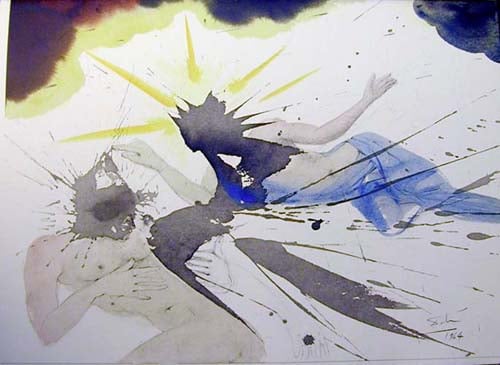
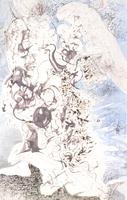
Tertia die resurrexit
Dettagli
Analisi esperta di Tertia die resurrexit di Salvador Dali
Stile: Abstract Expressionism, Symbolism · Genere: religious painting
Expert Analysis: "Tertia die resurrexit" by Salvador Dalí
This work is a remarkable synthesis of two seemingly disparate movements—Abstract Expressionism and Symbolism—applied to a traditional religious subject. Painted during Dalí’s Classic Period (1941–1989), a time when the artist increasingly turned to spiritual and historical themes, Tertia die resurrexit (Latin for “On the third day He rose again”) stands as a testament to Dalí’s ability to fuse formal innovation with deep symbolic meaning.
Significance within its Style and Period
-
Abstract Expressionist vocabulary applied to sacred narrative: Unlike Dalí’s earlier Surrealist precision, this painting employs gestural brushwork, spontaneous color fields, and non-representational forms—hallmarks of Abstract Expressionism. Yet the title anchors the work firmly in Christian theology, creating a tension between chaotic abstraction and doctrinal order. This choice forces the viewer to experience the Resurrection not as a literal scene but as an emotional and spiritual event, where the act of rising becomes a visceral, explosive gesture.
-
Symbolist iconography in a modernist guise: The Symbolist layer operates through recognizable motifs—a cruciform composition, a burst of light at the apex, and a suggestion of three distinct vertical forms (possibly referencing the three days in the tomb). Dalí distills the Resurrection to its essential symbolic elements: death, transformation, and transcendence. The abstract handling prevents these symbols from becoming mere illustrations, instead charging them with the ineffable quality of mystery.
-
Defining the Classic Period’s religious turn: Dalí’s Classic Period marks his retreat from overt Surrealist provocation toward a more contemplative, even Catholic-inspired spirituality. Tertia die resurrexit exemplifies this shift: it is a work of profound faith expressed through contemporary artistic language. By merging Abstract Expressionism’s emotional immediacy with Symbolism’s layered meanings, Dalí created a religious painting that feels both ancient and radically modern—a bridge between the spiritual crises of the 20th century and the enduring power of sacred narrative.
In short, the work’s significance lies in its bold reinterpretation of a core Christian mystery through the dual lenses of mid-century abstraction and timeless symbolism, establishing Dalí as a singular voice in religious modernism.
Visivamente simili
20 opere con composizione e palette affini
In principiodeus creavit...
Salvador Dali
Mane, thecel, phares
Salvador Dali
Noe qui primus plantavit vineam… (Genesis 9:20f)
Salvador Dali
Uxnor Lot in satuam salis conversa (Genesis 19:24)
Salvador Dali
Mulier e latere viri
Salvador Dali
Iesus a Satana tentatur (Mark 1:13)
Salvador Dali
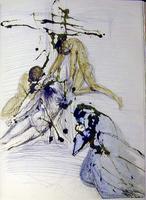
De cruce depositio
Salvador Dali
Two Women
Otto Muehl
Nude 1
Reuben Nakian
Pietà
George Stefanescu
Cadaver in seoulchro Elisei (2 Kings 13:21)
Salvador Dali
Untitled
Auguste Rodin
Proelium magnum in caelo
Salvador Dali
Spiritus promptus est, caro vero infirma
Salvador Dali
Woman
Otto Muehl
Witches Spitting Fire
Joseph Beuys
Song of Songs II
Marc Chagall
Ipse erat Elias (Mark 1:4)
Salvador Dali
Angel
Salvador Dali
Abraham, Abraham! (Genesis 22:2)
Salvador Dali