Analisi esperta di Cos Cob di John Henry Twachtman
Stile: Impressionism · Genere: landscape
Expert Analysis of Cos Cob by John Henry Twachtman
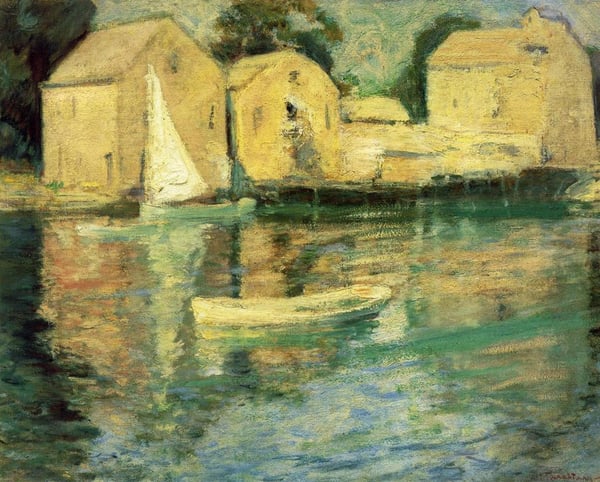
John Henry Twachtman’s Cos Cob stands as a quiet yet pivotal work within American Impressionism, distinguished by its intimate, atmospheric approach to landscape. While many American Impressionists aimed for bright, sun-drenched scenes akin to their French counterparts, Twachtman cultivated a more subdued, personal lyricism—one that finds its purest expression in this painting of the Cos Cob art colony in Greenwich, Connecticut.
Composition and Technique
Twachtman employs a restrained palette dominated by soft grays, silvery blues, and muted greens, key hallmarks of his mature style. The brushwork is loose and fluid, yet deliberate: dabs and short strokes suggest the shimmer of light on water and the delicate rustle of foliage, without descending into mere description. The scene—likely a view of the Mianus River or a nearby inlet—is framed with a crop that emphasizes flatness and horizontal expanse, a device Twachtman used to evoke stillness and a sense of passing time. There is no dramatic focal point; instead, the viewer’s eye drifts across the canvas, absorbing the subtle interplay of reflected light and atmosphere.
Significance within Twachtman’s Oeuvre and American Impressionism
Cos Cob exemplifies Twachtman’s departure from the bravura brushwork of his earlier Barbizon-influenced paintings. Here, he aligns with the Tonalist strain in American art, prioritizing mood over narrative. The painting is also a document of a crucial moment in American art history: Cos Cob was a summer haven for artists like Childe Hassam, J. Alden Weir, and Twachtman himself, who collectively helped define a distinctly American branch of Impressionism. Twachtman, however, was the most introspective of the group, and Cos Cob captures that introspective quality—a landscape not just seen, but felt.
What Makes It Stand Out
Unlike the more overtly decorative or sunlit works of his peers, Cos Cob proposes that Impressionism can be meditative and melancholic. The painting’s limited tonal range and soft edges create a sense of enveloping atmosphere, almost veiled in quiet mist. This is not a celebration of leisure or modernity, but a contemplation of nature’s transience. Twachtman’s ability to suffuse a simple riverbank with poignant stillness sets Cos Cob apart as a significant contribution to the evolution of American landscape painting—one that bridges the gap between Tonalism and Impressionism, and affirms Twachtman’s reputation as one of the most sensitive, original talents of his generation.
Museum / Gallery
Visivamente simili
20 opere con composizione e palette affini
The Old Mill at Cos Cobb
John Henry Twachtman
Rockport, Boats in a Harbor
Robert Spencer
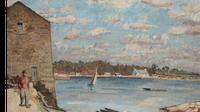
Moulin À Marée
Maurice Bompard
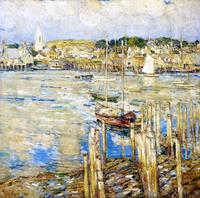
Gloucester
Childe Hassam
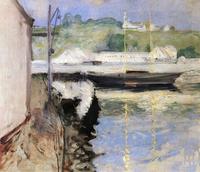
Fish Sheds and Schooner, Gloucester
John Henry Twachtman
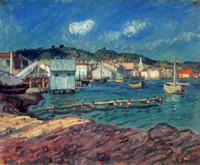
The Port of Martigues
Raoul Dufy
Ships at Port
Gustave Loiseau
Harbor in Hel
Roman Selsky
Landscape
John Henry Twachtman
Fish Sheds and Schooner, Gloucester
William Merritt Chase
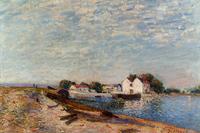
Saint Mammes Dam
Alfred Sisley
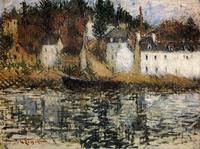
The Quay at Pont Aven
Gustave Loiseau
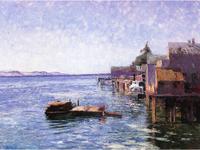
Brookville
T. C. Steele
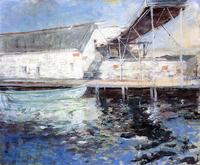
Fish Sheds, Gloucester, Massachusetts
John Henry Twachtman
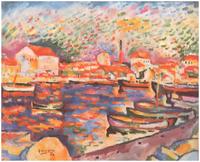
La Ciotat Harbor
Georges Braque
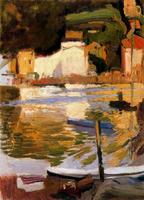
Excerpts
Joaquín Sorolla
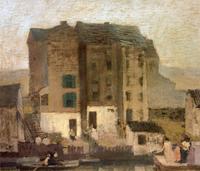
Misty Evening
Robert Spencer
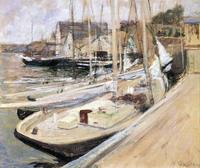
Fishing Boats at Gloucester
John Henry Twachtman
French Landscape
C. R. W. Nevinson
Boats at rest, at Petit-Gennevilliers
Claude Monet