Expert analysis of Claude Lorrain’s Landscape with Apollo and Mercury
Style: Classicism · Genre: mythological painting
Expert Analysis: "Landscape with Apollo and Mercury" by Claude Lorrain
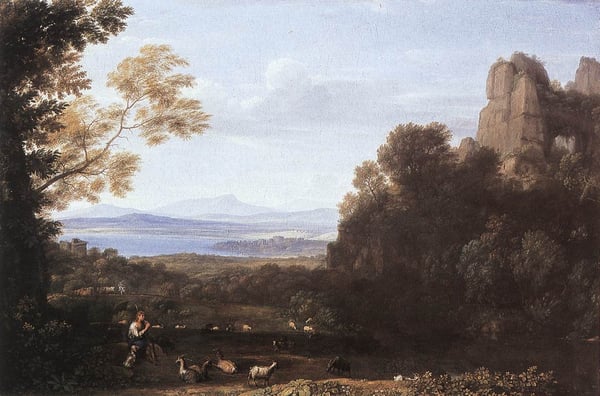
Claude Lorrain’s Landscape with Apollo and Mercury (c. 1645) is a quintessential example of Classicism in seventeenth-century painting, representing the harmonious union of idealized nature with mythological narrative. The work is significant for several reasons that define both Lorrain’s legacy and the broader classical landscape tradition.
1. Mastery of the Classical Landscape Ideal
Lorrain was a pioneer of the paysage idéal—a balanced, orderly vision of nature inspired by the landscapes of the Roman Campagna and the theoretical principles of Renaissance classicism. In this painting, the composition is carefully structured: a framing foreground of dark trees and ruins leads the eye through a middle ground of sunlit meadows and a river, toward a distant, hazy horizon. This progression from shadow to light creates a sense of depth and serenity, echoing the classical virtues of clarity, proportion, and concinnitas (harmonious arrangement). The inclusion of ancient ruins (a temple-like structure on the left) underscores the work’s dialogue with antiquity, a core tenet of Classicism.
2. Mythological Narrative Integrated with Landscape
While the title references Apollo (god of music, light, and prophecy) and Mercury (messenger god), Lorrain subordinates these figures to the landscape itself. The two gods appear small in the left foreground, engaged in what is often interpreted as a pastoral exchange or a symbolic interaction—Apollo with his lyre, Mercury with his caduceus. This diminishes the traditional heroic scale of mythological painting, instead making the figures an integral, almost incidental, part of the natural world. This approach was revolutionary: it shifted the genre of mythological painting from a focus on dramatic action to a meditation on the harmony between humanity and nature, a key theme in Claude’s oeuvre.
3. Luminary Atmosphere and Poetic Tone
Lorrain’s handling of light is central to his significance. Here, the golden, diffused sunlight—especially the glowing sky at dawn or dusk—permeates the entire scene, softening edges and unifying the composition. This technique, which he refined through direct observation of nature and endless sketches (plein air studies), creates an almost pastoral, nostalgic atmosphere. The light not only models forms but also imbues the landscape with a metaphysical, “Arcadian” quality. This poetic, luminous treatment influenced generations of artists, from the British landscape painters (Turner, Constable) to the French Impressionists.
4. Significance within Classicism
Unlike the more rigid, didactic Classicism of Nicolas Poussin (his contemporary), Lorrain’s Classicism is lyrical and atmospheric, not purely intellectual. He balances the formal order of balanced diagonals, repoussoir elements, and planes of recession with a palpable sense of natural magic. Landscape with Apollo and Mercury exemplifies this: it is both a controlled, rational composition and a window into a timeless, idyllic world where myth feels plausible within a real, sun-drenched landscape. This fusion made Lorrain the definitive master of the classical landscape, an archetype that shaped European landscape painting for two centuries.
Conclusion
The artwork’s significance lies in its perfect synthesis of mythological painting and lassical landscape, where the gods are not the story but the guests in a larger hymn to nature’s eternal harmony. Lorrain’s ability to infuse a structured, classical scene with intimate, luminous beauty—as seen in the delicate interplay of Apollo and Mercury against a boundless horizon—marks this work as a cornerstone of the Classical tradition and a testament to the enduring power of idealized landscape.
Visually similar
20 works with related composition and palette
Landscape
Paul Bril
Villagers Dancing
Claude Lorrain
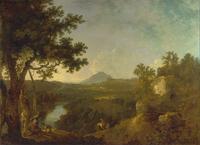
View near Wynnstay, the Seat of Sir Watkin Williams-Wynn, BT.
Richard Wilson
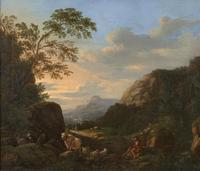
Berger et son troupeau dans un paysage de montagne
Johann Heinrich Roos
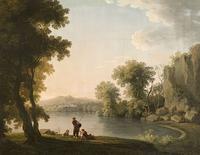
Groupe de pêcheurs au bord d'un lac
Michael Wutky
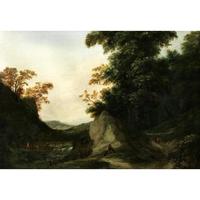
FELSIGE WALDLANDSCHAFT MIT WASSERSTURZ UND ARCHITEKTUR
Adriaen Frans Boudewyns
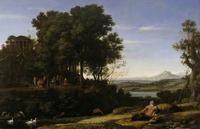
Landscape with Apollo and the Muses
Claude Lorrain
The White Monk
Richard Wilson
Italian Landscape with Roman Warriors
Jan Dirksz Both
A ROCKY RIVER LANDSCAPE WITH THREE FIGURES CONVERSING IN THE FOREGROUND
Christian Wilhelm Ernst Dietrich
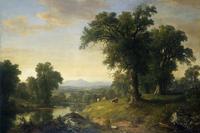
A Pastoral Scene
Asher Brown Durand
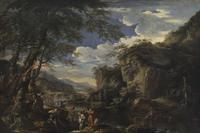
Saint John the Baptist Baptizing Christ in the Jordan
Salvator Rosa
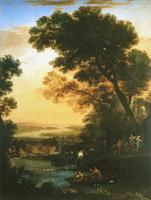
Landscape with Flight into Egypt
Claude Lorrain
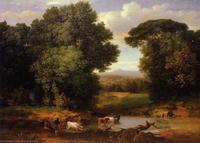
A Bit Of Roman Aqueduct
George Inness
Landscape with Cephalus and Procris Reunited by Diana
Claude Lorrain
Landscape with Paris and Oenone
Claude Lorrain
Hagar and the Angel
Nicolas Poussin
A Lake Scene
George Philip Reinagle
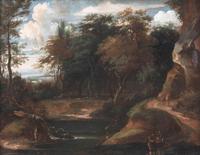
Wooded landscape with a river valley, rocks, hunters and travellers
Jacques d'Arthois
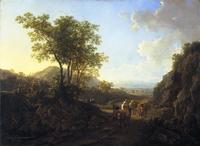
Italian Landscape
Jan Dirksz Both