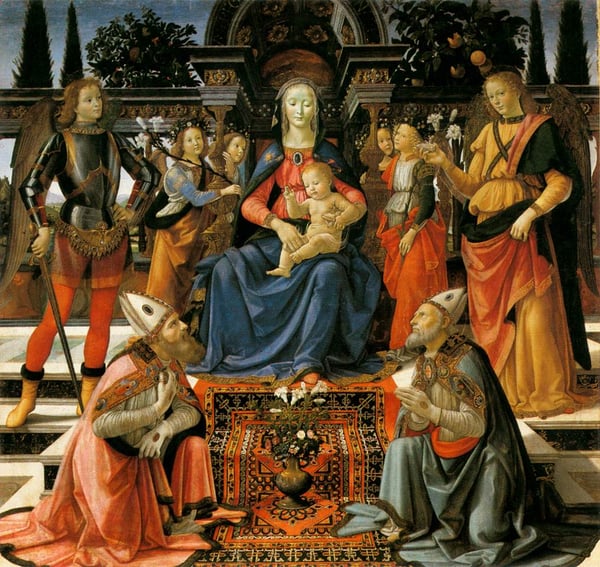
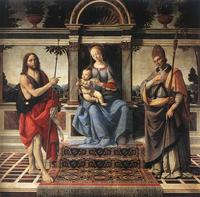
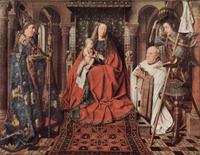
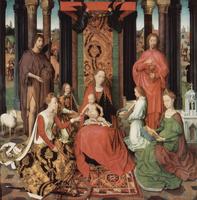
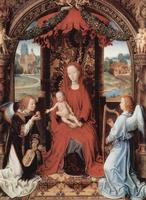
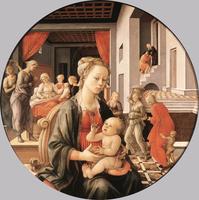
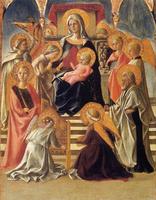
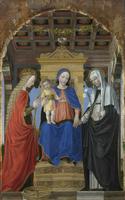
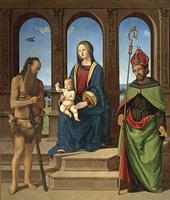
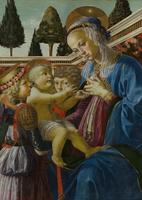
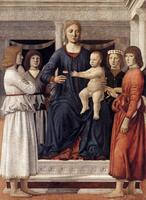
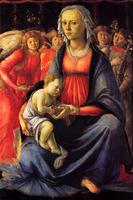
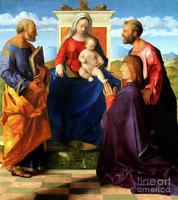
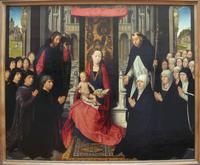
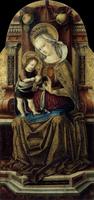
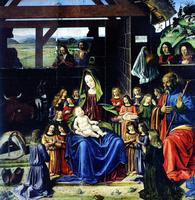
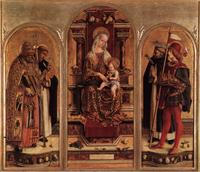
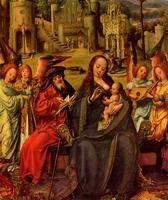
This altarpiece by Domenico Ghirlandaio exemplifies the transition from late Gothic to Early Renaissance religious painting, with a focus on naturalism, spatial clarity, and devotional narrative.
Significance within Early Renaissance religious painting:
-
Composition and spatial depth: The enthroned Madonna and Child are centrally placed, surrounded by a balanced arrangement of angels and saints. Ghirlandaio employs a clear perspectival structure, creating a believable architectural space that draws the viewer into the sacred scene. This reflects the Early Renaissance interest in rational, mathematical order.
-
Humanized figures: The Madonna and Child are rendered with naturalistic proportions and gentle, lifelike expressions, moving away from the flat, hieratic style of the medieval period. The angels and saints display individualized features and calm, dignified poses, typical of Ghirlandaio’s attention to detail and his skill in portraiture.
-
Local Florentine significance: The inclusion of St. Zenobius (first bishop of Florence) and St. Giusto (a local martyr) ties the work directly to Florentine civic and religious identity, while the archangels Michael and Raphael underscore the theme of divine protection. This combination of universal and local saints was common in altarpieces of the period, reinforcing the link between the church, the city, and the faithful.
-
Technical mastery: Ghirlandaio’s precise handling of drapery, gold highlights, and the subtle modulation of light and shadow demonstrate his training in the Florentine workshop tradition. The rich, luminous colors and the intricate details of the angels’ wings and the saints’ attributes showcase the artist’s reputation for refined craftsmanship, a hallmark of Early Renaissance panel painting.
In summary, this work is significant for its balanced composition, naturalistic treatment of sacred figures, and its integration of local Florentine saints, all of which exemplify the Early Renaissance ideal of blending religious devotion with humanistic clarity.