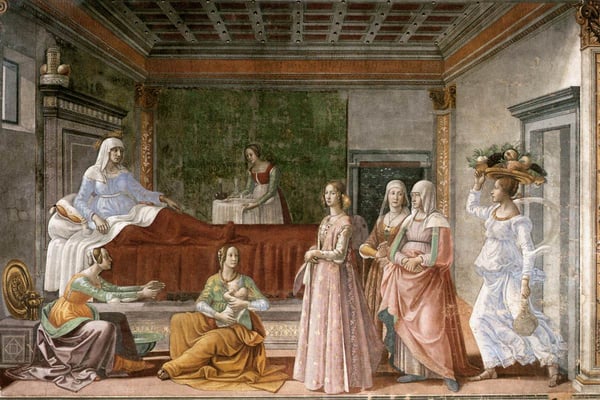
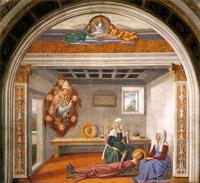
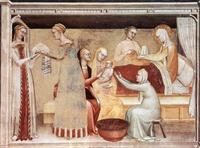
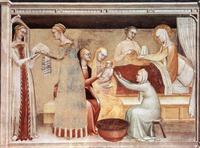
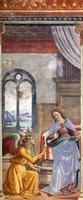
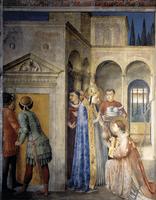
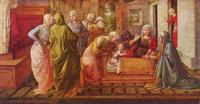
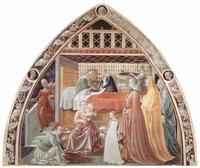
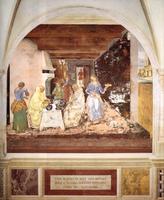
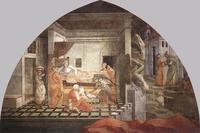
As an Early Renaissance religious painting, Domenico Ghirlandaio’s The Birth of St. John the Baptist is significant for its decisive break with medieval iconographic traditions, embracing instead a naturalistic, human-centered narrative that typifies the period’s core innovations. The work exemplifies the Early Renaissance ambition to ground sacred stories in believable, contemporary settings—here, a domestic interior rendered with meticulous attention to perspective, spatial depth, and everyday objects. This fusion of the divine with the quotidian was a hallmark of Ghirlandaio’s style and of Florentine art in the late 15th century: the holy event becomes an intimate genre scene, allowing viewers to connect with the biblical figure through a familiar, domestic lens. The painting’s significance also lies in its demonstration of emerging artistic principles such as linear perspective, chiaroscuro, and careful observation of natural light, all of which served to humanize the religious subject while elevating the technical sophistication of devotional art. Within the broader context of the Early Renaissance, Ghirlandaio’s work stands as a masterful synthesis of sacred narrative and secular realism, influencing subsequent generations—most notably his young apprentice, Michelangelo—by proving that religious painting could be both profoundly spiritual and vividly, convincingly real.