Analisi esperta di Knight, Death and girl di Hans Baldung
Stile: Northern Renaissance · Genere: allegorical painting
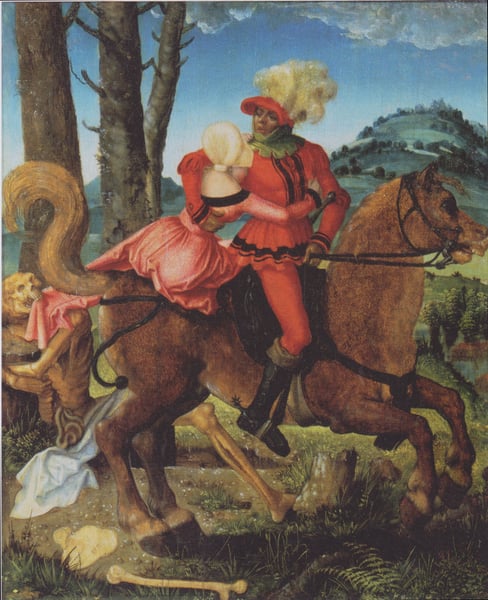
“Knight, Death, and the Girl” (ca. 1510–1520) by Hans Baldung Grien stands as a striking exemplar of Northern Renaissance allegorical painting, merging meticulous naturalistic detail with a profound, often unsettling, moral message. The work is significant for its bold synthesis of two central concerns of the period: the humanist fascination with classical and chivalric ideals, and the deeply rooted Germanic tradition of the Danse Macabre (Dance of Death) and Memento Mori (reminder of mortality).
Stylistic and Compositional Significance
Baldung, a gifted pupil of Albrecht Dürer, inherits his master’s precision in rendering textures and anatomy, yet pushes the Northern Renaissance style toward a more deliberately expressive and sensual direction. In this painting, the knight—armored, resolute, and emblematic of earthly duty—is contrasted with two allegorical figures: a grotesque, skeletal Death, who points an hourglass toward the knight, and a nude young woman, whose flowing hair and soft flesh represent transient beauty and desire. The composition is tightly cropped, almost claustrophobic, forcing the viewer into an intimate confrontation with the allegory.
Allegorical Innovation and Period Context
What makes this work especially significant within the Northern Renaissance is its integration of eroticism with mortality. Unlike earlier, more didactic Danse Macabre scenes (where Death seizes victims of all stations), Baldung introduces a charged, psychological tension. The girl—often interpreted as either a temptress or a symbol of fleeting life—clings to the knight, while Death pulls time away. This triad reflects the period’s increasing anxiety about human frailty, a theme that pervades German art in the wake of the Reformation and the Black Death.
Baldung’s use of the knight is also telling: while the chivalric ideal was still potent in early 16th-century Europe, the painting subverts it. The knight’s armor cannot shield him from mortality, and his gaze is not toward salvation but toward the girl—suggesting the folly of worldly attachment. This aligns with the Northern Renaissance’s tendency to use allegory not for abstract moralizing, but for a raw, personal, and often melancholic examination of human nature.
Technical and Symbolic Mastery
Baldung’s handling of light and color further underscores the theme. The girl’s pale skin glows against the dark, forested background, while Death’s yellowed bones and the knight’s cold steel create a stark tonal contrast. The hourglass—a common vanitas symbol—is rendered with careful realism, reminding viewers that time is a constant, impartial force.
Conclusion
“Knight, Death, and the Girl” is significant because it encapsulates the Northern Renaissance’s unique blend of realism, allegory, and psychological depth. Rather than presenting a simple moral lesson, Baldung invites the viewer to dwell on the tension between desire and decay, valour and vanity. It is a work that both celebrates the Northern Renaissance’s technical achievements and articulates its most profound existential concerns—making it a landmark of allegorical painting in the age of Dürer and beyond.
Museum / Gallery
Visivamente simili
20 opere con composizione e palette affini
Heller Altarpiece (detail)
Matthias Grünewald
St. George Killing the Dragon
Vittore Carpaccio
Procession of the Magus Caspar (detail)
Benozzo Gozzoli
Saint George and the Dragon
Luca Signorelli
Portrait Of Giuliano De Medici. Procession of the Magus Caspar (detail)
Benozzo Gozzoli
Allegory of March – Triumph of Minerva and Sign of Aries. Frescos in Palazzo Schifanoia (detail)
Francesco del Cossa
The Adoration of the Magi
Raphael
Triptych of the Mystical Marriage of St. Catherine of Alexandria, left wing: The Beheading of John the Baptist
Hans Memling
Procession of the Magus Caspar (detail)
Benozzo Gozzoli
The Ghent Altar (detail)
Jan van Eyck
Calvary Triptych (detail)
Justus van Gent
Procession of the Magus Caspar (Portrait Of Giuliano De Medici, detail)
Benozzo Gozzoli
Procession of the Oldest King
Benozzo Gozzoli
The Adoration of the Magi
Domenico Veneziano
St. George and the Dragon
Raphael
Conversion of St. Paul
Pieter Bruegel the Elder
Beheading of St. Catherine
Albrecht Altdorfer
Martyrdom of St. Hippolytus - the central panel from St. Hippolytus Triptych
Dirk Bouts
Haywain (detail)
Hieronymus Bosch
The Martyrdom of St. Catherine
Jan Provoost