Expert Analysis: "St. George Killing the Dragon" by Vittore Carpaccio
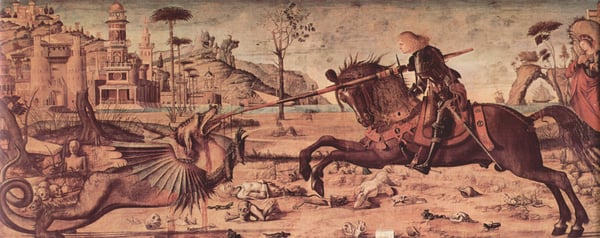
As a work of the High Renaissance, Carpaccio’s St. George Killing the Dragon exemplifies the era’s quest for harmony, naturalism, and narrative clarity—yet it stands apart through its distinctly Venetian sensibility. The painting transforms a traditional religious subject into a richly observed, almost theatrical scene, blending miracle with palpable everyday detail.
Significance within the High Renaissance and Religious Painting:
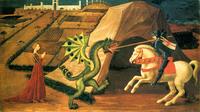
Carpaccio was a master of istoria (storytelling), and this piece demonstrates his ability to infuse a sacred legend with the tangible world of 16th-century Venice. Unlike the idealized, centrally composed figures of Florentine High Renaissance masters, Carpaccio places St. George in a sweeping, atmospheric landscape that mirrors the lagoons and terra firma of the Veneto. The dragon itself is not a symbolic grotesque but a vividly naturalistic, scaly beast—grounding the supernatural in physical reality. This approach makes the spiritual triumph feel both immediate and believable.
The composition is also significant for its deft use of perspective and light. The diagonal thrust of St. George’s lance leads the eye across the canvas, while the soft, golden light—a hallmark of Venetian painting—unifies the scene. The inclusion of the princess in quiet prayer, separated by a jagged chasm, heightens the drama and underscores the painting’s moral: faith and courage overcoming evil.
In essence, Carpaccio’s St. George is a masterpiece of High Renaissance narrative. It fuses the era’s core values—humanism, perspective, and naturalistic detail—with the Venetian love for color, texture, and storytelling. The work remains significant as a prime example of how northern Italian painters reimagined religious iconography as a living, breathing encounter between the divine and the everyday.