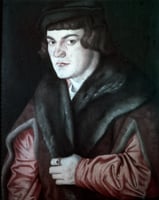
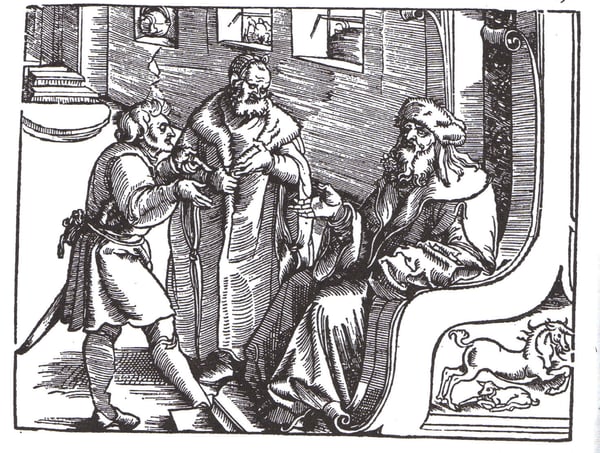
Expertenanalyse zu Hans Baldungs Marquard von Lindau ask and answer the Ten Commandments
Stil: Northern Renaissance · Genre: genre painting
This analysis is based exclusively on the provided structured facts: artwork title, artist, style, and genre.
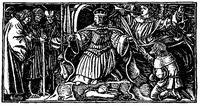
Expert Art Historical Analysis: "Marquard von Lindau ask and answer the Ten Commandments" by Hans Baldung
Hans Baldung (also known as Hans Baldung Grien), a master of the Northern Renaissance, here presents a work that is both didactic and distinctly of its period: a genre painting that transforms theological instruction into a vivid, everyday scene. The title explicitly names the 14th-century Franciscan theologian Marquard von Lindau, a figure known for popularizing religious knowledge for lay audiences. By depicting a historical holy man engaged in the act of "asking and answering" the Ten Commandments, Baldung aligns the painting with the Northern Renaissance’s deep concern for accessible piety, moral clarity, and the integration of the sacred into domestic or communal life.
Significance within the Northern Renaissance Style and Genre:
-
Blurring of Sacred and Secular: As a genre painting, this work elevates a seemingly ordinary act—a conversation or catechism—to a subject worthy of serious art. This is a hallmark of Northern Renaissance innovation, where painters like Baldung, Albrecht Dürer (his teacher), and Jan van Eyck rooted spiritual messages in recognizable, tactile human experiences. Here, the very structure of the Ten Commandments is framed as a dialogue, emphasizing practical understanding over abstract doctrine.
-
Intellectual and Emotional Realism: Baldung is renowned for his intense, often unsettling emotional expressiveness (as seen in his famous "The Bewitched Groom" or "The Fall of Man"). In this religious instructional scene, we can infer that his treatment would bring psychological immediacy to the exchange: Marquard von Lindau is not merely a distant saint but a teacher engaged in a real-time, probing inquiry. The act of "asking and answer" suggests a dynamic, even Socratic, method—bold for an era when religious instruction could be strictly top-down. This mirrors the Northern Renaissance interest in the interior life and the individual's relationship with divine law.
-
Moral and Catechetical Purpose: The theme directly recalls the late medieval and Renaissance emphasis on the Decalogue as a guide for lay conduct, central to movements like the Devotio Moderna. Baldung, working in Strasbourg and Freiburg, would have been immersed in this devotional culture. The painting functions as a visual sermon, making the commandments not a list but a lived ethical practice. Its significance lies in how it uses the conventions of genre (domestic setting, direct interaction) to make theology feel immediate and personal.
-
Stylistic Tension: Baldung’s Northern Renaissance style is characterized by sinuous lines, sharp colors, and a love for grotesque or exaggerated details. Even in a subject as sober as the Ten Commandments, we can anticipate a tension between the orderly, instructive content and Baldung’s characteristically energetic, almost gothic flourishes—perhaps visible in the gestures, drapery, or the expressive faces of the figures. This interplay between formality (the commandments) and vitality (the human drama) is a key reason Baldung’s work remains so arresting.
Conclusion: "Marquard von Lindau ask and answer the Ten Commandments" is significant because it exemplifies the Northern Renaissance’s distinctive merger of religious instruction with the vernacular of everyday life. Hans Baldung, never content with simple illustration, likely imbued this genre scene with psychological depth and morphological intensity. The work stands as a testament to the period’s belief that grace and moral law could be debated, taught, and visually experienced in the real, messy, and human world.
Visuell ähnlich
20 Werke mit ähnlicher Komposition und Farbpalette
Pilate Washing His Hands
Albrecht Durer
Christ before Herod
Albrecht Durer
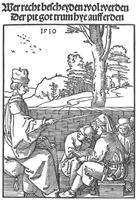
Schoolmaster
Albrecht Durer
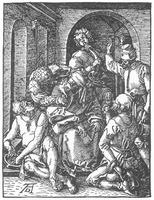
The Mocking of Christ
Albrecht Durer
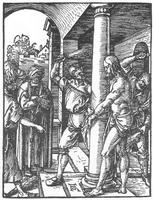
The Flagellation
Albrecht Durer
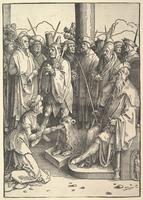
The Mouth of Truth
Lucas van Leyden
Christ before Pilate
Albrecht Durer
The Meeting of Joachim and Anne at the Golden Gate
Albrecht Durer
The Hermits St Anthony and St Paul
Albrecht Durer
Christ Being Crowned with Thorns
Albrecht Durer
The Presentation of the Virgin in the Temple
Albrecht Durer
Christ before Annas
Albrecht Durer
Leaena Before the Judges
Hans Holbein the Younger
Salome with the Head of John the Baptist
Lucas van Leyden
Virgil in The Basket
Lucas van Leyden
The Virgin Worshipped by Angels and Saints
Albrecht Durer
The King at the Gate
Frederick Sandys
Christ on the Mount of Olives
Albrecht Durer
Otto of the Silver Hand 40
Howard Pyle
Christ among the Doctors in the Temple
Albrecht Durer