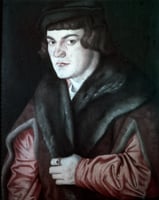
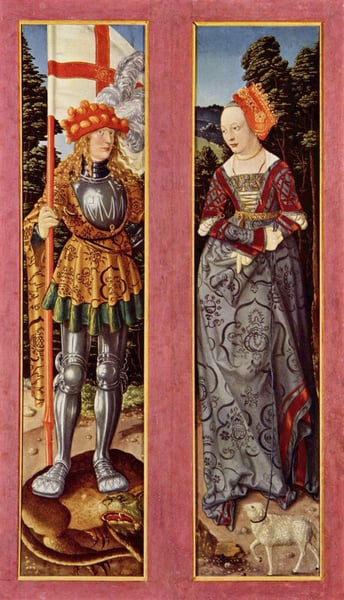
Hans Baldung sanatçısının Three king altar eseri hakkında uzman analizi
Tarz: Northern Renaissance · Tür: religious painting
Expert Analysis: "Three King Altar" by Hans Baldung (Northern Renaissance)
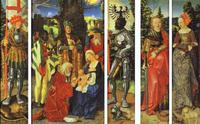
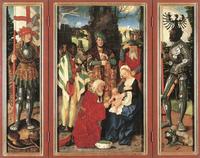
Hans Baldung Grien’s Three King Altar (also known as the Epiphany Altarpiece, ca. 1510–1511) stands as a masterful example of the Northern Renaissance’s blend of meticulous naturalism and heightened emotional expression. While the subject—the Adoration of the Magi—is a standard religious trope, Baldung infuses it with a distinctive energy and psychological intensity that sets his work apart from his contemporaries, including his teacher Albrecht Dürer.
Significance within the Northern Renaissance
-
Expressive Stylization over Pure Realism: Unlike the cooler, mathematically balanced compositions of Dürer, Baldung introduces a dynamic, almost restless quality. The figures in this altarpiece are characterized by dramatic gestures, exaggerated drapery folds, and vivid, often acidic color contrasts (e.g., deep greens against crimson and gold). This tendency toward expressive distortion foreshadows the Mannerist tendencies that would emerge later in the 16th century.
-
Innovative Use of Light and Shadow: Baldung employs a sharp, sometimes unnatural chiaroscuro that isolates the holy family and the Magi against a dark, wooded background. The light source—typically emanating from the Christ child—casts long, dramatic shadows that heighten the sense of divine revelation. This technique owes debt to the Danube School’s love of atmospheric landscapes, yet Baldung pushes it into a more theatrical, almost supernatural realm.
-
Narrative and Symbolic Depth: The altar likely includes a highly detailed landscape glimpsed through architectural ruins or a window—a common Northern Renaissance device linking sacred history to the contemporary world. Baldung also embeds subtle symbolic details: the eldest king’s ornate gift vessel may allude to the Eucharistic chalice, while the exotic fabrics and turbans reflect the period’s fascination with the “Orient.” Yet beyond iconography, Baldung emphasizes the humanity of the moment—the Virgin’s slightly protective posture, the child’s reaching hand, and the Magi’s palpable awe.
-
Baldung’s Unique Artistic Identity: As a student of Dürer, Baldung absorbed his master’s precision but deliberately broke away toward a more personal, even unsettling style. The Three King Altar reveals his fascination with the macabre and the sensual—hints of which appear in the wrinkled, almost grotesque features of the eldest king and the lush, rolling folds of fabric that mimic organic growth. This tension between the sacred and the raw, earthly self-awareness makes Baldung a transitional figure between the High Renaissance and the more turbulent art of the Reformation era.
In sum, the Three King Altar is significant not merely as a religious commission but as a bold statement of Northern Renaissance individualism. Baldung’s synthesis of Dürer’s craftsmanship with a more expressive, emotionally charged visual language marks a pivotal moment in German art—one that anticipates the unrest and subjectivity that would define the next generation.
Görsel olarak benzer
İlişkili kompozisyon ve renk paletine sahip 20 eser
The Three Kings Altarpiece
Hans Baldung
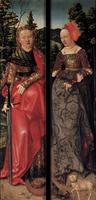
Three Kings Altarpiece (closed)
Hans Baldung
Maximilian I (1459-1519)
Bernhard Strigel
The Reliquary of St. Ursula
Hans Memling
The Adoration of the Magi
Jean Fouquet
The Flight into Egypt
Limbourg brothers
Tribute of Edward III to Philip
Jean Fouquet
Procession of the Magus Caspar (detail)
Benozzo Gozzoli
Calvary Triptych (detail)
Justus van Gent
Procession of the Magus Balthazar (detail)
Benozzo Gozzoli
Adoration Of The Magi
Hans Baldung
Triptych of the Mystical Marriage of St. Catherine of Alexandria, left wing: The Beheading of John the Baptist
Hans Memling
Game of Civettino (detail)
Lo Scheggia
Emperor Maximilian I (1459-1519)
Bernhard Strigel
St. Augustine Departing for Milan (detail)
Benozzo Gozzoli
St. John Altarpiece left wing
Hans Memling
Portrait of a Knight
Vittore Carpaccio
April. Fresco in Palazzo Schifanoia (detail) - Triumph of Venus
Francesco del Cossa
Prayer Book of Cardinal Albrecht of Brandenburg: The Arrest of Christ
Simon Bening
Coronation of Lothair
Jean Fouquet