Expertenanalyse zu Bernhard Strigels Maximilian I (1459-1519)
Stil: Northern Renaissance · Genre: portrait
Expert Analysis of Maximilian I (1459-1519) by Bernhard Strigel
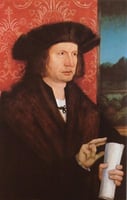
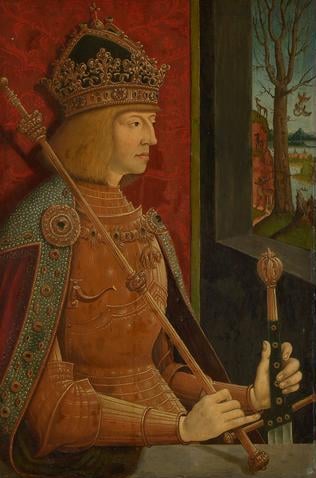
As a Northern Renaissance portrait, Bernhard Strigel’s depiction of Holy Roman Emperor Maximilian I stands as a masterful example of how the period fused meticulous realism with symbolic authority. The painting’s significance lies in three key areas: its role as a tool of imperial propaganda, its demonstration of Northern Renaissance technical precision, and its intimate insight into one of the era’s most influential rulers.
Historical & Political Significance
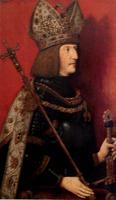
Maximilian I (1459–1519) was a pivotal figure—often called the “last knight”—who modernized the Habsburg empire through marriage alliances, military reform, and patronage of the arts. Strigel, as the emperor’s court painter, created this portrait not merely as a likeness but as a calculated image of dynastic power. The sitter’s direct gaze, princely attire, and the inclusion of imperial regalia (such as the collar of the Order of the Golden Fleece) reinforce Maximilian’s role as a divinely sanctioned sovereign. In an age before mass media, such portraits were crucial for projecting authority across a vast territory.
Northern Renaissance Stylistic Elements
True to the Northern Renaissance tradition, Strigel employs painstaking detail: the texture of velvet, the glint of gold brocade, the subtle modeling of the face through light and shadow. The emperor’s fur-lined cloak and elaborate hat are rendered with almost microscopic precision, a hallmark of the period’s fascination with material reality. Yet Strigel also balances this naturalism with a certain idealism—Maximilian’s features are less harshly aged than in other contemporary portrayals, suggesting a deliberate softening to emphasize wisdom and gravitas rather than the toll of decades of war.
Artistic & Symbolic Significance
Beyond mere documentation, the composition conveys psychological depth. Maximilian’s slight, knowing smile and his calm, steady gaze suggest a ruler both contemplative and resolute. Strigel’s use of a dark, neutral background focuses all attention on the sitter, a technique that would become standard in later Northern European portraiture. The inclusion of a letter or tablet in the emperor’s hand (a common motif) hints at his renowned literacy and patronage of humanist learning, aligning him with the intellectual currents of his time.
Conclusion
Bernhard Strigel’s Maximilian I is not just a portrait but a strategic political document and a triumph of Northern Renaissance craftsmanship. It captures the intersection of individual character and imperial identity, making it a key work for understanding both the artist’s oeuvre and the visual culture of early 16th-century Europe. Its enduring power lies in how it transforms a historical figure into an eternal symbol of majesty, rendered with the exquisite detail that defines the era’s greatest achievements.
Museum / Gallery
Visuell ähnlich
20 Werke mit ähnlicher Komposition und Farbpalette
Emperor Maximilian I (1459-1519)
Bernhard Strigel
Emperor Maximilian I (1459-1519)
Bernhard Strigel
Three king altar
Hans Baldung
Abishai Kneeling before David
Konrad Witz
Portrait of Emperor Maximilian and His Family
Bernhard Strigel
Saint George
Carlo Crivelli
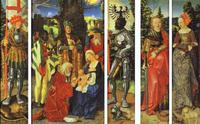
The Three Kings Altarpiece
Hans Baldung
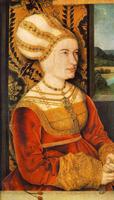
Portrait of Sibylla (or Sybilla) von Freyberg (born Gossenbrot)
Bernhard Strigel
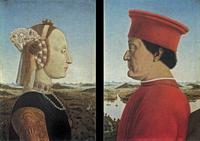
Portraits Federico da Montefeltro and Battista Sforza
Piero della Francesca
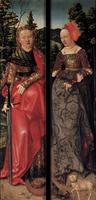
Three Kings Altarpiece (closed)
Hans Baldung
Portrait of Maximilian I (1459-1519)
Bernhard Strigel
Donor with St. Nicholas and his Wife with St. Godelina
Jan Provoost
St. Mary Salome and Zebedee with John the Evangelist and James the Great
Bernhard Strigel
The Annunciation
Rogier van der Weyden
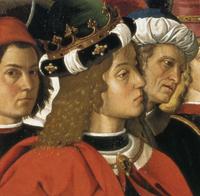
The Adoration of the Magi (particular detail)
Pietro Perugino
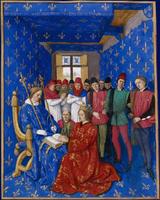
Tribute of Edward III to Philip
Jean Fouquet
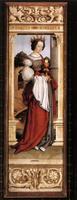
St Barbara (Sebastiansaltar)
Hans Holbein the Elder
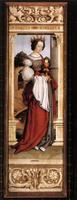
St. Barbara
Hans Holbein the Younger
Justice of the Emperor Otto: The Ordeal by Fire
Dirk Bouts
Calvary Triptych (detail)
Justus van Gent