Expert analysis of Jacob Jordaens’s The Peasants and the Satyr
Style: Baroque · Genre: literary painting
Expert Analysis: "The Peasants and the Satyr" by Jacob Jordaens
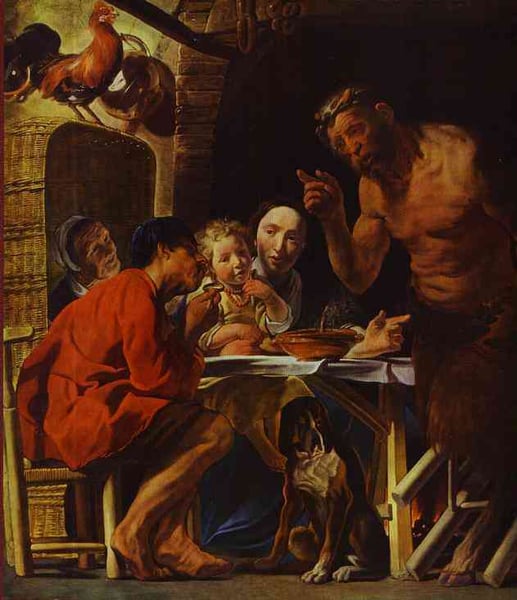
This painting is a quintessential example of the Baroque style’s ability to merge high drama with everyday life, while also serving as a literary painting that illustrates a moral fable. The work is based on Aesop’s fable "The Man and the Satyr," in which a satyr befriends a peasant but is repulsed when the peasant blows on his hands to warm them and then on his food to cool it—declaring he cannot trust a man who blows both hot and cold.
Significance within the Baroque Period:
-
Dynamic Realism: Jordaens captures the moment of confrontation with incredible energy. The peasant’s open-mouthed explanation, the satyr’s shocked recoil, and the lively gestures of the rustic family create a theatrical, almost cinematic tension. This aligns with Baroque interest in capturing a decisive, emotional instant.
-
Caravaggist Chiaroscuro: The strong contrast of light and shadow—with a bright, warm light falling on the central figures and deep, mysterious darkness around them—highlights the moral and physical contrast between the human and mythical realms. The rough, naturalistic details of the peasants’ hands, faces, and clothing root the story in a tangible, earthy reality.
-
Moral Allegory, Not Mythology: Unlike many Baroque literary paintings that depict classical myths or biblical stories, Jordaens uses a humble fable to explore themes of trust, hypocrisy, and human nature. This reflects the Counter-Reformation era’s interest in accessible, didactic art that speaks to common people while still displaying virtuoso technique.
-
Genre Crossing: By combining a literary/moral narrative with a domestic peasant scene, Jordaens elevates a lowly subject to the status of history painting—a hallmark of Flemish Baroque. The painting’s significance lies in how it proves that a simple, everyday encounter can carry the same weight as a grand epic, using the Baroque toolkit of emotional intensity, realistic detail, and dramatic light to make the fable come alive.
In sum, "The Peasants and the Satyr" is a masterful Baroque work that uses literary source material to deliver a timeless moral lesson, all while showcasing Jordaens’ skill in capturing human (and semi-human) emotion with raw, compelling immediacy.
Museum / Gallery
Visually similar
20 works with related composition and palette
Satyr and Peasant
Jacob Jordaens
The Satyr with the Peasants
Jacob Jordaens
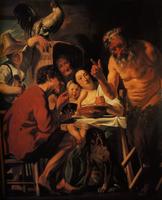
Satyr and Peasant
Jacob Jordaens
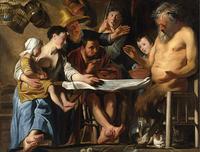
The Satyr and the Peasant Family
Jacob Jordaens
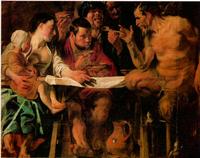
Satyr and Peasant
Jacob Jordaens
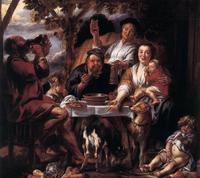
Eating Man
Jacob Jordaens
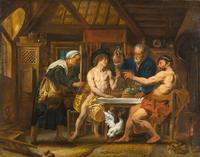
Jupiter and Mercury in the House of Philemon and Baucis
Jacob Jordaens
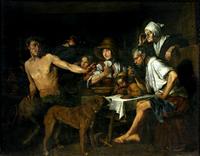
Satyr as a Guest of a Peasant
Jan Cossiers
DIE KARTENSPIELER
David Rijckaert III
The Paschal Lamb
Palma il Giovane
Interior with Card Players
David Rijckaert III
The Last Supper
Le Nain brothers
The Supper at Emmaus
Jacob Jordaens
Jupiter et Mercure chez Philémon et Baucis
François Marot
The Bean King (The King Drinks)
Jacob Jordaens
A Mother Entrusting Her Sons to Christ
Mattia Preti
The Testament of Eudamidas
Nicolas Poussin
Small card players
Le Nain brothers
Supper at Emmaus
Caravaggio
Tooth Puller
Caravaggio