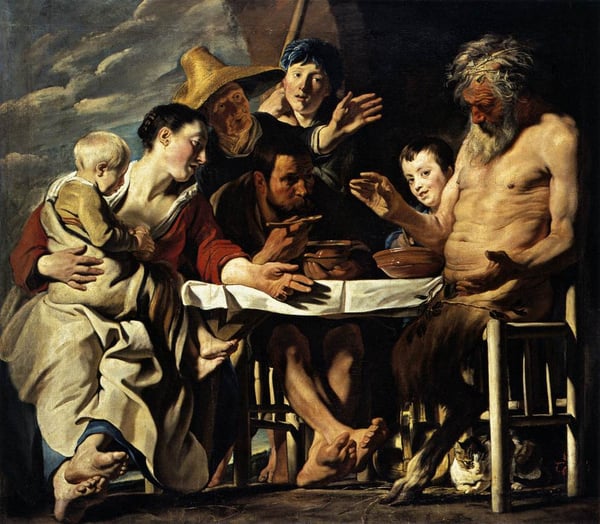
Expert analysis of Jacob Jordaens’s The Satyr with the Peasants
Style: Baroque · Genre: literary painting
Expert Analysis: "The Satyr with the Peasants" by Jacob Jordaens
As a quintessential example of Flemish Baroque painting, Jacob Jordaens’ The Satyr with the Peasants achieves significance through its masterful blend of earthy realism, moral allegory, and dynamic narrative—hallmarks of the Baroque period’s emphasis on emotional engagement and theatrical immediacy.
Stylistic and Period Significance
Executed in the grand Baroque idiom, the work exemplifies the movement’s fascination with dramatic contrasts of light and shadow (chiaroscuro) and the vigorous, robust treatment of human figures. Jordaens, a contemporary of Rubens, here displays a distinctly robust and unidealized approach to the human form: the peasants are depicted with coarse, tactile textures, flushed skin, and lively expressions, grounding the mythological subject in a tangible, everyday reality. This alignment with Baroque sensibilities—celebrating the visceral, the dynamic, and the emotionally direct—makes the painting a powerful vehicle for moral instruction.
Genre and Literary Context
As a “literary painting,” the work derives from Aesop’s fable The Satyr and the Traveller, in which a satyr befriends a man who blows on his hands to warm them and on his soup to cool it. The satyr, horrified by the man’s ability to produce both heat and cold from the same mouth, declares the friendship broken. Jordaens transforms this simple cautionary tale into a crowded, bustling domestic scene filled with anecdotal detail—children, animals, and rustic implements—that amplifies the fable’s core lesson about hypocrisy and inconsistency. The satyr’s raised hand and startled expression form the focal point, arresting the viewer’s attention and underscoring the moral: beware those who “blow hot and cold.”
What Makes This Work Significant
Its significance lies in how Jordaens elevates a humble folk tale into a monumental Baroque narrative. Unlike the more aristocratic mythological scenes common to the period, here the artist champions the peasant class as worthy subjects for high art, infusing them with dignity, humor, and psychological depth. The painting also demonstrates the Baroque tendency to merge classical morality with contemporary life, making ancient wisdom accessible and urgent. Through its vigorous brushwork, lively composition, and unflinching realism, The Satyr with the Peasants stands as a vivid testament to Jordaens’ unique voice within the Baroque canon—a voice that celebrates the unruly, the comic, and the profoundly human.
Museum / Gallery
Visually similar
20 works with related composition and palette
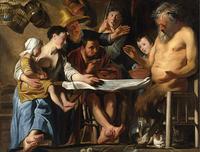
The Satyr and the Peasant Family
Jacob Jordaens
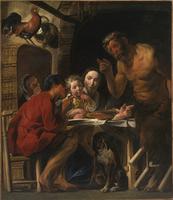
Satyr and Peasant
Jacob Jordaens
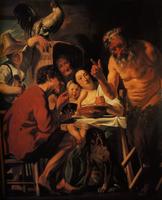
Satyr and Peasant
Jacob Jordaens
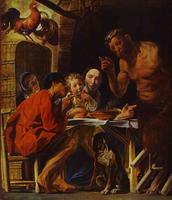
The Peasants and the Satyr
Jacob Jordaens
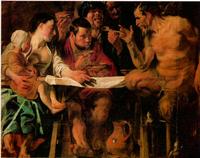
Satyr and Peasant
Jacob Jordaens
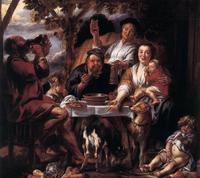
Eating Man
Jacob Jordaens
The Paschal Lamb
Palma il Giovane
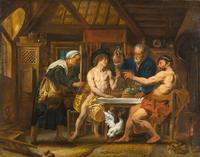
Jupiter and Mercury in the House of Philemon and Baucis
Jacob Jordaens
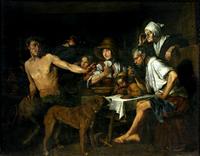
Satyr as a Guest of a Peasant
Jan Cossiers
Hercules and Onphale
Domenico Fiasella

Prophet Elijah and the Widow of Sarepta
Bernardo Strozzi
The Bean King (The King Drinks)
Jacob Jordaens
Jupiter et Mercure chez Philémon et Baucis
François Marot
A Mother Entrusting Her Sons to Christ
Mattia Preti
The King Drinks
Jacob Jordaens

The Beheading of John the Baptist
Carel Fabritius
Supper at Emmaus
Caravaggio
The Beheading of John the Baptist
Rembrandt
Restout Philémon Et Baucis Donnant L'hospitalité À Jupiter Et Mercure
Jean-Bernard Restout
DIE KARTENSPIELER
David Rijckaert III