
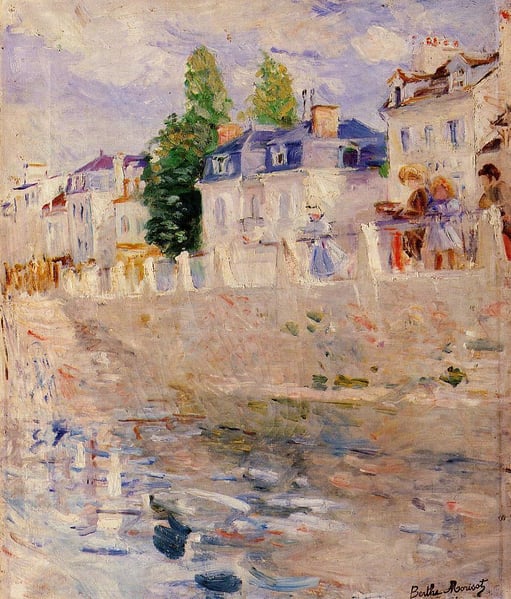
Expertenanalyse zu Berthe Morisots The Quay at Bougival
Stil: Impressionism · Genre: cityscape
Expert Analysis of "The Quay at Bougival" by Berthe Morisot
As an Impressionist cityscape, The Quay at Bougival exemplifies the movement’s core principles—capturing fleeting light, atmospheric color, and the modern urban-riverine life—through the distinctive lens of one of its central yet often underrecognized figures, Berthe Morisot. Although only three facts are supplied, their interplay defines the work’s significance:
-
Berthe Morisot’s position within Impressionism – As a founding member of the Impressionist group and one of the few women in its inner circle, Morisot brought a nuanced perspective to subjects typically dominated by male peers. Her cityscapes, like this one, often foreground intimate, everyday moments along the Seine, merging domestic sensibility with public urbanity. This challenges the gender norms of the era, situating women as active observers of modern life rather than mere subjects.
-
The choice of Bougival – This riverside commune was a favorite haunt of Impressionists (Monet, Sisley, Renoir painted there extensively). By depicting the quay, Morisot aligns herself with the movement’s fascination with leisure, tourism, and the transformation of the Parisian periphery into a site of light and movement. The location itself becomes a symbol of Impressionist modernity: the interplay of water, sky, and built environment.
-
Genre (cityscape) reimagined – While Impressionist cityscapes often emphasize grand boulevards or sweeping views, Morisot’s treatment of a quieter quay focuses on the subtle rhythms of daily life—boats, pedestrians, reflections. Her characteristically loose, feathery brushwork (typical of her mature style) dissolves solid forms into shimmering patches of color, prioritizing optical sensation over topographical accuracy. This aligns with the Impressionist goal of rendering the “impression” of a moment, particularly the flickering light on water and the hazy summer atmosphere.
Significance: The work is significant not only as a fine example of Impressionist plein-air technique but also as a testament to Morisot’s role in expanding the movement’s scope. She transforms a conventional cityscape into a study of transient beauty, while her presence as a female artist painting such public spaces redefines who gets to portray modern life. In combining a popular Impressionist locale with a distinctly personal, delicate touch, The Quay at Bougival stands as a quiet but powerful assertion of Morisot’s artistic voice within a male-dominated avant-garde.
Museum / Gallery
Visuell ähnlich
20 Werke mit ähnlicher Komposition und Farbpalette
Horses being Watered at Marly le Roi
Alfred Sisley
The Embankment of Lagny under Flood Water
Maxime Maufra
The Watering Place at Marly Le Roi Hoarfrost
Alfred Sisley
Mill at Pont Aven
Gustave Loiseau
Banks of the Loing, Saint Mammes
Alfred Sisley
Saint Mammes House on the Canal du Loing
Alfred Sisley
Quay on Oise in Pontoise
Gustave Loiseau
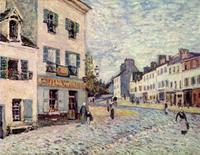
Street in Marly
Alfred Sisley
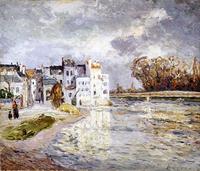
The Marne at Lagny
Maxime Maufra

The Blocked Seine at Port Marly
Alfred Sisley
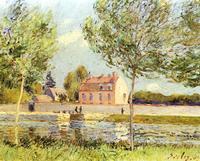
Houses on the banks of the Loing
Alfred Sisley
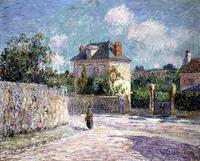
The Small Bourgeois House
Gustave Loiseau
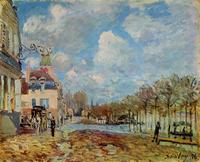
The Flood at Port Marly
Alfred Sisley
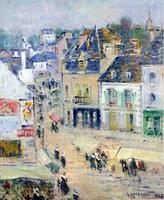
Pont Aven, Grey Weather
Gustave Loiseau
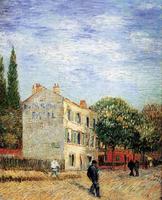
The Rispal Restaurant at Asnieres
Vincent van Gogh
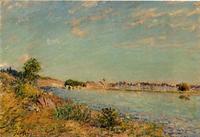
Saint Mammes
Alfred Sisley
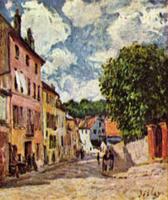
Street in Moret Sur Loing
Alfred Sisley
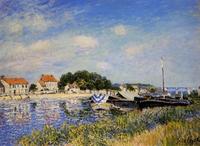
Banks of the Loing at Saint Mammes
Alfred Sisley
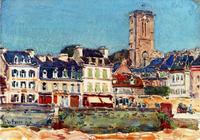
The Quai, Lannion
Childe Hassam
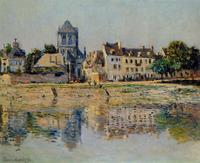
By the River at Vernon
Claude Monet