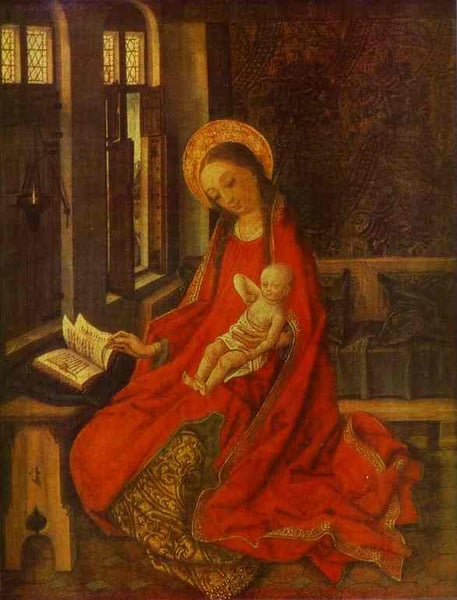
The Virgin with Infant
Expert analysis of Martin Schongauer’s The Virgin with Infant
Style: Northern Renaissance · Genre: religious painting
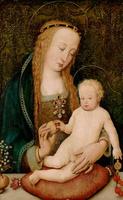
Expert Analysis: "The Virgin with Infant" by Martin Schongauer
Martin Schongauer, a master of the Northern Renaissance, is celebrated for his meticulous draftsmanship and his pioneering role in elevating printmaking to a fine art. While the supplied facts identify "The Virgin with Infant" as a religious painting, Schongauer’s significance lies in his ability to infuse sacred subjects with profound intimacy and naturalism, bridging the late Gothic tradition and the emerging Renaissance.
Stylistic Significance within the Northern Renaissance: Schongauer’s Virgin and Child compositions—whether in oil or his famous engravings—exemplify the Northern Renaissance’s obsession with optical realism and symbolic detail. The painting likely displays his hallmark precision in rendering textiles, halos, and the delicate features of the Virgin. Unlike the more idealized Madonnas of the Italian Renaissance, Schongauer’s figures are grounded in observed humanity: the Infant’s chubby limbs, the Virgin’s tender gaze, and the careful modeling of fabric folds reflect a devotion to tangible, tactile reality. This aligns with the Northern school’s emphasis on empathy and domestic spirituality—the holy family is made approachable, emotionally resonant, and deeply human.
Religious Painting as Narrative: As a religious work, "The Virgin with Infant" likely serves as a Andachtsbild (devotional image), intended for private prayer. Schongauer’s composition typically directs the viewer’s focus to the intimate bond between mother and child, using subtle gestures (such as the Infant reaching for a flower or the Virgin’s protective hand) to convey theological themes of Incarnation and maternal sacrifice. The inclusion of symbolic motifs—perhaps a rose, apple, or book—would reinforce Mary’s role as the New Eve or Seat of Wisdom, rendered with the Northern Renaissance’s signature symbolic naturalism where every object carries layered meaning.
Influence and Legacy: Schongauer’s graphic works, particularly his engravings of the Virgin and Child, circulated widely across Europe, directly inspiring Albrecht Dürer, who traveled to Colmar in 1492 to study under the recently deceased master. The delicate cross-hatching and volumetric forms in Schongauer’s prints—and by extension his paintings—set a new standard for tonal shading and emotional nuance. "The Virgin with Infant" thus stands as a pivotal example of how Northern Renaissance artists transformed static iconography into a living, breathing encounter between the divine and the everyday. Its significance lies not only in its devotional function but in its role as a technical and emotional benchmark for generations of Northern European artists to come.
Museum / Gallery
Visually similar
20 works with related composition and palette
Madonna del Mare
Sandro Botticelli
Madonna of the Sea
Sandro Botticelli
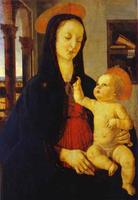
The Virgin and Child
Domenico Ghirlandaio
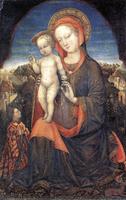
The Madonna of Humility adored by Leonello d'Este
Jacopo Bellini
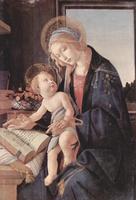
Madonna of the Book
Sandro Botticelli
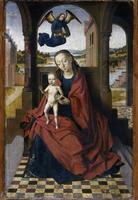
Madonna with the Child
Petrus Christus
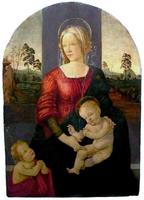
Madonna and Child with St. John the Baptist
Sandro Botticelli
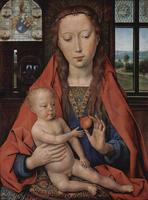
Madonna and Child, from The Diptych of Maerten van Nieuwenhove
Hans Memling
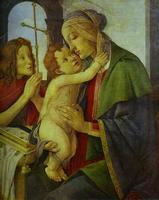
The Virgin and Child with the Infant St. John
Sandro Botticelli
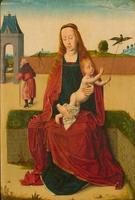
Madonna and Child on a grass bench
Dirk Bouts
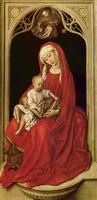
Madonna and Child
Rogier van der Weyden
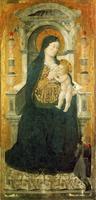
Madonna Del Latte
Antoniazzo Romano
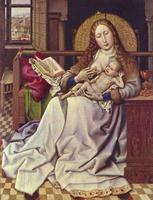
Virgin and Child Before a Firescreen
Robert Campin
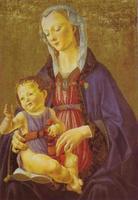
Madonna and Child
Domenico Ghirlandaio
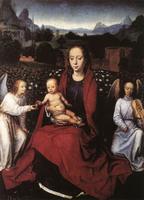
Virgin and Child in a Rose Garden with Two Angels
Hans Memling
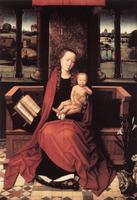
Virgin and Child Enthroned
Hans Memling
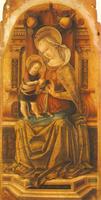
Madonna and Child Enthroned
Carlo Crivelli
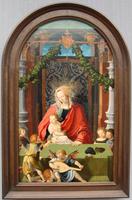
Virgin and Child with Angels
Lucas van Leyden
Maria, Dem Kind Einen Granatapfel Reichend
Hans Holbein the Elder
Madonna
Petrus Christus