Analisi esperta di Catskill Mountain House, The Four Elements di Thomas Cole
Stile: Romanticism · Genere: landscape
Expert Analysis: "Catskill Mountain House, The Four Elements" by Thomas Cole
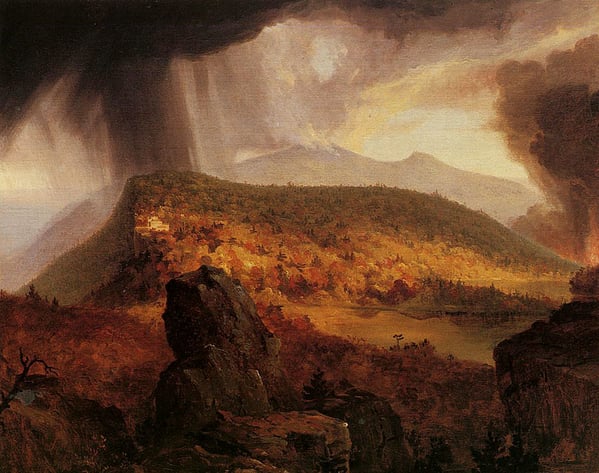
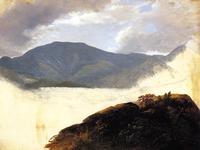
Thomas Cole’s Catskill Mountain House, The Four Elements stands as a pivotal work within the Romantic landscape tradition, embodying the Hudson River School’s fusion of precise naturalism with allegorical meaning. This painting is not merely a topographic view; it is a philosophical meditation on the unity of nature and the human place within it.
Significance within Romanticism and the Hudson River School
Cole, as the founder of the Hudson River School, elevated American landscape painting by imbuing wild scenery with moral and spiritual resonance. In The Four Elements, he departs from simple depiction to structure the composition around the classical elements—Earth, Water, Air, and Fire—transforming a specific locale (the Catskill Mountain House, a famous resort) into a universal emblem of cosmic order. This allegorical layering is a hallmark of Romanticism, where nature is not just a backdrop but a living symbol of divine creation and human transience.
Compositional and Symbolic Mastery
The painting likely balances the four elements through distinct zones: the solid mountain mass and rocky foreground (Earth), the reflective lake or river below (Water), the expansive sky with dramatic clouds (Air), and the warm glow of sunrise or sunset (Fire). Cole’s use of light—often a fiery, golden hue—anchors the scene in a moment of sublime transition, a favorite Romantic device that suggests both the power and fragility of existence. The Catskill Mountain House itself appears as a small, almost fragile human structure amid the vast landscape, underscoring the Romantic theme of humanity’s humble place in the face of nature’s grandeur.
Why This Work Is Significant
- Synthesis of Landscape and Idea: Cole integrates a specific American wilderness with a European-derived allegorical framework, creating a distinctly New World Romanticism that is both local and universal.
- Pioneering Atmospheric Effect: The treatment of light and atmosphere anticipates the Luminist tendencies later developed by artists like Frederic Edwin Church and Sanford Robinson Gifford.
- Environmental and Spiritual Commentary: By reducing the natural world to its four essential elements, Cole invites viewers to see the landscape as a harmonious, interconnected system—a proto-ecological vision that resonates with Romantic idealism.
In essence, Catskill Mountain House, The Four Elements is a masterful example of how Romantic landscape painting could transcend documentation to become a vehicle for philosophical inquiry, marking a high point in Cole’s career and in the development of American art.
Museum / Gallery
Visivamente simili
20 opere con composizione e palette affini
Landscape with Dead Tree
Thomas Cole
View of L`Esperance on the Schoharie River
Thomas Cole
Peace at Sunset (Evening in the White Mountains)
Thomas Cole
Landscape with Figures A Scene from The Last of the Mohicans
Thomas Cole
View on the Schoharie
Thomas Cole
Indian Sacrifice
Thomas Cole
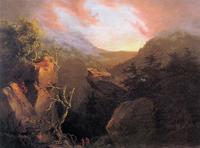
Mountain Sunrise
Thomas Cole

Schroon Mountain, Adirondacks
Thomas Cole
Mountain Scene
Thomas Moran

The Course of Empire: The Savage State
Thomas Cole
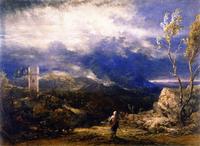
Christian Descending into the Valley of Humiliation
Samuel Palmer

Twilight in the Wilderness
Frederic Edwin Church
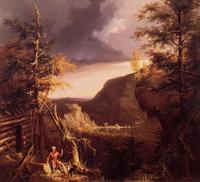
Daniel Boone Sitting at the Door of His Cabin on the Great Osage Lake
Thomas Cole
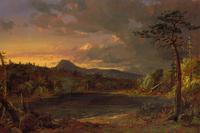
Catskill Creek
Jasper Francis Cropsey
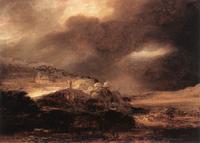
Stormy Landscape
Rembrandt
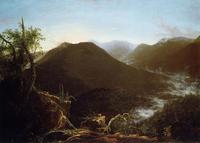
Sunrise in the Catskill Mountains
Thomas Cole
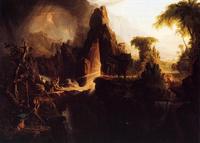
Expulsion from the Garden of Eden
Thomas Cole

View of the Hudson River from Olana
Frederic Edwin Church

Woolshed Creek, Beechworth
Isaac Whitehead
Hudson River Sketch
Asher Brown Durand