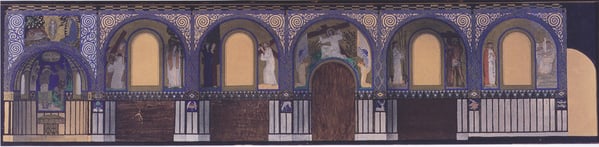
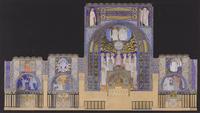
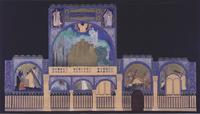
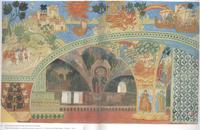
Holy Spirit Church in Düsseldorf, design for the left side wall with a baptistery
Ayrıntılar
Koloman Moser sanatçısının Holy Spirit Church in Düsseldorf, design for the left side wall with a baptistery eseri hakkında uzman analizi
Tarz: Art Nouveau (Modern) · Tür: design
Expert Analysis of Koloman Moser’s "Holy Spirit Church in Düsseldorf, design for the left side wall with a baptistery"
Koloman Moser’s design for the left side wall of the Holy Spirit Church in Düsseldorf stands as a remarkable synthesis of sacred function and Art Nouveau innovation. While Moser is best known as a founding member of the Vienna Secession and a master of decorative arts (from furniture to stained glass), this ecclesiastical project reveals his ambition to apply modernist principles to the most traditional of spaces: a church interior.
Significance within Art Nouveau and Modernism
-
Integration of Symbolism and Geometry
Although the description provides only the title and style, Moser’s known work in this period often marries organic Art Nouveau curves with a disciplined, almost abstract geometric order. In a baptistery design—a space for the sacrament of rebirth—Moser likely employed motifs of water, light, and regeneration. The left side wall would have anchored the baptismal font, and Moser’s treatment of the architecture (perhaps through stylized floral patterns, symmetrical panels, or a rhythmic sequence of arches) would have transformed a liturgical necessity into a cohesive, modern visual experience. -
Art Nouveau’s Reach into Sacred Architecture
By 1900, Art Nouveau had flourished in Paris, Brussels, and Vienna, but its application to church interiors was rare and radical. Most ecclesiastical art remained historicist (Neo-Gothic, Neo-Romanesque). Moser’s design challenges this conservatism by proving that modern, flowing lines and flat decorative surfaces could enhance rather than undermine spiritual contemplation. This project places him alongside contemporaries such as Antoni Gaudí (Sagrada Família) and Otto Wagner (Steinhof Church), both of whom sought a new, integrated sacred aesthetic. -
Moser’s Role as a Total-Design Pioneer
As a designer of everything from postage stamps to entire interiors, Moser believed in the Gesamtkunstwerk (total work of art). In this church design, every element—wall panels, lighting, the baptistery itself—would have been conceived as part of a unified, harmonious whole. The left side wall was not mere decoration but an active participant in the liturgical experience, guiding the eye and the faithful toward the font. This holistic approach is a hallmark of the Vienna Secession and prefigures later modernist functionalism. -
A Bridge Between Decoration and Abstraction
By the late 1900s, Moser’s style was moving away from sinuous, Whiplash-style curves toward a more restrained, rectilinear ornament. This design likely reflects that transition: while still Art Nouveau in spirit (emphasizing craftsmanship, stylized nature, and elegant line), it hints at the geometric clarity that would define early modernism. The baptistery wall thus becomes a document of Moser’s evolution—and of Art Nouveau’s own shift from floral excess to structural purity.
Conclusion
Koloman Moser’s design for the Holy Spirit Church baptistery is significant because it demonstrates that Art Nouveau was not merely a decorative fashion for domestic or commercial spaces, but a viable philosophy for sacred architecture. It challenges the period’s historicism, asserts the beauty of modern line and light in a spiritual context, and showcases Moser’s dual mastery of symbolic content and avant-garde form. Though only a design, it stands as a testament to the Vienna Secession’s belief that modernity could ennoble tradition—and that a church wall could be both a liturgical framework and a work of art.
Görsel olarak benzer
İlişkili kompozisyon ve renk paletine sahip 20 eser
Holy Spirit Church in Düsseldorf, design for the right side wall
Koloman Moser
Holy Spirit Church in Düsseldorf, design for the left side wall
Koloman Moser
Holy Spirit Church in Düsseldorf, design for the choir wall
Koloman Moser
Holy Spirit Church in Düsseldorf, design for the entrance wall
Koloman Moser
Fatti Della Vita Di Gesù Cristo, Varii Profeti E Martiri
Giuseppe Barberis
Fatti Della Vita Di Gesù Cristo, Varii Profeti, Porto E Città Di Classe
Giuseppe Barberis
Le martyre de Saint Sebastien act I set design
Leon Bakst
Throne of the invisible God
Nicholas Roerich
Interior, Monreale Cathedral, Italy
Romanesque Architecture
Am Steinhof Church, mosaic design for the main altar
Koloman Moser
Throne of the invisible God
Nicholas Roerich
Scenes from the Life of St. Francis (north wall)
Benozzo Gozzoli

Christ on the Cross with Saint Francis, the Virgin Mary, Saint John the Evangelist, and Saint Dominic
Luca di Tommé
Message to the Church of Smyrna
Ende
Presentation of Christ in the Temple
Giotto
Jugement de Babylone réduite à un brasier. Apoc. XVIII
Facundus
Am Steinhof Church, Design for the left side altar Our Lady of Mercy
Koloman Moser
Return of Christ to Jerusalem
Giotto
Christmas and other holy scene of the life of Jesus Christ and Virgin Mary. Sketch of murals for the south wall of the church of the Assumption in Olshany
Ivan Bilibin
Sketches of scenery for Sadko by Nikolai Rimsky-Korsakov
Ivan Bilibin