David Alfaro Siqueiros sanatçısının Excommunication and Execution of Father Hidalgo eseri hakkında uzman analizi
Tarz: Expressionism · Tür: genre painting
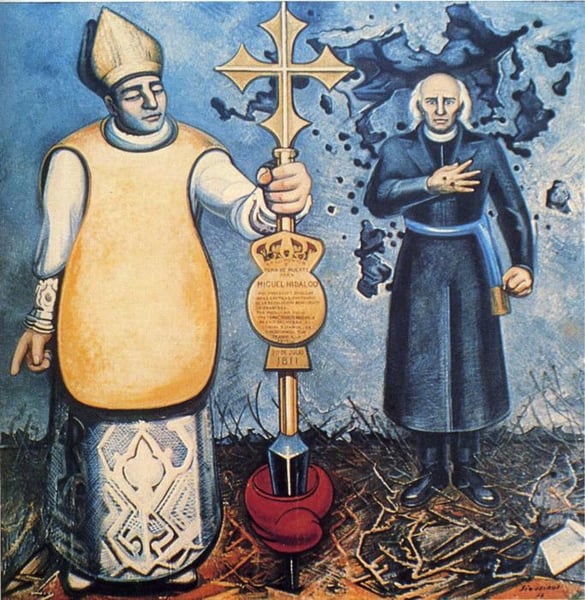
Expert Analysis: "Excommunication and Execution of Father Hidalgo" by David Alfaro Siqueiros
Style & Period Context (Expressionism):
Siqueiros’s use of Expressionism here is not merely an aesthetic choice but a deliberate tool to amplify the emotional and political weight of the subject. Expressionism, with its distorted forms, jarring perspectives, and heightened color contrasts, allows the artist to move beyond literal depiction and into visceral, psychological territory. The scene of Father Hidalgo’s excommunication and execution is rendered with a raw, almost brutal energy—figures are likely compressed into a shallow, claustrophobic space, their faces and bodies contorted to convey anguish, defiance, or institutional cruelty. This aligns with Siqueiros’s broader commitment as a muralist and revolutionary: Expressionism becomes a means of social and historical critique, forcing the viewer to feel the injustice and martyrdom of Hidalgo rather than simply observe it.
Genre Painting as Political History:
While classified as genre painting—traditionally a depiction of everyday life—Siqueiros subverts the genre’s typical domestic or mundane subject matter. Here, the “everyday” is the cruel machinery of colonial power: the Church’s act of excommunication and the state’s act of execution. By presenting a specific historical event through the lens of genre, he makes political violence a tangible, immediate human experience. This elevates genre painting from anecdotal to monumental, linking a personal tragedy to the birth of Mexican national consciousness.
Significance within Its Style/Period:
- Fusion of Expressionist Emotion with Mexican Muralist Scale: Siqueiros was a leading figure of the Mexican Mural Renaissance, but this work applies Expressionist intensity to a single, self-contained composition (likely a canvas or easel painting) rather than a vast wall. It demonstrates that Expressionism could carry the same monumental, ideological weight as muralism.
- Anticipating Political Expressionism: The painting bridges the gap between early 20th-century European Expressionism (e.g., Kirchner, Nolde) and the socially engaged, activist art of Latin America. Siqueiros rejects Expressionism’s potential for pure subjectivity; instead, he harnesses its formal chaos to narrate a collective historical trauma.
- Modernist Reinterpretation of Martyrdom: The title explicitly contrasts the religious act of excommunication (a spiritual death) with the secular execution (a physical one). Expressionism’s fragmentation and dissonance mirror this dual crisis—faith is weaponized, then the state delivers finality. The painting thus stands as a proto-modernist icon of anti-colonial struggle, where style itself becomes a form of protest.
Conclusion:
This artwork is significant because it proves that Expressionism, far from being merely introspective, can be a potent vehicle for historical memory and political mobilization. It reframes a pivotal moment in Mexican independence through a lens of emotional extremity, making the viewer complicit in Hidalgo’s passion. Siqueiros transforms genre painting into a battlefield of form and meaning, ensuring that the excommunication and execution of Father Hidalgo is felt as a living wound, not a distant fact.
Görsel olarak benzer
İlişkili kompozisyon ve renk paletine sahip 20 eser
Tatic, Samuel Ruiz
Vlady
Bapteme
Theophile Steinlen
Archbishop Lost in the Woods
Fernando Botero
Saint-Valentin
Jean Hugo
The Shedim and the Holy Men - Golden Legend of St Stephen
Joe Machine
Saint Laurenzius
Carlo Crivelli
The Austrian Saints
Albrecht Durer

St. Benedict
Piero della Francesca
Polyptych of San Vincenzo Ferreri
Giovanni Bellini
St Augustine
Maarten de Vos
St. Lawrence
Francisco de Zurbaran
Saint Nicolas
Carlo Crivelli
St. Theotonius
Nuno Gonçalves

Promenade
Fernando Botero
St. Romuald
Fra Angelico
Genesis The Clothing of Adam and Eve
Joe Machine
St. Augustine
Piero della Francesca
St. Stephen
Giotto
Altar of Recanati polyptych, the left wing: St. Thomas Aquinas and St. Flavian
Lorenzo Lotto
Perugia Altarpiece (left panel)
Fra Angelico