Expert analysis of Albrecht Durer’s The Austrian Saints
Style: Northern Renaissance · Genre: religious painting
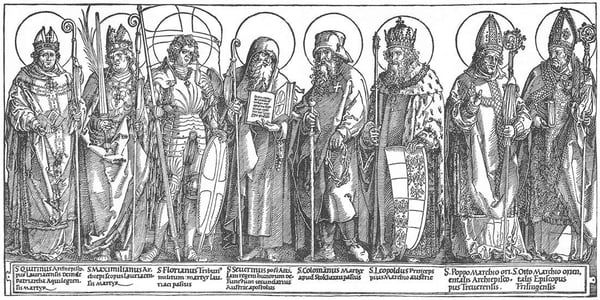
Expert Analysis: The Austrian Saints by Albrecht Dürer
Albrecht Dürer’s The Austrian Saints stands as a pivotal work within the Northern Renaissance, demonstrating the artist’s unique synthesis of meticulous Northern naturalism with the compositional clarity and humanist ideals emerging from Italy. As a religious painting, it not only serves devotional purposes but also embodies the era’s shift toward individualized, emotionally resonant sacred figures.
Stylistic Significance: Dürer’s handling of detail—seen in the precise rendering of textiles, hair, and symbolic attributes—exemplifies the Northern Renaissance fascination with observable reality. The saints are depicted with distinct physiognomies and postures, moving away from the static, hieratic traditions of medieval art. This individuality reflects Dürer’s engagement with Italian Renaissance portraiture, yet the intricate symbolism (such as specific iconographic attributes tied to Austrian patron saints) remains deeply rooted in Northern allegorical traditions.
Composition and Religious Narrative: The grouping of saints likely represents a sacra conversazione—a holy conversation—set in a unified pictorial space. Dürer integrates landscape or architectural elements to create a coherent setting, a hallmark of his maturing style. The balanced arrangement, often with a central Christ or Virgin if present, anchors the viewer’s gaze, while the saints’ interactions (gestures, glances) invite contemplation of their intercessory roles. This composition demonstrates Dürer’s mastery of spatial organization, a lesson absorbed from his travels to Venice.
Cultural and Historical Context: Painted during a period of heightened national identity within the Holy Roman Empire, The Austrian Saints likely served to reinforce Habsburg piety and legitimacy. Dürer’s choice to localize the saints—linking them to Austrian territories—was both a spiritual and political statement. The work’s meticulous execution also reflects the growing patronage of wealthy burghers and courtly clients who valued art as both devotion and status symbol.
Legacy: This painting exemplifies how Northern Renaissance artists like Dürer elevated religious subject matter through empirical observation and intellectual depth. Its fusion of Gothic precision with Renaissance harmony makes it a key document of the transition from late medieval to early modern visual culture, cementing Dürer’s reputation as the “Leonardo of the North.”
Museum / Gallery
Visually similar
20 works with related composition and palette
St. Fridolin
Albrecht Durer
Statua Di San Nicola Nella Basilica Omonima
Giuseppe Barberis
Philip
Albrecht Durer
Mass of Cardinal Albrecht of Brandenburg in the Abbey Church Hall
Albrecht Durer
Saint Isidore
Bartolome Esteban Murillo
Bapteme
Theophile Steinlen
The Clergy of Rome Paying Homage to St. Gregory After His Investiture
Charles-Andre van Loo (Carle van Loo)
St. Philip
Albrecht Durer
Saint Nicolas
Carlo Crivelli
St. Bartholomew
Albrecht Durer
Stephan I
Josef Kriehuber
Hortus deliciarum
Herrad of Landsberg
St. Paul (First State)
Albrecht Durer
The Sudarium of St Veronica
Albrecht Durer
The Shedim and the Holy Men - Golden Legend of St Stephen
Joe Machine
St. Juliana
Vladimir Borovikovsky
Christ as the True Light
Hans Holbein the Younger
A Bishop Saint
Fra Angelico
St. Stephen
Giotto
Plaque with Bishop
Nicholas of Verdun