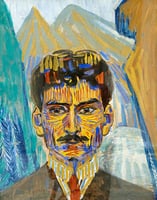
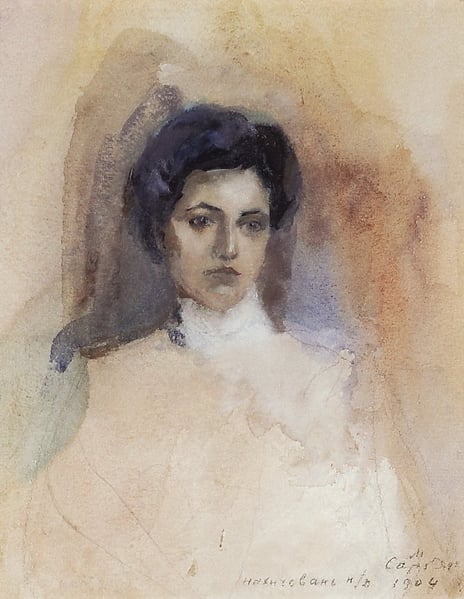
Martiros Sarian sanatçısının Armenian from Nakhichevan eseri hakkında uzman analizi
Tarz: Post-Impressionism · Tür: portrait
Expert Analysis of "Armenian from Nakhichevan" by Martiros Sarian
Martiros Sarian’s "Armenian from Nakhichevan" is a compelling portrait that exemplifies the artist’s distinctive synthesis of Post-Impressionist principles with a deeply rooted Armenian cultural identity. Working within a genre that traditionally emphasizes individual likeness, Sarian transcends mere representation to evoke the spirit of a people and a place.
Stylistic Significance within Post-Impressionism
As a Post-Impressionist work, the painting prioritizes expressive color, structural simplification, and emotional resonance over naturalistic fidelity. Sarian employs bold, often saturated hues—likely warm ochres, deep blues, and vibrant reds—to model the sitter’s face and traditional attire. This use of color is not arbitrary but purposeful: it conveys the intense sunlight and arid landscape of Nakhichevan, while also reflecting the artist’s admiration for the Fauvist and Symbolist currents within Post-Impressionism. The brushwork is energetic yet controlled, building form through distinct strokes that lend the portrait a sense of vitality and dignity.
Cultural and Regional Identity
The title explicitly grounds the work in a specific Armenian locality—Nakhichevan, a historic region once home to a significant Armenian population. Sarian, who traveled extensively through the Middle East and the Caucasus, was deeply influenced by the people and landscapes he encountered. Here, the sitter’s clothing, facial features, and direct, solemn gaze become markers of ethnic pride and resilience. Rather than exoticizing the subject, Sarian presents the Armenian from Nakhichevan as a universal figure of quiet strength, merging ethnographic observation with Post-Impressionist lyricism.
Significance in Sarian’s Oeuvre
This portrait occupies a key place in Sarian’s move away from academic realism toward a more modernist, color-driven approach. It demonstrates his ability to use portraiture as a vehicle for cultural memory, anticipating later works in which he would paint landscapes and people of Armenia with an almost iconic intensity. "Armenian from Nakhichevan" is significant precisely because it proves that Post-Impressionism could be adapted to capture not only French café scenes or Tahitian maidens, but also the proud, enduring identity of an Armenian community at a pivotal moment in its history.
Conclusion
Sarian’s "Armenian from Nakhichevan" is a masterful portrait that pushes the boundaries of genre through its vibrant Post-Impressionist technique and profound cultural sensibility. It stands as a testament to the artist’s role in bringing Armenian visual heritage into dialogue with early 20th-century modernism, offering viewers both a striking individual likeness and a window into a world shaped by light, history, and identity.
Görsel olarak benzer
İlişkili kompozisyon ve renk paletine sahip 20 eser
Portrait of young woman
Mary Cassatt
Portrait of Edith French
John Singer Sargent
Portrait of a Woman
Edgar Degas
Portrait of Y.E. Proshinskaya
Boris Kustodiev
Portrait of An Italian Lady
Fujishima Takeji
Study of a Head
John Henry Twachtman
Vörösblúzos Lány
Bela Czobel
Frances Metzger West
Arthur Beecher Carles
Young Woman in a Blue Blouse
Berthe Morisot
Portrait of Madame Alfred Lavergne, born Magdalena Mellon
Mary Cassatt
Modok Mária, Önarckép
Modok Mária
Mama
Oleg Holosiy
Portrait de Mme Bjornsson Langen
Theophile Steinlen
Woman`s Head
Pierre-Auguste Renoir
Gladys (detail)
Abbott Handerson Thayer
A GIRL IN BLUE
Frank O'Meara
Head of a Girl
Pierre-Auguste Renoir
Portrait of E. Vladimirskaya
Konstantin Somov
Marianne von Meixner
Christian Schad
Portrait of a woman
Pompeo Mariani