Description
Style: Futurism · Genre: landscape
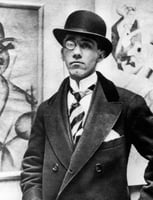
After moving from Rome to Paris in 1906, Gino Severini came into close contact with Georges Braque, Pablo Picasso, and the other leading artists of the avant-garde capital, while staying in touch with his compatriots who remained in Italy. In 1910 he signed the “Futurist Painting: Technical Manifesto” with four other Italian artists, Giacomo Balla, Umberto Boccioni, Carlo Carrà, and Luigi Russolo, who wanted their paintings to express the energy and speed of modern life.
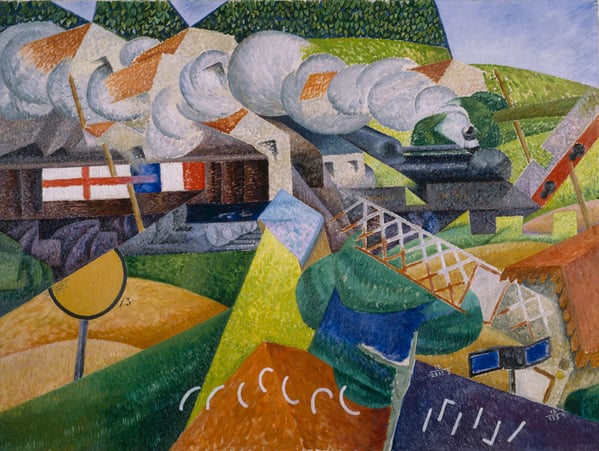
In this painting of a train moving through the countryside, Severini split the landscape in order to impart a sense of the momentary fractured images that characterize our perception of a speeding object. The clash of intense contrasting colors suggests the noise and power of the train, which the Futurists admired as an emblem of vitality and potency.
Severini’s paintings—like Futurist work in general—are informed by the legacy of Cubism, building on the Cubists’ deconstruction of the motif, their collage technique, and their incorporation of graphic signs. But the Futurists’ interest in depicting motion, use of bright expressive color, and politically inspired dedication to bridging the gap between art and life departed decisively from Cubist aesthetic practice, which focused on the rarefied world of the studio, investigating formal issues through often-somber portraits and still lifes.
Severini painted this canvas in the midst of World War I while living in Igny, outside Paris. Years later he recalled the circumstances: “Next to our hovel, trains were passing day and night, full of war matériel, or soldiers, and wounded.” During 1915 he created many canvases in which he attempted to evoke war in paint, culminating in his January 1916 First Futurist Exhibition of Plastic Art of the War. This exhibition, held in Paris, included Red Cross Train Passing a Village.
Museum / Gallery
Visually similar
20 works with related composition and palette
Suburban Train Arriving in Paris
Gino Severini
Scheiber Hugó, Világváros,
Scheiber Hugó
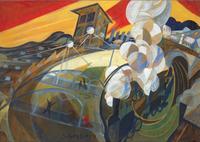
Scheiber Hugó Világváros, 1926 Olaj, Karton, 71x101cm
Scheiber Hugó
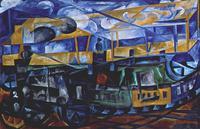
Airplane over train
Natalia Goncharova
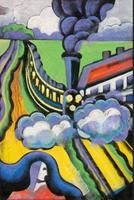
Scheiber Hugó Vonat,
Scheiber Hugó
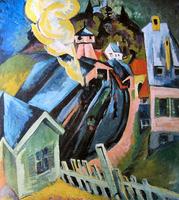
Station in Königstein
Ernst Ludwig Kirchner
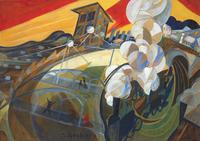
Scheiber Hugó, Világváros
Scheiber Hugó
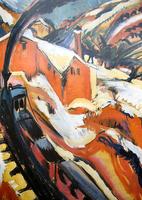
Railways in the Taunus
Ernst Ludwig Kirchner
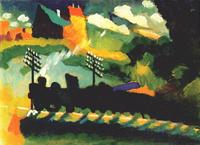
Murnau view with railway and castle
Wassily Kandinsky
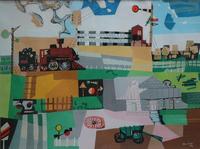
Untitled (Railroad)
Jean David
The Composition with the Train
Olga Rozanova
Landscape
Jean Metzinger
Rhaetian Railway, Davos
Ernst Ludwig Kirchner
States of Mind I: The Farewells
Umberto Boccioni
Red Engine
Sandor Bortnyik
Train of the Wounded
Gino Severini
Landscape with a steam locomotive
Wassily Kandinsky
E.F.C.B. (Estrada de Ferro Central do Brasil)
Tarsila do Amaral
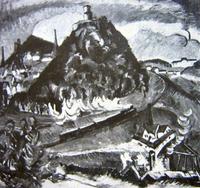
Königstein and railway
Ernst Ludwig Kirchner
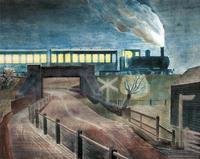
Train Going over a Bridge at Night
Eric Ravilious