Expertenanalyse zu Gino Severinis Still Life
Stil: Synthetic Cubism · Genre: still life
Expert Analysis: "Still Life" by Gino Severini
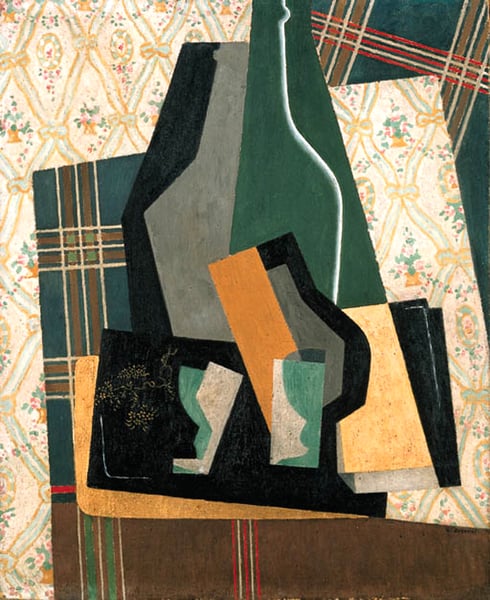
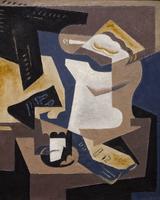
Gino Severini’s Still Life is a compelling example of Synthetic Cubism, a movement that evolved from early Cubism’s analytical fragmentation into a more decorative and flattened approach. Created during Severini’s transition from Futurism to a purer Cubist vocabulary, this work demonstrates the style’s hallmark use of simplified forms, vibrant color planes, and a deliberate departure from deep spatial illusion.
Significance within Synthetic Cubism:
- Color as Structure: Unlike the muted, monochromatic palette of Analytical Cubism, Severini employs bold, contrasting hues—characteristic of Synthetic Cubism’s embrace of color as a compositional force. The still-life objects (likely a table, bottle, fruit, or musical instrument) are reduced to faceted, overlapping color fields that build the image through juxtaposition rather than modeling or shading.
- Flattened Space: The composition rejects traditional perspective, compressing the tabletop and objects onto a single plane. This flattening—achieved through broad, unmodulated patches of color and rhythmic outlines—emphasizes the picture surface, a key Synthetic Cubist principle.
- Synthesis of Forms: Severini synthesizes multiple viewpoints into a cohesive whole. For instance, a bottle might be shown from both front and side simultaneously, but the forms are simplified into geometric shapes (ovals, arcs, and angular cuts) that create a decorative, almost mosaic-like pattern. This synthesis reflects the movement’s goal of constructing an object from memory and concept rather than direct observation.
- Bridge between Movements: Severini’s Still Life also carries echoes of his Futurist roots—fragmentary lines and a sense of dynamic rhythm—but now channeled into Cubism’s stable, formal order. His adaptation of Futurist vibrancy gives Synthetic Cubism an infusion of energy and clarity, contributing to the style’s later influence on Art Deco and abstraction.
The painting as a “still life” is reimagined not as a static arrangement but as a dynamic interplay of shape and color. The objects become vehicles for formal exploration: edges blur, contours break, and the background merges with the subjects. This work exemplifies how Synthetic Cubism transformed everyday motifs into autonomous, self-referential compositions—a hallmark of modernism.
In summary, Severini’s Still Life is significant for its vivid coloration, flattened yet structured design, and its role in synthesizing Cubist and Futurist sensibilities—offering a fresh, decorative interpretation of Synthetic Cubism’s principles.
Visuell ähnlich
20 Werke mit ähnlicher Komposition und Farbpalette
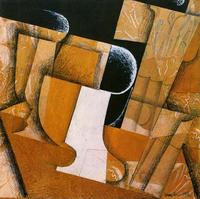
The Glass ( The Fruit Bowl)
Juan Gris
duplicate
Amedee Ozenfant
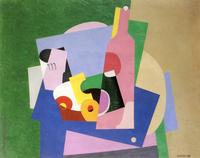
Still Life with Bottle
Georges Valmier
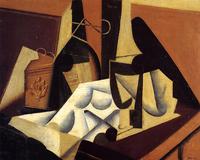
Still Life with White Tablecloth
Juan Gris
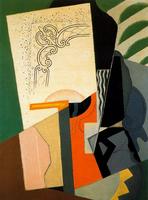
Composición Cubista
Maria Blanchard
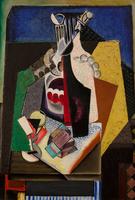
Bodegón Con Caja De Cerillas
Maria Blanchard
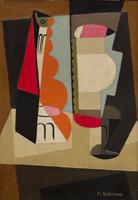
Cubist Composition
Maria Blanchard
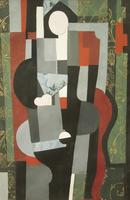
Black Pierrot
Jindrich Styrsky
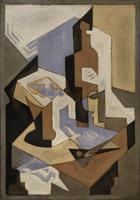
Composición Cubista Con Botella
Maria Blanchard
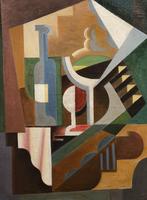
Naturaleza Muerta
Maria Blanchard
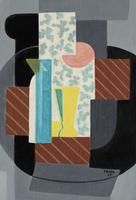
Nature Morte Cubiste (Ice Cream)
Toyen
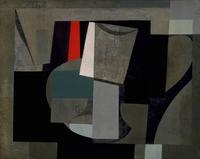
1934-6 (painting - still life)
Ben Nicholson
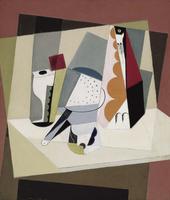
Cubist Still Life
Maria Blanchard
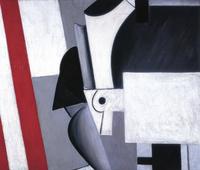
Study for Aviation. Evolution of Forms Under Aerodynamic Limitations (Newark Airport Mural)
Arshile Gorky
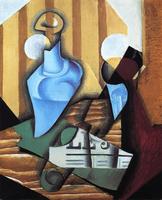
Still Life with Bottle and Glass
Juan Gris
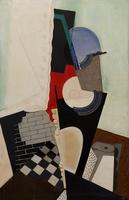
Naturaleza Muerta Composición
Maria Blanchard
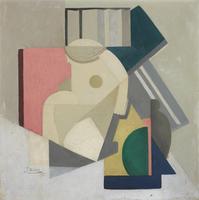
Abstraction d'une Statuette
Marthe Donas
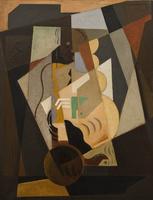
Naturaleza Muerta Mujer Con Mandolina
Maria Blanchard
Bodegón
Maria Blanchard
Nature morte à la pipe
Serge Charchoune