Analisi esperta di Horizontal Volumes di Umberto Boccioni
Stile: Futurism · Genere: portrait
Expert Analysis of “Horizontal Volumes” by Umberto Boccioni
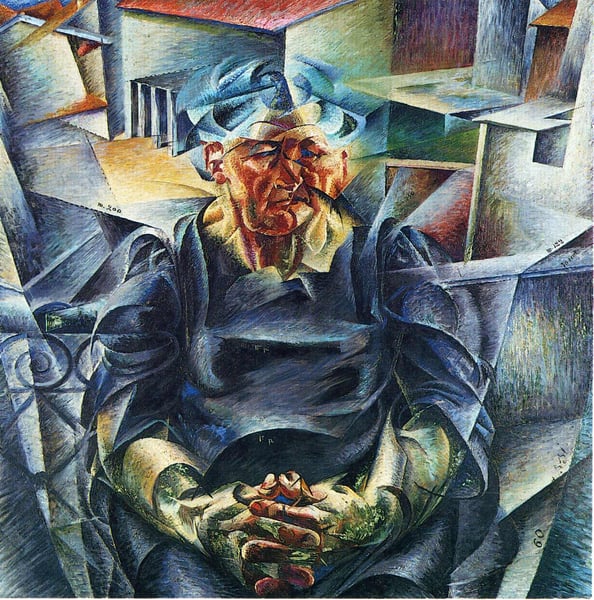
As a seminal work within the Futurist movement, Umberto Boccioni’s “Horizontal Volumes” represents a radical departure from traditional portraiture. Executed in the early 1910s—the period when Boccioni was most intensely developing the theoretical and visual language of Futurism—this painting exemplifies the movement’s core ambition: to capture the dynamic sensation of modern life rather than static, frozen likenesses.
Significance within Futurism
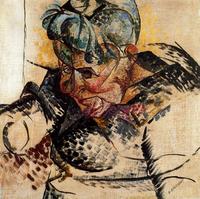
The title itself is instructive. “Horizontal Volumes” foregrounds a geometric, almost architectural treatment of the human figure that rejects the vertical, symmetrical, and psychologically inward conventions of Renaissance and bourgeois portraiture. Boccioni instead constructs the sitter through a series of interlocking, horizontally oriented planes and massed volumes that seem to press outward and expand into the surrounding space. This technique embodies the Futurist principle of universal dynamism—the belief that objects and figures are not isolated but are continuously interacting with their environment, light, and motion.
In this portrait, the viewer does not find a face with readable emotions or a stable pose. Instead, the subject is broken down into faceted, cylindrical, and block-like forms that suggest both presence and movement. The “volumes” are not static containers; they appear to rotate, slide, and resonate with the colored planes that surround them. This is a direct application of Boccioni’s own theoretical writings, particularly his 1912 “Technical Manifesto of Futurist Sculpture,” where he called for the abolition of the closed figure and the creation of forms that express “the sensation of movement” itself.
Genre Transformation: Portrait as Dynamic Field
As a portrait, “Horizontal Volumes” subverts the genre’s traditional function of recording a specific individual’s appearance or character. Instead, Boccioni treats the human figure as a nexus of forces—a vibrating, energetic entity that is partially fused with its background. The horizontal emphasis (as opposed to the vertical, upright posture of classical portraiture) reinforces a sense of spatial and temporal flow. The figure seems to slide sideways, as if caught during a swift turn or a moment of transit, aligning with the Futurist obsession with speed, simultaneity, and the fragmentation of visual experience.
This work is significant because it pushes Boccioni’s research beyond the more obviously violent or mechanical subjects of early Futurism (like speeding cars or marching crowds) into the realm of inner dynamism. Here, the human presence itself becomes a site of plastic energy. The result is a portrait that is not about who the sitter is, but about how energy organizes matter in space—a perfect visual translation of the Futurist credo that “movement and light destroy the materiality of bodies.”
In the broader history of modern art, “Horizontal Volumes” stands as a crucial bridge between Cubist faceting (which was primarily analytical and static) and a fully synthetic, kinetic vision of form. Boccioni’s unique contribution here is his insistence that the portrait, the most intimate of genres, could be reimagined as a diagram of universal force. This piece thus remains a touchstone for understanding how Futurism transformed every genre it touched into an engine of dynamic sensation.
Visivamente simili
20 opere con composizione e palette affini
Materia
Umberto Boccioni
Untitled
Albert Gleizes
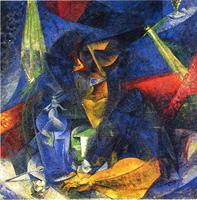
Woman in a Café: Compenetrations of Lights and Planes
Umberto Boccioni
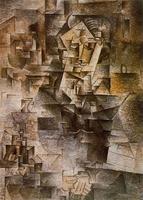
Portrait of Daniel-Henry Kahnweiler
Pablo Picasso
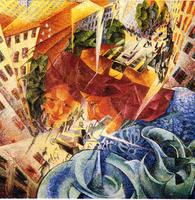
Simultaneous Visions
Umberto Boccioni
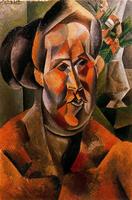
Bust of woman with flowers
Pablo Picasso
Abstract Dimensions
Umberto Boccioni
Farm woman
Pablo Picasso
Living in a big hotel
Kazimir Malevich
Femmes cousant
Albert Gleizes
Lecciones Botanica
Jean Dubuffet
Models
Rudolf Bér
Portrait of the Regisseur Alexander Tairov
Aristarkh Lentulov
Self-Portrait as Mars
Otto Dix
Stephen Spender
Lucian Freud
Rosa Schapire
Walter Gramatté
Master Gevorg
Minas Avetisyan
Harlequin leaning
Pablo Picasso
Harlequin's family
Pablo Picasso
Kubistinis Motinos Portretas
Vytautas Kairiukstis