Expertenanalyse zu Umberto Boccionis Factories At Porta Romana
Stil: Divisionism · Genre: cityscape
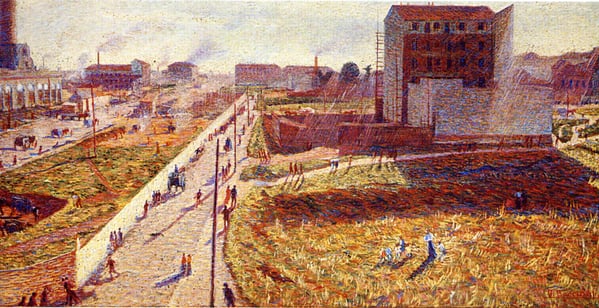
Analysis of "Factories At Porta Romana" by Umberto Boccioni
This cityscape exemplifies Umberto Boccioni’s early engagement with Divisionism, a technique derived from Neo-Impressionism that uses tiny, separate strokes of pure color to create vibrant, optically mixed tones. At this stage, Boccioni was still exploring the interplay of light and atmosphere through divided brushwork, before his full shift to Futurism. The painting’s significance lies in its application of Divisionist principles to an industrial, urban subject—here, the factories of Milan’s Porta Romana district. Rather than depicting a pastoral scene (as many Divisionists did), Boccioni focuses on the modern, working-class periphery, capturing the luminous, vibrating air around smokestacks and rooftops. This early work foreshadows his later Futurist obsession with speed, energy, and the dynamic modern city, while remaining rooted in the scientific color theory of Divisionism. It demonstrates Boccioni’s transitional moment: using a static technique to render a subject that would soon demand explosive, dynamic forms.
Visuell ähnlich
20 Werke mit ähnlicher Komposition und Farbpalette
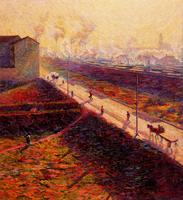
The Morning
Umberto Boccioni
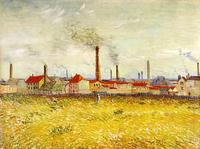
Factories at Asnieres, Seen from the Quai de Clichy
Vincent van Gogh
View of Argenteuil in the Snow
Claude Monet
Dight's Falls
Fred Williams
Port de Javel
Paul Gauguin
Dieppe, Dunquesne Basin, Low Tide, Sun, Morning
Camille Pissarro
The Outskirts of Madrid
William Merritt Chase
Landscape
Paul Cezanne
The Train, Bedford Park
Camille Pissarro
The Western Railway at its Exit from Paris
Charles Angrand
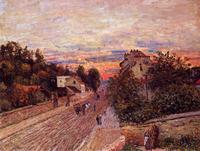
Sunset at Port Marly
Alfred Sisley
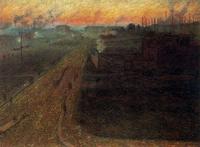
Twilight
Umberto Boccioni
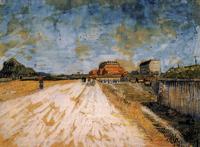
Road Running Beside the Paris Ramparts
Vincent van Gogh
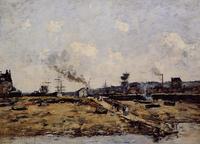
Trouville, the Ferry to Deauville
Eugene Boudin
Fecamp, the Inner Port under Construction
Eugene Boudin
Man with Spade in a Suburb of Paris
Vincent van Gogh
Suburbs of Paris
Vincent van Gogh
Huddersfield
L. S. Lowry
Suburb
Georges Seurat
Winter landscape
Giuseppe De Nittis