
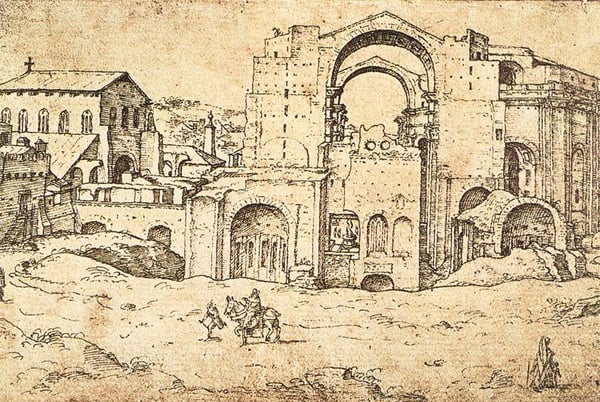
Expert analysis of Maerten van Heemskerck’s Construction of the new St Peter's Basilica in Rome
Style: Mannerism (Late Renaissance) · Genre: cityscape
This artwork is a cityscape by Maerten van Heemskerck, painted in the Mannerist (Late Renaissance) style. Its significance lies in how it captures a specific, transformative moment in architectural history while embodying the Mannerist penchant for intricate detail and spatial complexity.
As a Mannerist work, the painting likely emphasizes elongated forms, unusual perspectives, and a crowded, dynamic composition—features that distinguish it from the balanced harmony of the High Renaissance. Van Heemskerck, a Northern artist who traveled to Rome, uses this lens to document the massive construction site of the new St. Peter’s Basilica. The subject itself is historically pivotal: the rebuilding of the central church of Christendom under popes like Julius II and Paul III, involving architects such as Bramante, Michelangelo, and later Maderno.
What makes the work particularly significant is its dual role as a visual record and a Mannerist interpretation. It preserves a snapshot of the basilica’s unfinished state—scaffolding, partial domes, and active labor—offering a rare documentary view of Renaissance construction practices. At the same time, the Mannerist style infuses the scene with a sense of artificiality and tension, perhaps reflecting the ambitious, sometimes chaotic spirit of the era’s grand projects. This combination of factual cityscape and stylistic flourish marks the painting as a key example of how Mannerist artists engaged with contemporary reality through a deliberately sophisticated, exaggerated visual language.
Visually similar
20 works with related composition and palette
St. Peter's basilica under construction
Maerten van Heemskerck
A view of the remains of two Triclinj who belonged to Nero`s Golden House
Giovanni Battista Piranesi
St Peter's Basilica seen from east
Maerten van Heemskerck
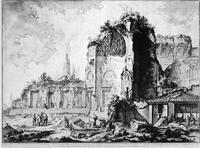
Reconstruction of the column referred to in the preceding tables, and various medals of Antoninus and Faustina
Giovanni Battista Piranesi
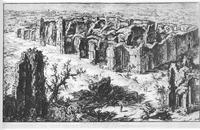
Vedute di Roma
Giovanni Battista Piranesi
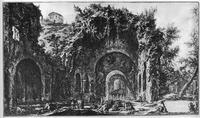
Vedute di Roma
Giovanni Battista Piranesi
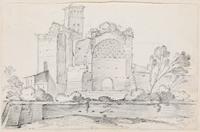
Ruins of the Temple of Venus and Rome in the Forum
Joseph-Marie Vien
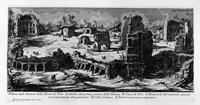
The Roman antiquities, t. 1, Plate XXVIII. "Baths of Titus" (really the Baths of Traianus).
Giovanni Battista Piranesi
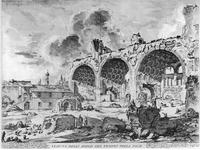
Vedute di Roma
Giovanni Battista Piranesi
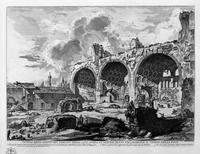
View the remains of Nero`s Golden House Tablino, vulgarly called the Temple of Peace
Giovanni Battista Piranesi
The Roman antiquities, t. 1, Plate XXXIII. Veduta with ruins of Nero`s Golden House.
Giovanni Battista Piranesi
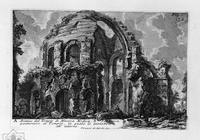
The Roman antiquities, t. 1, Plate XVI. Temple of Minerva Medica.
Giovanni Battista Piranesi
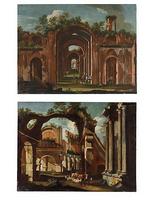
Two landscapes of ruins
Jakob de Heusch
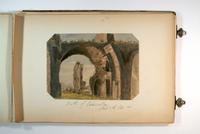
Baths of Caracalla
Louis Comfort Tiffany
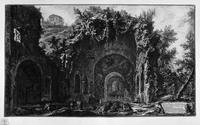
View of the Temple of Camene
Giovanni Battista Piranesi
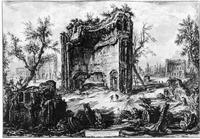
Vedute di Roma
Giovanni Battista Piranesi
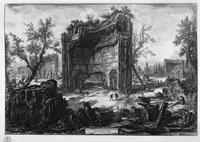
View the remains of factories on the second floor of the Baths of Titus
Giovanni Battista Piranesi
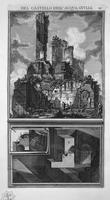
Perspective of one of the sides, and construction details of the five branches of the orifice of the aqueduct
Giovanni Battista Piranesi
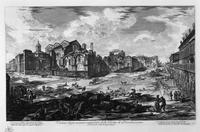
A view of the surpluses above the Baths of Diocletian
Giovanni Battista Piranesi
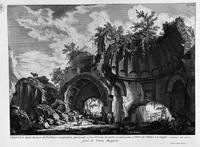
The Roman antiquities, t. 2, Plate LX. A view of the magnificent tomb near the remains of the factory in Torre de `Schiavi outside Porta Maggiore.
Giovanni Battista Piranesi